Center for Nanotechnology and Nanotoxicology, Harvard T.H. Chan School of Public Health, Harvard University, 665 Huntington Avenue, Boston, Massachusetts 02115, United States.
Environmental and Occupational Health Sciences Institute, School of Public Health, Rutgers University, 170 Frelinghuysen Road, Piscataway, New Jersey 08854, United States.
Chem Res Toxicol. 2022 Sep 19;35(9):1541-1557. doi: 10.1021/acs.chemrestox.2c00183. Epub 2022 Sep 6.
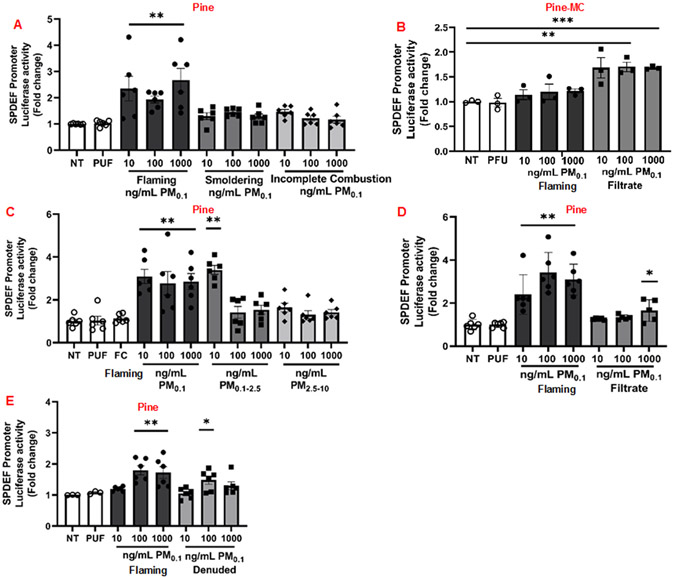
Wood burning contributes to indoor and ambient particulate matter (PM) pollution and has been associated with increased morbidity and mortality. Here, we present an integrated methodology that allows to generate, sample, and characterize wood smoke derived from different moisture contents and representative combustion conditions using pine wood as a model. Flaming, smoldering, and incomplete combustion were assessed for low-moisture pine, whereas both low-moisture pine and high-moisture pine were investigated under flaming conditions. Real-time monitoring of carbon monoxide, volatile organic compounds, and aerosol number concentration/size in wood smoke was performed. The PM was size-fractionated, sampled, and characterized for elemental/organic carbon, organic functional groups, and inorganic elements. Bioactivity of PM was assessed by measuring the sterile alpha motif (SAM) pointed domain containing ETS (E-twenty-six) transcription factor (SPDEF) gene promoter activity in human embryonic kidney 293 (HEK-293T) cells, a biomarker for mucin gene expression. Findings showed that moisture content and combustion condition significantly affected the organic and inorganic elemental composition of PM as well as its bioactivity. Also, for a given moisture and combustion scenario, PM chemistry and bioactivity differed considerably with PM size. Importantly, PM from flaming combustion of low-moisture pine contained the highest abundance of the oxygenated saturated aliphatic functional group [H-C-O] and was also biologically most potent in stimulating SPDEF promoter activity, suggesting the role of organic compounds such as carbohydrates and sugar alcohols (that contain [H-C-O]) in driving mucus-related respiratory outcomes. Our platform enables further well-controlled parametric studies using a combination of in vitro and in vivo approaches to link wood burning parameters with acute and chronic inhalation health effects of wood smoke.
燃烧木材会导致室内和环境中颗粒物(PM)污染,并与发病率和死亡率的增加有关。在这里,我们提出了一种综合方法,该方法允许使用松木作为模型,生成、采样和表征来自不同水分含量和代表性燃烧条件的木烟。评估了低水分含量的松木的火焰、闷烧和不完全燃烧,而在火焰条件下研究了低水分含量的松木和高水分含量的松木。实时监测木烟中的一氧化碳、挥发性有机化合物和气溶胶数浓度/粒径。对 PM 进行了粒径分级、采样和分析,以测定元素/有机碳、有机官能团和无机元素。通过测量无菌α基序(SAM)点结构域包含 ETS(E-二十六)转录因子(SPDEF)基因启动子在人胚肾 293(HEK-293T)细胞中的活性,评估了 PM 的生物活性,这是一种粘蛋白基因表达的生物标志物。研究结果表明,水分含量和燃烧条件显著影响 PM 的有机和无机元素组成及其生物活性。此外,对于给定的水分和燃烧情况,PM 的化学性质和生物活性随 PM 粒径的不同而有很大差异。重要的是,来自低水分含量的松木火焰燃烧的 PM 含有最高丰度的含氧饱和脂肪族官能团[H-C-O],并且在刺激 SPDEF 启动子活性方面也具有最强的生物学活性,这表明碳水化合物和糖醇(含有[H-C-O])等有机化合物在驱动与粘液相关的呼吸道结果方面发挥作用。我们的平台使我们能够使用体外和体内方法的组合进行进一步的良好控制参数研究,将木材燃烧参数与木材烟雾的急性和慢性吸入健康影响联系起来。