Poznyak Anastasia V, Sadykhov Nikolay K, Kartuesov Andrey G, Borisov Evgeny E, Melnichenko Alexandra A, Grechko Andrey V, Orekhov Alexander N
Institute for Atherosclerosis Research, Moscow, Russia.
Petrovsky National Research Centre of Surgery, Moscow, Russia.
Front Cardiovasc Med. 2022 Aug 22;9:959285. doi: 10.3389/fcvm.2022.959285. eCollection 2022.
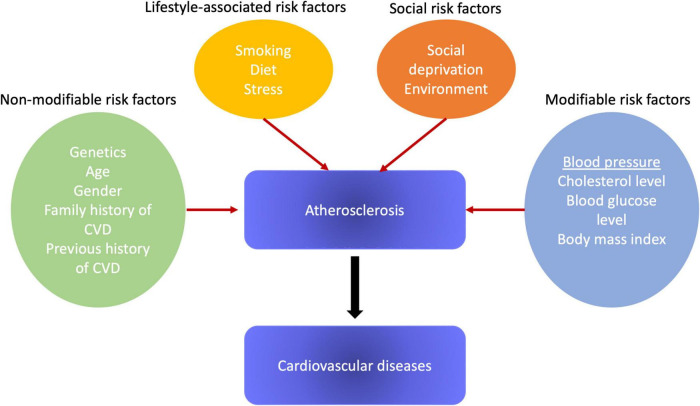
Atherosclerosis is a predecessor of numerous cardiovascular diseases (CVD), which often lead to morbidity and mortality. Despite the knowledge of the pathogenesis of atherosclerosis, an essential gap in our understanding is the exact trigger mechanism. A wide range of risk factors have been discovered; however, a majority of them are too general to clarify the launching mechanism of atherogenesis. Some risk factors are permanent (age, gender, genetic heritage) and others can be modified [tobacco smoking, physical inactivity, poor nutrition, high blood pressure, type 2 diabetes (T2D), dyslipidemia, and obesity]. All of them have to be taken into account. In the scope of this review, our attention is focused on hypertension, which is considered the most widespread among all modifiable risk factors for atherosclerosis development. Moreover, high blood pressure is the most investigated risk factor. The purpose of this review is to summarize the data on hypertension as a risk factor for atherosclerosis development and the risk assessment.
动脉粥样硬化是众多心血管疾病(CVD)的先兆,这些疾病常导致发病和死亡。尽管了解动脉粥样硬化的发病机制,但我们认识上的一个关键差距是确切的触发机制。已发现多种危险因素;然而,其中大多数过于宽泛,无法阐明动脉粥样硬化发生的启动机制。一些危险因素是不可改变的(年龄、性别、遗传因素),而其他因素可以改变[吸烟、缺乏运动、营养不良、高血压、2型糖尿病(T2D)、血脂异常和肥胖]。所有这些因素都必须加以考虑。在本综述范围内,我们将注意力集中在高血压上,高血压被认为是动脉粥样硬化发展的所有可改变危险因素中最普遍的。此外,高血压是研究最多的危险因素。本综述的目的是总结关于高血压作为动脉粥样硬化发展危险因素的数据以及风险评估。