Morita Akira, Murakami Aya, Uchihara Takushu, Ohashi Noriyuki, Ryu Koichi, Watanabe Yuki, Ochi Sadayuki, Okudaira Kazuho, Hirasaki Yoshiro, Namiki Takao
Department of Japanese-Oriental (Kampo) Medicine, Graduate School of Medicine, Chiba University, Chiba, Japan.
Center for Pharmaceutical Education, Faculty of Pharmacy, Yokohama University of Pharmacy, Yokohama, Japan.
Front Neurol. 2022 Aug 23;13:916944. doi: 10.3389/fneur.2022.916944. eCollection 2022.
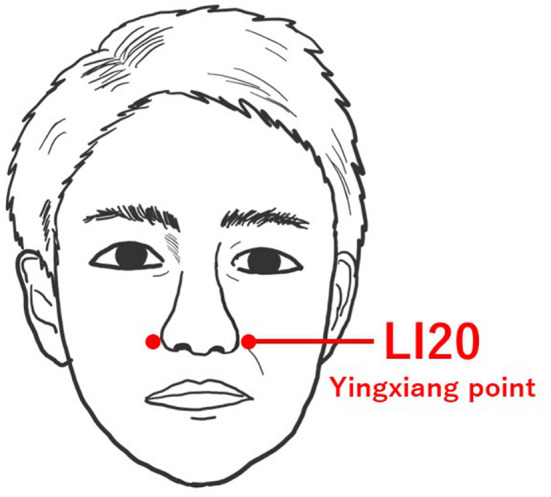
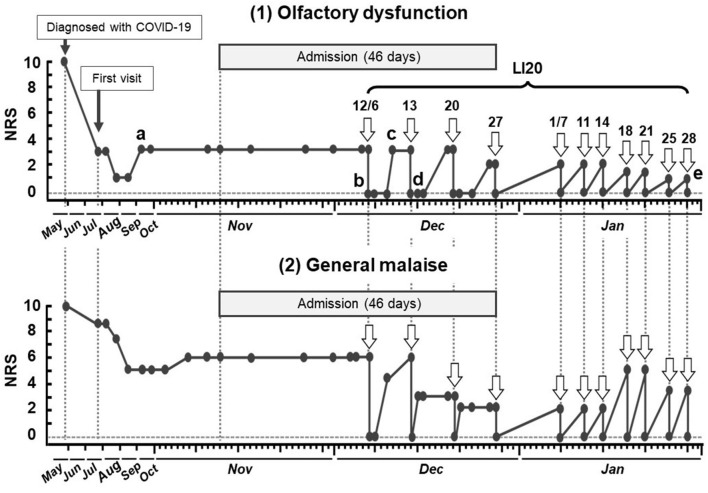
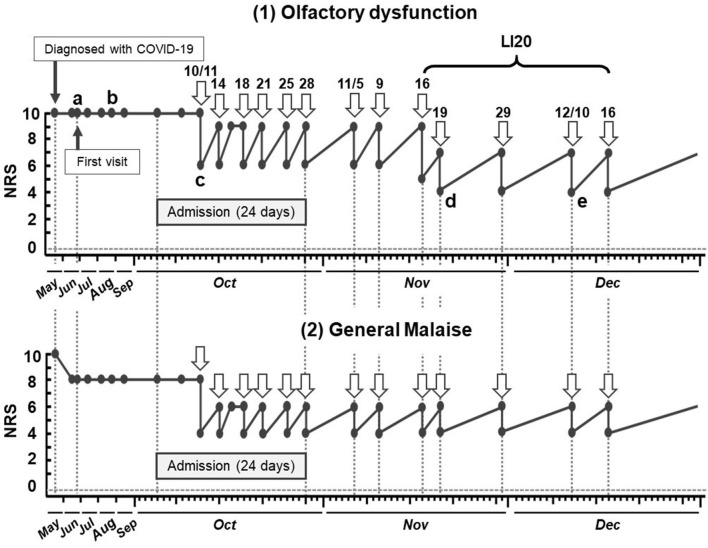
Olfactory dysfunction in the post COVID-19 condition reported worldwide are refractory for some patients. For this reason, appropriate treatment is desired. In this article, we describe two cases of olfactory dysfunction in the post COVID-19 condition that was improved by traditional acupuncture treatment. By using the Yingxiang point (LI20), which is said to improve the sense of smell since ancient times, acupuncture treatment was performed 1-2 times a week in two patients about 6 and 7 months after the diagnosis of COVID-19. Acupuncture needles with a body length of 30 mm and a body diameter of 0.16 mm were inserted about 10 mm deep into the skin. We stimulated LI20 of the right and left sides until the patients felt the de qi sensation (acupuncture resonance), and left needles in the points for about 15 min. Immediately after the acupuncture treatment, the symptoms of olfactory dysfunction were alleviated, and the improvement in olfactory dysfunction lasted for 2-4 days. As the number of acupuncture treatments increased, the time until the flareup of olfactory dysfunction was prolonged, and the symptoms tended to decrease. In our experience, the acupuncture treatment was effective in a short period for treating residual olfactory dysfunction of the post COVID-19 condition, suggesting that acupuncture may serve as an adjunct to modern medical treatment, and it may also be a new option for patients who are resistant to Western medical treatment or unable to continue treatment because of side effects. In conclusion, acupuncture may be a new option for patients who are resistant to modern medical treatment or who are unable to continue treatment because of side effects.
全球报告的新冠后嗅觉功能障碍对一些患者来说难以治愈。因此,需要合适的治疗方法。在本文中,我们描述了两例新冠后嗅觉功能障碍患者,他们通过传统针灸治疗得到了改善。对于两名在新冠确诊后约6个月和7个月的患者,使用自古以来就被认为能改善嗅觉的迎香穴(LI20),每周进行1 - 2次针灸治疗。将体长30毫米、体直径0.16毫米的针灸针插入皮肤约10毫米深。我们刺激左右两侧的LI20,直到患者感觉到得气感(针刺感应),并将针留在穴位约15分钟。针灸治疗后,嗅觉功能障碍症状立即得到缓解,且嗅觉功能改善持续2 - 4天。随着针灸治疗次数的增加,嗅觉功能障碍复发的时间延长,症状也趋于减轻。根据我们的经验,针灸治疗在短期内对治疗新冠后残留的嗅觉功能障碍有效,这表明针灸可作为现代医学治疗的辅助手段,对于那些对西医治疗有抵抗或因副作用无法继续治疗的患者来说,它也可能是一种新的选择。总之,对于那些对现代医学治疗有抵抗或因副作用无法继续治疗的患者,针灸可能是一种新的选择。