Centre for Global Health and Equity, School of Health Sciences, Swinburne University of Technology, Hawthorn, Australia.
Department of Epidemiology and Preventive Medicine, Monash University, Melbourne, Australia.
J Med Internet Res. 2022 Sep 16;24(9):e35772. doi: 10.2196/35772.
Web-based personal health records (PHRs) have the potential to improve the quality, accuracy, and timeliness of health care. However, the international uptake of web-based PHRs has been slow. Populations experiencing disadvantages are less likely to use web-based PHRs, potentially widening health inequities within and among countries.
With limited understanding of the predictors of community uptake and use of web-based PHR, the aim of this study was to identify the predictors of awareness, engagement, and use of the Australian national web-based PHR, My Health Record (MyHR).
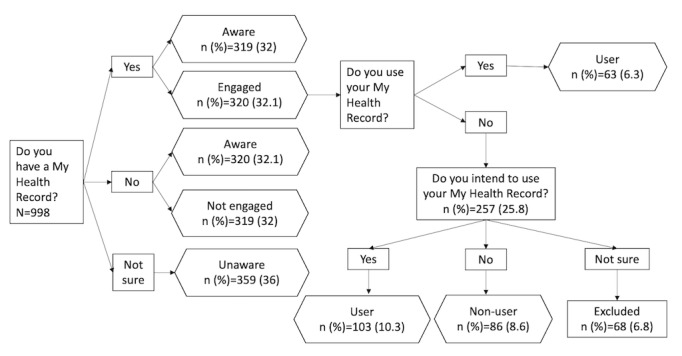
A population-based survey of adult participants residing in regional Victoria, Australia, was conducted in 2018 using telephone interviews. Logistic regression, adjusted for age, was used to assess the relationship among digital health literacy, health literacy, and demographic characteristics, and the 3 dependent variables of MyHR: awareness, engagement, and use. Digital health literacy and health literacy were measured using multidimensional tools, using all 7 scales of the eHealth Literacy Questionnaire and 4 out of the 9 scales of the Health Literacy Questionnaire.
A total of 998 responses were analyzed. Many elements of digital health literacy were strongly associated with MyHR awareness, engagement, and use. A 1-unit increase in each of the 7 eHealth Literacy Questionnaire scales was associated with a 2- to 4-fold increase in the odds of using MyHR: using technology to process health information (odds ratio [OR] 4.14, 95% CI 2.34-7.31), understanding of health concepts and language (OR 2.25, 95% CI 1.08-4.69), ability to actively engage with digital services (OR 4.44, 95% CI 2.55-7.75), feel safe and in control (OR 2.36, 95% CI 1.43-3.88), motivated to engage with digital services (OR 4.24, 95% CI 2.36-7.61), access to digital services that work (OR 2.49, 95% CI 1.32-4.69), and digital services that suit individual needs (OR 3.48, 95% CI 1.97-6.15). The Health Literacy Questionnaire scales of health care support, actively managing health, and social support were also associated with a 1- to 2-fold increase in the odds of using MyHR. Using the internet to search for health information was another strong predictor; however, older people and those with less education were less likely to use MyHR.
This study revealed strong and consistent patterns of association between digital health literacy and the use of a web-based PHR. The results indicate potential actions for promoting PHR uptake, including improving digital technology and skill experiences that may improve digital health literacy and willingness to engage in web-based PHR. Uptake may also be improved through more responsive digital services, strengthened health care, and better social support. A holistic approach, including targeted solutions, is needed to ensure that web-based PHR can realize its full potential to help reduce health inequities.
基于网络的个人健康记录(PHR)有可能提高医疗保健的质量、准确性和及时性。然而,基于网络的 PHR 在国际上的采用率一直很低。处于不利地位的人群不太可能使用基于网络的 PHR,这可能会在国家内部和国家之间扩大健康不平等。
由于对社区对基于网络的 PHR 的了解有限,本研究旨在确定澳大利亚全国性基于网络的 PHR(My Health Record,MyHR)的意识、参与和使用的预测因素。
2018 年,我们在澳大利亚维多利亚州的地区使用电话访谈对成年参与者进行了一项基于人群的调查。使用逻辑回归(按年龄调整)评估数字健康素养、健康素养和人口统计学特征与 MyHR 的 3 个依赖变量(意识、参与和使用)之间的关系。使用多维工具测量数字健康素养和健康素养,使用电子健康素养问卷的所有 7 个量表和健康素养问卷的 9 个量表中的 4 个。
共分析了 998 份回复。数字健康素养的许多要素与 MyHR 的意识、参与和使用密切相关。每个电子健康素养问卷量表增加 1 个单位,使用 MyHR 的几率就会增加 2 到 4 倍:使用技术处理健康信息(比值比[OR]4.14,95%CI 2.34-7.31)、理解健康概念和语言(OR 2.25,95%CI 1.08-4.69)、积极参与数字服务的能力(OR 4.44,95%CI 2.55-7.75)、感到安全和掌控(OR 2.36,95%CI 1.43-3.88)、有动力参与数字服务(OR 4.24,95%CI 2.36-7.61)、获得可行的数字服务(OR 2.49,95%CI 1.32-4.69)和适合个人需求的数字服务(OR 3.48,95%CI 1.97-6.15)。健康素养问卷的医疗保健支持、积极管理健康和社会支持量表也与使用 MyHR 的几率增加 1 到 2 倍有关。使用互联网搜索健康信息也是一个强有力的预测因素;然而,老年人和受教育程度较低的人不太可能使用 MyHR。
本研究揭示了数字健康素养与基于网络的 PHR 使用之间存在强烈且一致的关联模式。结果表明,可能需要采取行动来促进 PHR 的采用,包括改善数字技术和技能体验,这可能会提高数字健康素养和参与基于网络的 PHR 的意愿。通过更具响应能力的数字服务、加强医疗保健和更好的社会支持,也可以提高采用率。需要采取整体方法,包括有针对性的解决方案,以确保基于网络的 PHR 能够充分发挥其潜力,帮助减少健康不平等。
