Lu Hao, Zheng Li-Yan, Wu Ling-Yan, Chen Jun, Xu Na, Mi Sui-Cai
Xiamen Hospital of Traditional Chinese Medicine, Xiamen Hospital, Beijing University of Chinese Medicine, Xiamen, China.
Front Oncol. 2022 Sep 6;12:978921. doi: 10.3389/fonc.2022.978921. eCollection 2022.
Pancreatic ductal adenocarcinoma (PDAC) is one of the deadliest malignancies worldwide. Immune escape is considered to be a reason for immunotherapy failure in PDAC. In this study, we explored the correlation between immune escape-related genes and the prognosis of PDAC patients.
1163 PDAC patients from four public databases, including The Cancer Genome Atlas (TCGA), International Cancer Genome Consortium (ICGC), Array-express, and Gene Expression Omnibus (GEO), were included in our study. Cox regression analysis was used to identify the 182 immune genes which were significantly associated with overall survival (OS). And then we established an immune escape-related gene prognosis index (IEGPI) score using several datasets as the training cohort and validated it using the validation cohort. Kaplan-Meier (KM) and Cox regression analysis were used to detect the relationship of IEGPI score with OS. We further explored the relationship between the IEGPI and immune indexes. And the prediction value of response for immunotherapy in Tumor Immune Dysfunction and Exclusion (TIDE) dataset.
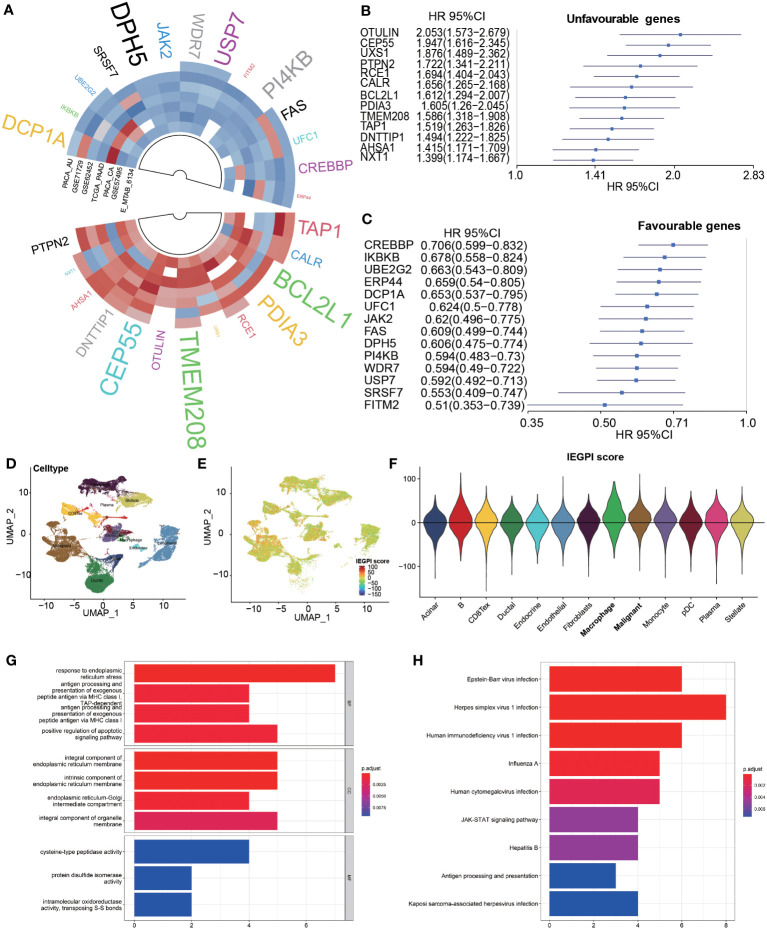
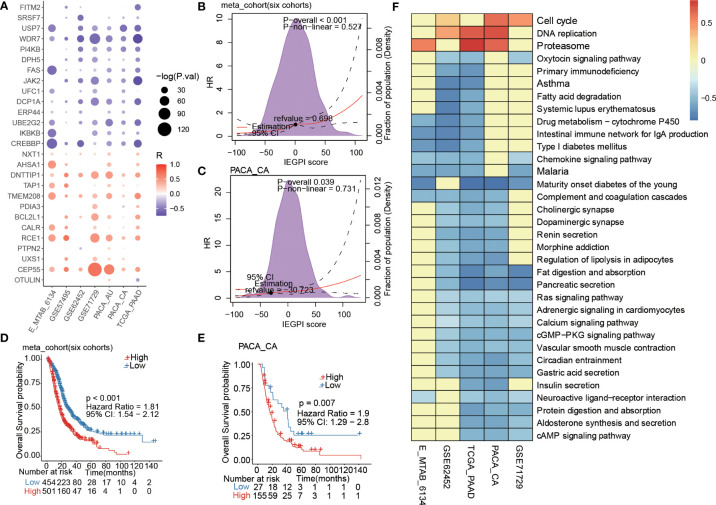
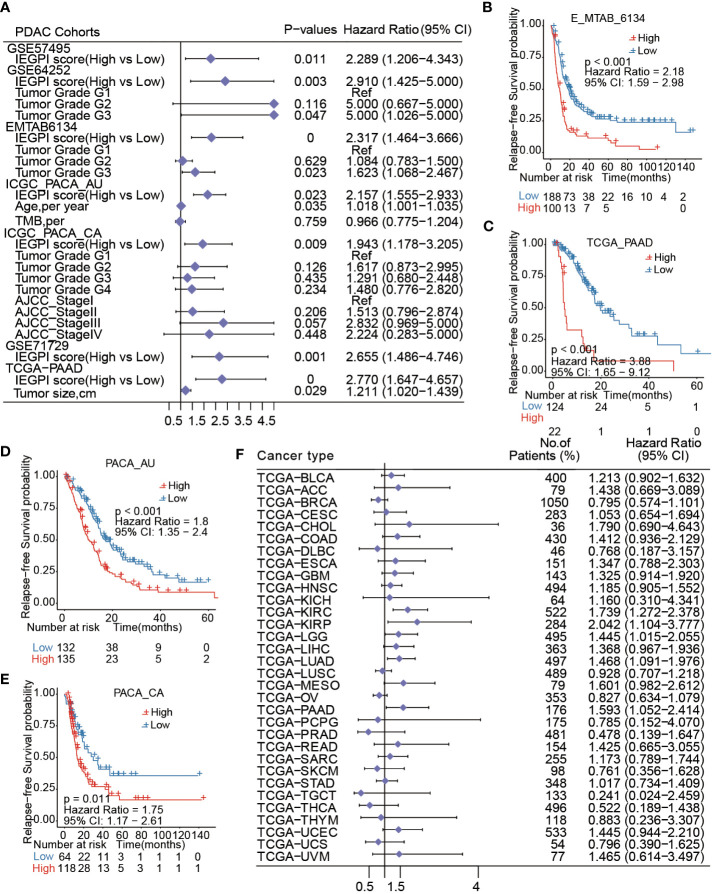
We establish an IEGPI score based on 27 immune escape genes which were significantly related to the prognosis of OS in PDAC patients. Patients in the high-IEGPI group had a significantly worse overall survival rate compared with that in the low-IEGPI groups by KM curves and cox-regression. 5 of the 32 cancer types in TCGA could be significantly distinguished in survival rates through the low- and high-IEGPI groups. Moreover, the correlation between the IEGPI score was negatively correlated with an immune score in several datasets. And higher IEGPI better recurrence-free survival (RFS) and OS in the patients after patients were treated with both PD-1 and CTLA4 in the public datasets (P<0.05). Intriguingly, by using RT-PCR, we verified that the gene of PTPN2, CEP55, and JAK2 were all higher in the BxPC-3 and PANC-1 than HPDE5 cells. Lastly, we found that the IEGPI score was higher in K-rasLSL.G12D/+, p53LSL.R172H/+, Pdx1Cre (KPC) mice model with anti-PD-L1 than that without anti-PD-L1.
Using the immune escape-related genes, our study established and validated an IEGPI score in PDAC patients from the public dataset. IEGPI score has the potential to serve as a prognostic marker and as a tool for selecting tumor patients suitable for immunotherapy in clinical practice.
胰腺导管腺癌(PDAC)是全球最致命的恶性肿瘤之一。免疫逃逸被认为是PDAC免疫治疗失败的一个原因。在本研究中,我们探讨了免疫逃逸相关基因与PDAC患者预后之间的相关性。
我们纳入了来自四个公共数据库(包括癌症基因组图谱(TCGA)、国际癌症基因组联盟(ICGC)、Array-express和基因表达综合数据库(GEO))的1163例PDAC患者。采用Cox回归分析来识别与总生存期(OS)显著相关的182个免疫基因。然后,我们使用几个数据集作为训练队列建立了一个免疫逃逸相关基因预后指数(IEGPI)评分,并使用验证队列对其进行验证。采用Kaplan-Meier(KM)和Cox回归分析来检测IEGPI评分与OS的关系。我们进一步探讨了IEGPI与免疫指标之间的关系。以及肿瘤免疫功能障碍和排除(TIDE)数据集中免疫治疗反应的预测价值。
我们基于27个与PDAC患者OS预后显著相关的免疫逃逸基因建立了IEGPI评分。通过KM曲线和Cox回归分析,高IEGPI组患者的总生存率明显低于低IEGPI组。TCGA的32种癌症类型中有5种可以通过低IEGPI组和高IEGPI组在生存率上得到显著区分。此外,在几个数据集中,IEGPI评分与免疫评分呈负相关。在公共数据集中,接受PD-1和CTLA4治疗的患者中,较高的IEGPI预示着更好的无复发生存期(RFS)和OS(P<0.05)。有趣的是,通过逆转录聚合酶链反应(RT-PCR),我们验证了蛋白酪氨酸磷酸酶非受体型2(PTPN2)、中心体蛋白55(CEP55)和酪氨酸激酶2(JAK2)基因在BxPC-3和PANC-1细胞中的表达均高于人胰腺导管上皮细胞系5(HPDE5)细胞。最后,我们发现抗程序性死亡受体配体1(PD-L1)的K-rasLSL.G12D/ +、p53LSL.R172H/ +、胰腺十二指肠同源盒1(Pdx1)Cre(KPC)小鼠模型中的IEGPI评分高于未使用抗PD-L1的模型。
利用免疫逃逸相关基因,我们的研究在公共数据集中建立并验证了PDAC患者的IEGPI评分。IEGPI评分有可能作为一种预后标志物,并作为临床实践中选择适合免疫治疗的肿瘤患者的工具。