Bragagnolo Felipe Sanchez, Socas-Rodríguez Bárbara, Mendiola Jose A, Cifuentes Alejandro, Funari Cristiano Soleo, Ibáñez Elena
Green Biotech Network, School of Agricultural Sciences, São Paulo State University, Botucatu, Brazil.
Laboratory of Foodomics, Institute of Food Science Research, CIAL, CSIC-UAM, Madrid, Spain.
Front Nutr. 2022 Sep 8;9:953169. doi: 10.3389/fnut.2022.953169. eCollection 2022.
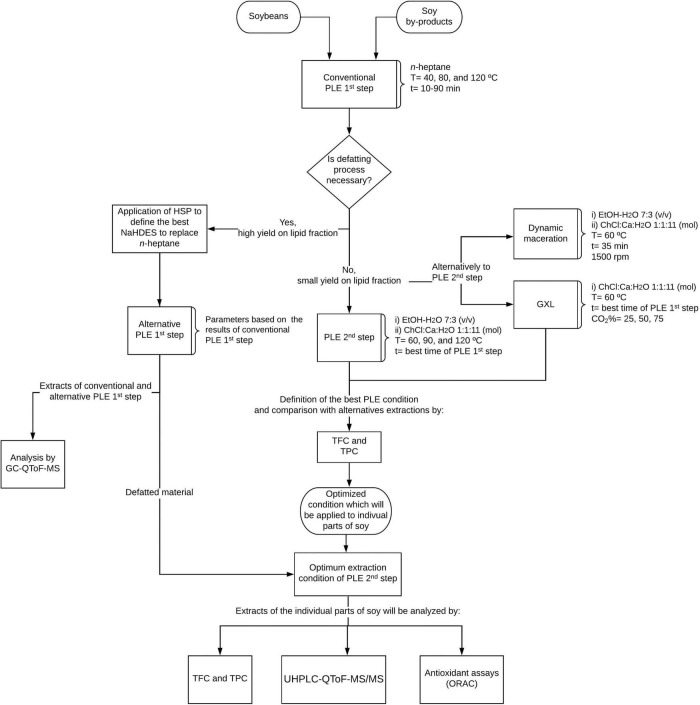
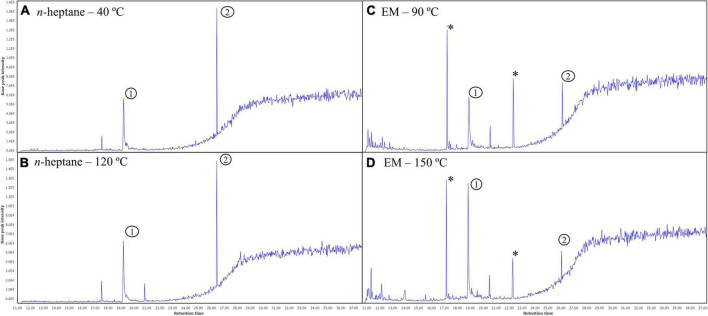
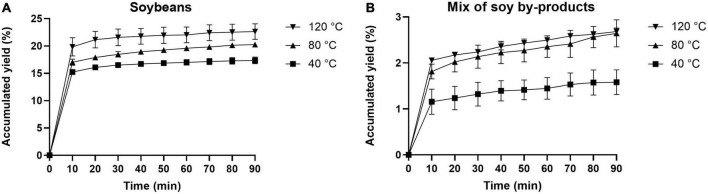
Soybeans are mainly used for food and biodiesel production. It is estimated that soy crops worldwide will leave about 651 million metric tons of branches, leaves, pods, and roots on the ground post-harvesting in 2022/23. These by-products might serve as largely available and cheap source of high added-value metabolites, such as flavonoids, isoflavonoids, and other phenolic compounds. This work aimed to explore green approaches based on the use of pressurized and gas expanded-liquid extraction combined with natural deep eutectic solvents (NADESs) to achieve phenolic-rich extracts from soy by-products. The total phenolic and flavonoid contents of the generated extracts were quantified and compared with conventional solvents and techniques. Pressurized liquid extraction (PLE) with choline chloride/citric acid/water (1:1:11 - molar ratio) at 120C, 100 bar, and 20 min, resulted in an optimized condition to generate phenolic and flavonoid-rich fractions of soy by-products. The individual parts of soy were extracted under these conditions, with their metabolic profile obtained by UHPLC-ESI-QToF-MS/MS and potential antioxidant properties by ROS scavenging capacity. Extracts of soy roots presented the highest antioxidant capacity (207.48 ± 40.23 mg AA/g), three times higher than soybean extracts (68.96 ± 12.30). Furthermore, Hansen solubility parameters (HSPs) were applied to select natural hydrophobic deep eutectic solvents (NaHDES) as substituents for -heptane to defat soybeans. Extractions applying NaHDES candidates achieved a similar yield and chromatography profile (GC-QToF-MS) to -heptane extracts.
大豆主要用于食品和生物柴油生产。据估计,2022/23年度全球大豆收获后,将有6.51亿吨的枝叶、豆荚和根留在地里。这些副产品可能成为大量可得且廉价的高附加值代谢物来源,如黄酮类化合物、异黄酮类化合物和其他酚类化合物。这项工作旨在探索基于加压和气体膨胀液体萃取与天然深共晶溶剂(NADESs)结合的绿色方法,以从大豆副产品中获得富含酚类的提取物。对所产生提取物的总酚和黄酮含量进行了定量,并与传统溶剂和技术进行了比较。在120℃、100巴和20分钟的条件下,用氯化胆碱/柠檬酸/水(1:1:11 - 摩尔比)进行加压液体萃取(PLE),得到了一个优化条件,以产生富含酚类和黄酮类的大豆副产品馏分。在这些条件下对大豆的各个部分进行萃取,通过超高效液相色谱-电喷雾电离-四极杆飞行时间串联质谱(UHPLC-ESI-QToF-MS/MS)获得其代谢谱,并通过活性氧清除能力获得其潜在的抗氧化性能。大豆根提取物表现出最高的抗氧化能力(207.48±40.23毫克抗坏血酸/克),是大豆提取物(68.96±12.30)的三倍。此外,应用汉森溶解度参数(HSPs)来选择天然疏水性深共晶溶剂(NaHDES)作为正庚烷的替代品来脱脂大豆。应用NaHDES候选物进行的萃取与正庚烷提取物具有相似的产率和色谱图(气相色谱-四极杆飞行时间质谱(GC-QToF-MS))。