From the Institute of Diagnosis and Treatment Hermitage Capodimonte (A.P., G.S.), Naples, Italy; Department of Motor Sciences and Wellness (E.T.L., R.M., A.R., G.S.), University of Naples "Parthenope", Italy; Department of Developmental and Social Psychology (M.L., F.L.), University of Rome "La Sapienza", Italy; Department of Advanced Medical and Surgical Sciences (F.T.), University of Campania "Luigi Vanvitelli", Naples, Italy; Turner Institute for Brain and Mental Health (L.G.), School of Psychological Sciences, Monash University, Victoria, Australia; Institut de Neurosciences des Systèmes (V.J., P.S.), Inserm, INS, Aix-Marseille University, France; Institute of Applied Sciences and Intelligent Systems of National Research Council (G.S., P.S.), Pozzuoli, Italy.
Neurology. 2022 Nov 22;99(21):e2395-e2405. doi: 10.1212/WNL.0000000000201200. Epub 2022 Sep 30.
Amyotrophic lateral sclerosis (ALS) is a multisystem disorder, as supported by clinical, molecular, and neuroimaging evidence. As a consequence, predicting clinical features requires a description of large-scale neuronal dynamics. Normally, brain activity dynamically reconfigures over time, recruiting different brain areas. Brain pathologies induce stereotyped dynamics which, in turn, are linked to clinical impairment. Hence, based on recent evidence showing that brain functional networks become hyperconnected as ALS progresses, we hypothesized that the loss of flexible dynamics in ALS would predict the symptoms severity.
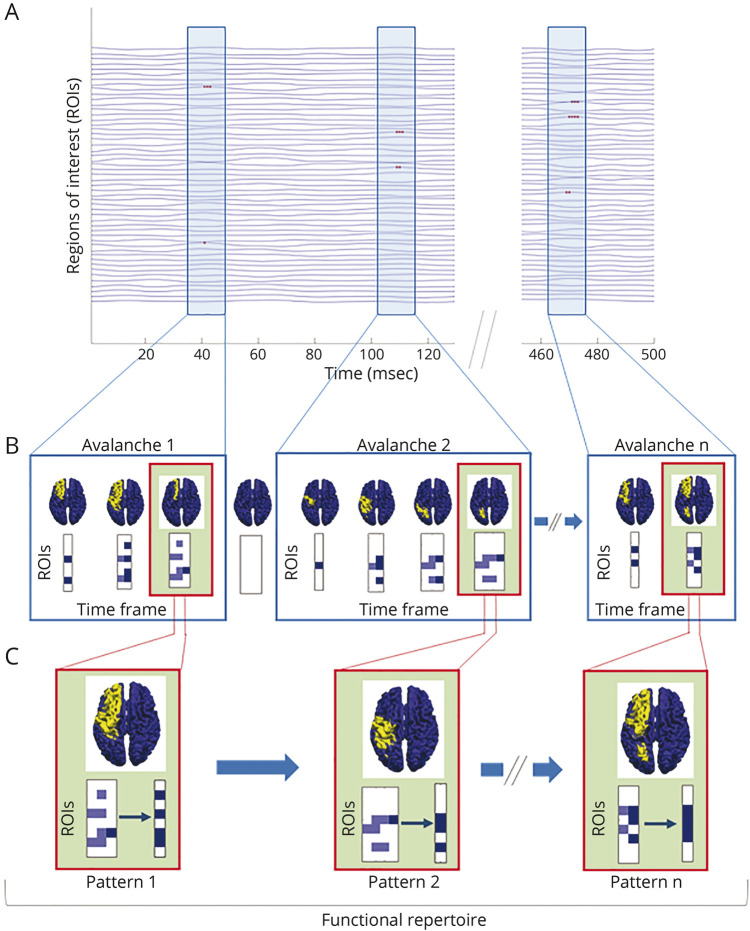
To test this hypothesis, we quantified flexibility using the "functional repertoire" (i.e., the number of configurations of active brain areas) as measured from source-reconstructed magnetoencephalography (MEG) in patients with ALS and healthy controls. The activity of brain areas was reconstructed in the classic frequency bands, and the functional repertoire was estimated to quantify spatiotemporal fluctuations of brain activity. Finally, we built a k-fold cross-validated multilinear model to predict the individual clinical impairment from the size of the functional repertoire.
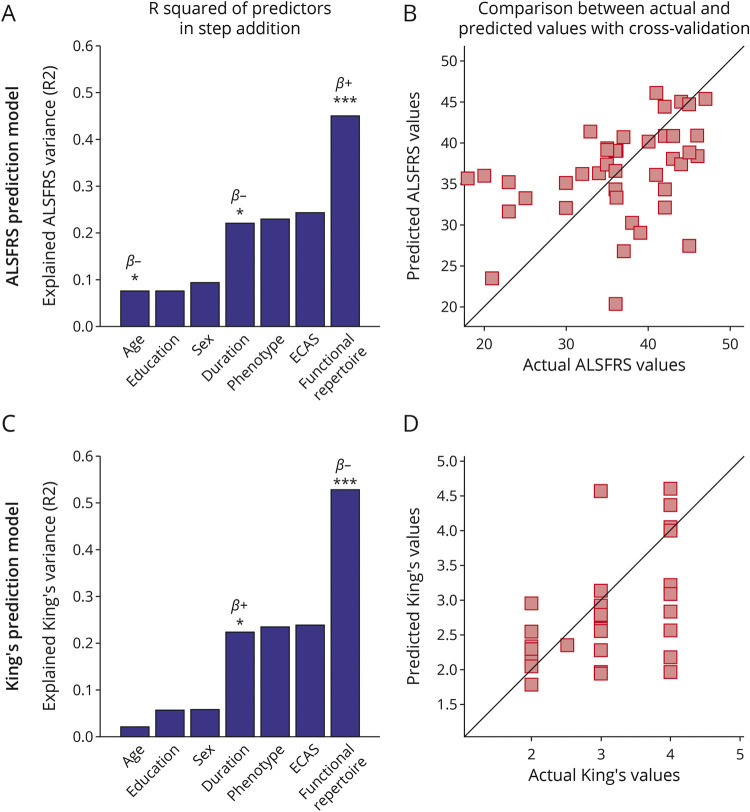
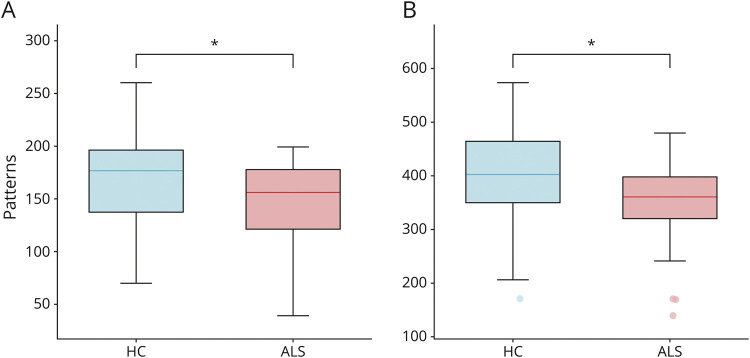
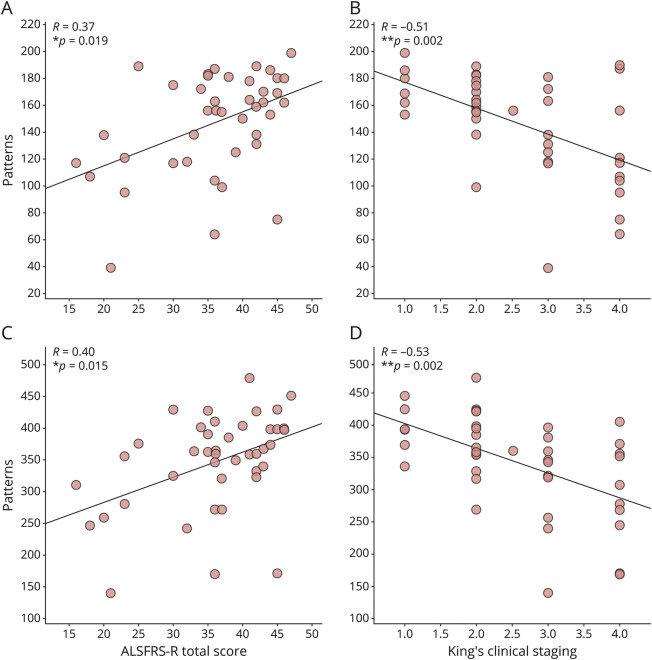
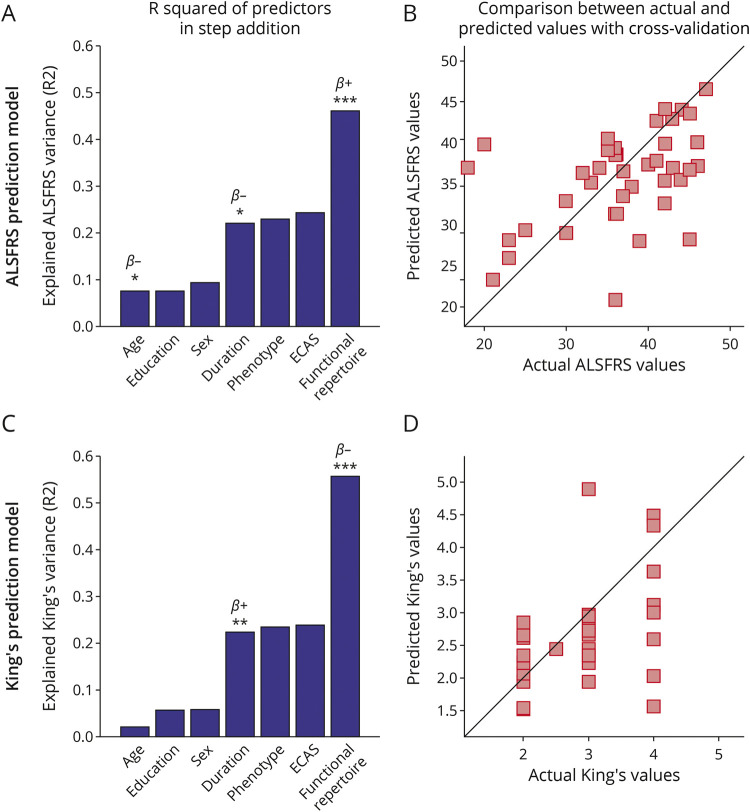
Comparing 42 patients with ALS and 42 healthy controls, we found a more stereotyped brain dynamics in patients with ALS ( < 0.05), as conveyed by the smaller functional repertoire. The relationship between the size of the functional repertoire and the clinical scores in the ALS group showed significant correlations in both the delta and the theta frequency bands. Furthermore, through a -fold cross-validated multilinear regression model, we found that the functional repertoire predicted both clinical staging ( < 0.001 and < 0.01, in the delta and theta bands, respectively) and symptoms severity ( < 0.001, in both the delta and theta bands).
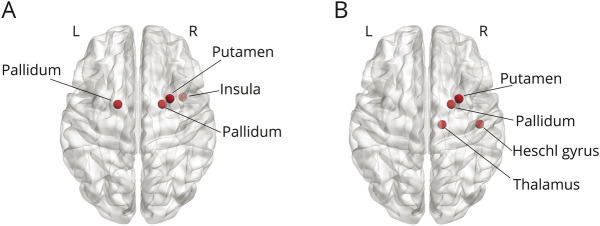
Our work shows that (1) ALS pathology reduces the flexibility of large-scale brain dynamics, (2) subcortical regions play a key role in determining brain dynamics, and (3) reduced brain flexibility predicts disease stage and symptoms severity. Our approach provides a noninvasive tool to quantify alterations in brain dynamics in ALS (and, possibly, other neurodegenerative diseases), thus opening new opportunities in disease management and a framework to test, in the near future, the effects of disease-modifying interventions at the whole-brain level.
肌萎缩侧索硬化症(ALS)是一种多系统疾病,临床、分子和神经影像学证据均支持这一观点。因此,预测临床特征需要描述大规模神经元的动态。通常情况下,大脑活动随时间动态重新配置,招募不同的大脑区域。大脑病变会引起刻板的动态,而这些动态反过来又与临床损伤有关。因此,基于最近的证据表明,随着 ALS 的进展,大脑功能网络变得过度连接,我们假设 ALS 中灵活动态的丧失将预测症状的严重程度。
为了验证这一假设,我们使用从 ALS 患者和健康对照者的源重建脑磁图(MEG)中测量的“功能谱”(即活跃脑区的配置数量)来量化灵活性。在经典频段重建脑区活动,并估计功能谱以量化脑活动的时空波动。最后,我们构建了一个 k 折交叉验证的多线性模型,以从功能谱的大小预测个体的临床损伤。
在 42 名 ALS 患者和 42 名健康对照者中进行比较,我们发现 ALS 患者的大脑动态更刻板(<0.05),表现为功能谱更小。ALS 组中功能谱大小与临床评分之间的关系在 delta 和 theta 频段均显示出显著相关性。此外,通过 k 折交叉验证的多线性回归模型,我们发现功能谱可以预测临床分期(delta 和 theta 频段分别为<0.001 和<0.01)和症状严重程度(delta 和 theta 频段均为<0.001)。
我们的工作表明:(1)ALS 病理学降低了大脑动态的灵活性;(2)皮质下区域在决定大脑动态方面起着关键作用;(3)大脑灵活性降低预测疾病分期和症状严重程度。我们的方法提供了一种非侵入性工具来量化 ALS 中大脑动态的变化(可能还有其他神经退行性疾病),从而为疾病管理开辟了新的机会,并为在不久的将来在全脑水平上测试疾病修饰干预措施的效果提供了框架。