School of Atmospheric Sciences, Nanjing University, Nanjing, China.
Joint International Research Laboratory of Atmospheric and Earth System Sciences, Nanjing University, Nanjing, China.
Nat Commun. 2022 Oct 10;13(1):5955. doi: 10.1038/s41467-022-33622-0.
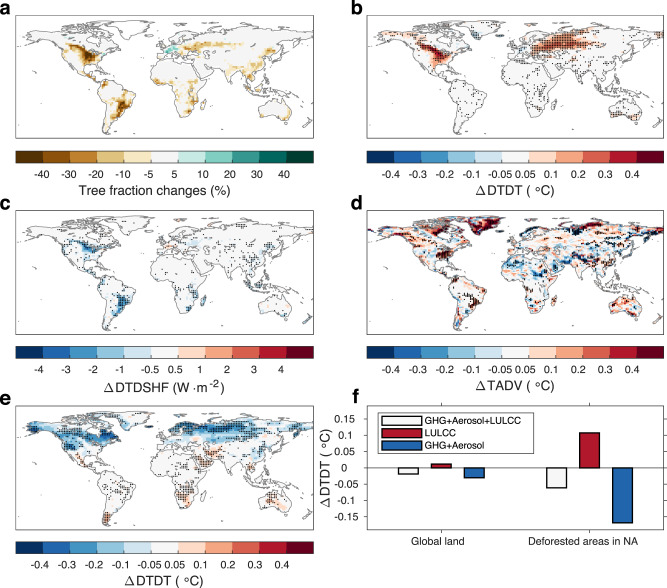
While the biogeophysical effects of deforestation on average and extreme temperatures are broadly documented, how deforestation influences temperature variability remains largely unknown. To fill this knowledge gap, we investigate the biogeophysical effects of idealized deforestation on daily temperature variability at the global scale based on multiple earth system models and in situ observations. Here, we show that deforestation can intensify daily temperature variability (by up to 20%) in the northern extratropics, particularly in winter, leading to more frequent rapid extreme warming and cooling events. The higher temperature variability can be attributed to the enhanced near-surface horizontal temperature advection and simultaneously is partly offset by the lower variability in surface sensible heat flux. We also show responses of daily temperature variability to historical deforestation and future potential afforestation. This study reveals the overlooked effects of deforestation or afforestation on temperature variability and has implications for large-scale afforestation in northern extratropic countries.
虽然森林砍伐对平均和极端温度的生物地球物理影响已被广泛记录,但森林砍伐如何影响温度变化在很大程度上仍不清楚。为了填补这一知识空白,我们基于多个地球系统模型和实地观测,研究了理想化森林砍伐对全球范围日温度变化的生物地球物理影响。在这里,我们表明,森林砍伐会加剧北方外温带(尤其是在冬季)的日温度变化(高达 20%),导致更频繁的快速极端暖化和冷却事件。更高的温度变化可归因于近地表水平温度平流的增强,同时部分被地表感热通量变化较小所抵消。我们还展示了日温度变化对历史森林砍伐和未来潜在造林的响应。本研究揭示了森林砍伐或造林对温度变化的被忽视影响,这对北方外温带国家的大规模造林具有重要意义。