van der Wal Jessica E M, Spottiswoode Claire N, Uomini Natalie T, Cantor Mauricio, Daura-Jorge Fábio G, Afan Anap I, Attwood Mairenn C, Amphaeris Jenny, Balasani Fatima, Begg Colleen M, Blair Cameron J, Bronstein Judith L, Buanachique Iahaia O, Cuthill Rion R T, Das Jewel, Deb Apurba, Dixit Tanmay, Dlamini Gcina S, Dounias Edmond, Gedi Isa I, Gruber Martin, Hoffmann Lilian S, Holzlehner Tobias, Isack Hussein A, Laltaika Eliupendo A, Lloyd-Jones David J, Lund Jess, Machado Alexandre M S, Mahadevan L, Moreno Ignacio B, Nwaogu Chima J, Pereira Valdomiro L, Pierotti Raymond, Rucunua Seliano A, Dos Santos Wilson F, Serpa Nathalia, Smith Brian D, Tolkova Irina, Tun Tint, Valle-Pereira João V S, Wood Brian M, Wrangham Richard W, Cram Dominic L
FitzPatrick Institute of African Ornithology, Department of Science and Innovation-National Research Foundation Centre of Excellence University of Cape Town Cape Town South Africa.
Department of Zoology University of Cambridge Cambridge UK.
Conserv Lett. 2022 Jul-Aug;15(4):e12886. doi: 10.1111/conl.12886. Epub 2022 Jun 9.
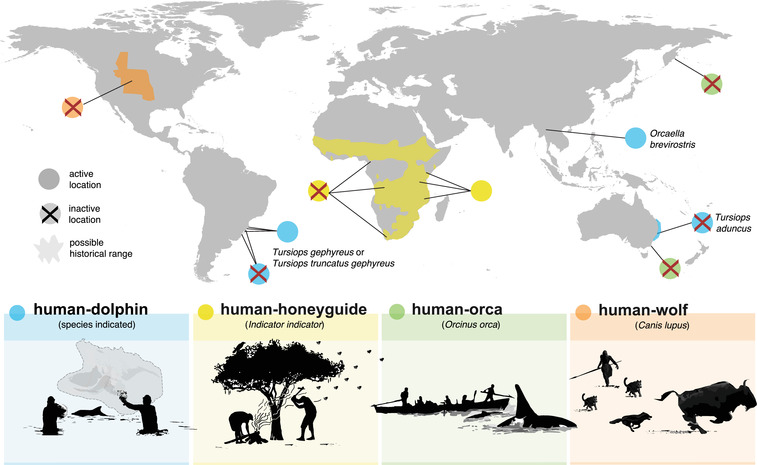
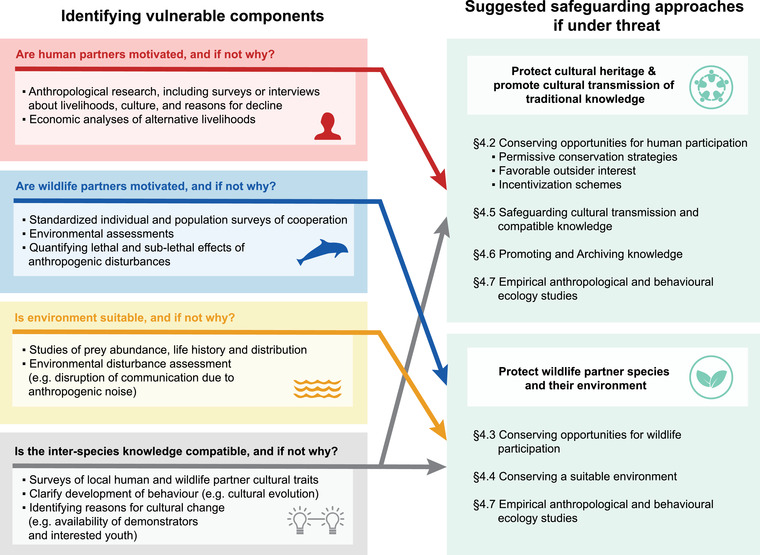
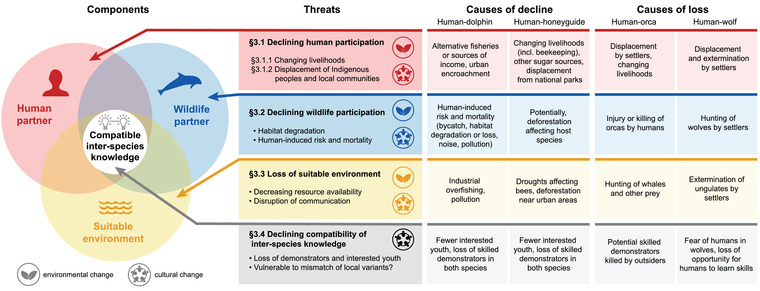
Human-wildlife cooperation occurs when humans and free-living wild animals actively coordinate their behavior to achieve a mutually beneficial outcome. These interactions provide important benefits to both the human and wildlife communities involved, have wider impacts on the local ecosystem, and represent a unique intersection of human and animal cultures. The remaining active forms are human-honeyguide and human-dolphin cooperation, but these are at risk of joining several inactive forms (including human-wolf and human-orca cooperation). Human-wildlife cooperation faces a unique set of conservation challenges, as it requires multiple components-a motivated human and wildlife partner, a suitable environment, and compatible interspecies knowledge-which face threats from ecological and cultural changes. To safeguard human-wildlife cooperation, we recommend: (i) establishing ethically sound conservation strategies together with the participating human communities; (ii) conserving opportunities for human and wildlife participation; (iii) protecting suitable environments; (iv) facilitating cultural transmission of traditional knowledge; (v) accessibly archiving Indigenous and scientific knowledge; and (vi) conducting long-term empirical studies to better understand these interactions and identify threats. Tailored safeguarding plans are therefore necessary to protect these diverse and irreplaceable interactions. Broadly, our review highlights that efforts to conserve biological and cultural diversity should carefully consider interactions between human and animal cultures. Please see AfricanHoneyguides.com/abstract-translations for Kiswahili and Portuguese translations of the abstract.
当人类与自由生活的野生动物积极协调其行为以实现互利结果时,就会发生人类与野生动物的合作。这些互动给相关的人类和野生动物群体都带来了重要益处,对当地生态系统产生更广泛的影响,并且代表了人类文化与动物文化的独特交汇点。现存仍在进行的合作形式有人类与响蜜鴷以及人类与海豚的合作,但这些合作形式也面临着加入几种已不再存在的合作形式(包括人类与狼以及人类与虎鲸的合作)的风险。人类与野生动物的合作面临着一系列独特的保护挑战,因为它需要多个要素——有积极性的人类和野生动物伙伴、适宜的环境以及相互兼容的物种间知识——而这些要素都面临着来自生态和文化变化的威胁。为了保护人类与野生动物的合作,我们建议:(i)与参与其中的人类社区共同制定符合道德规范的保护策略;(ii)保护人类和野生动物参与的机会;(iii)保护适宜的环境;(iv)促进传统知识的文化传承;(v)以易于获取的方式存档本土知识和科学知识;(vi)开展长期实证研究,以更好地理解这些互动并识别威胁。因此,需要制定量身定制的保护计划来保护这些多样且不可替代的互动。总体而言,我们的综述强调,保护生物多样性和文化多样性的努力应仔细考虑人类文化与动物文化之间的互动。有关摘要的斯瓦希里语和葡萄牙语翻译,请访问AfricanHoneyguides.com/abstract - translations。