Pinello Katia, Amorim Irina, Pires Isabel, Canadas-Sousa Ana, Catarino José, Faísca Pedro, Branco Sandra, Peleteiro Maria C, Silva Daniela, Severo Milton, Niza-Ribeiro João
Vet-OncoNet, Departamento de Estudo de Populações, ICBAS, Instituto de Ciências Biomédicas Abel Salazar, Universidade do Porto, 4050-313 Porto, Portugal.
EPIUnit, Instituto de Saúde Pública, Universidade do Porto, 4050-600 Porto, Portugal.
Vet Sci. 2022 Sep 28;9(10):535. doi: 10.3390/vetsci9100535.
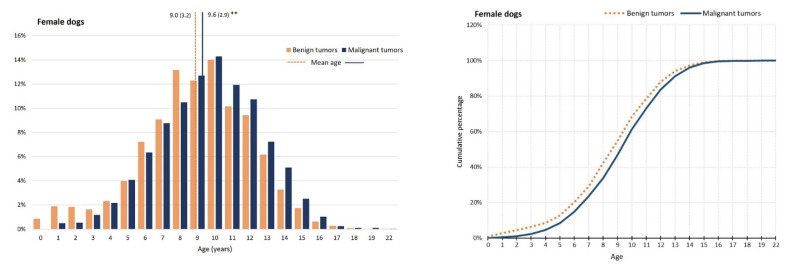
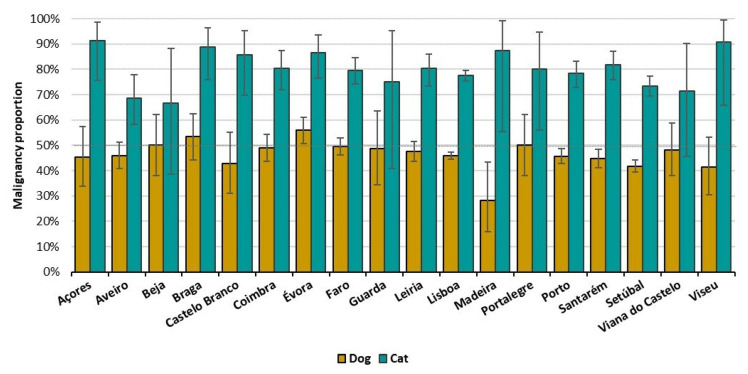
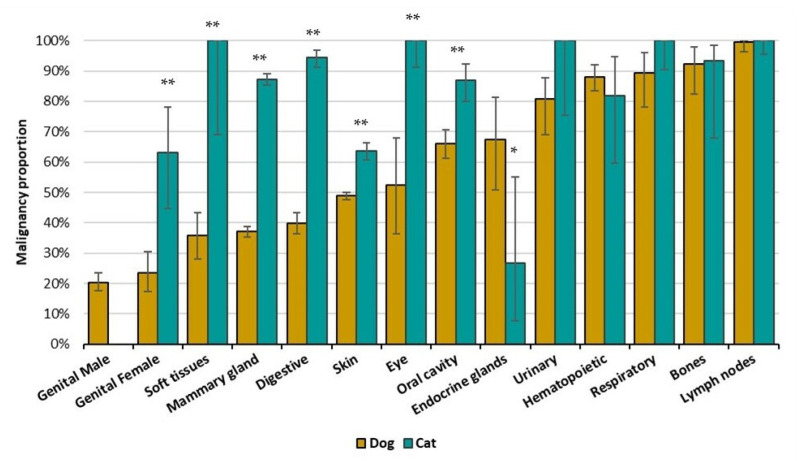
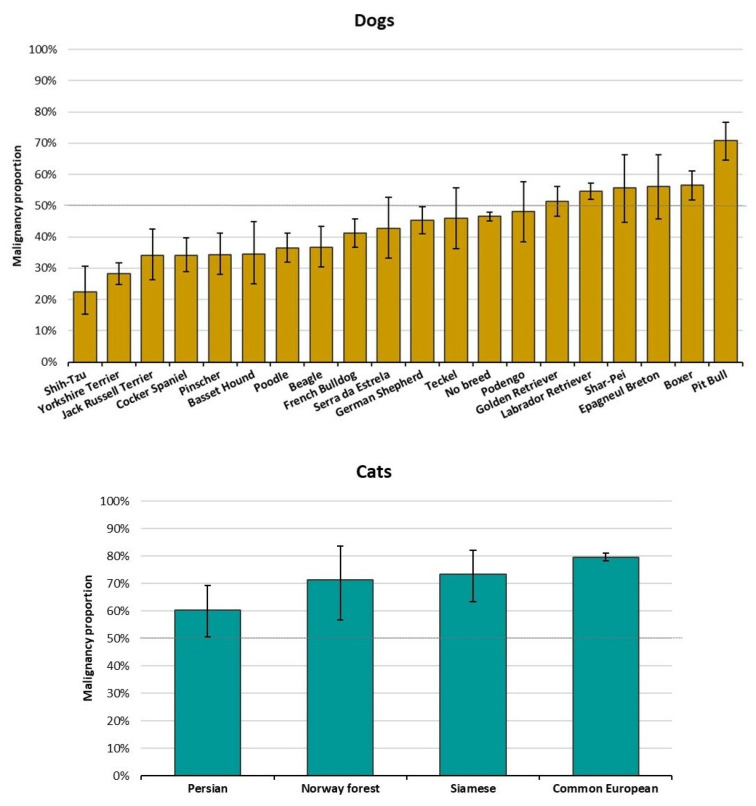
Analysis of canine and feline tumor malignancy data can help clinicians identify high-risk patients and make more accurate decisions. Based on a sample of 16,272 cancer records, including 3266 cats and 13,006 dogs, collected from January 2019 to December 2021 in the Vet-OncoNet Network database, this study aimed to compare the tumor malignancy profile between cats and dogs, considering animal-related factors (sex, age, and breed), topography, and geographic location using a mixed-effects logistic regression model. Cats had a higher proportion of malignant tumors (78.7%) than dogs (46.2%), and the malignancy profile was very different regarding tumors' topographies. The mean age of malignant tumors occurred eight months later than benign ones (9.1, SD = 3.4; 9.8, SD = 3.2), in general. Species (OR = 3.96, 95%CI 3.57: 4.39) and topography (MOR = 4.10) were the two most important determinants of malignancy risk. Female dogs had a higher risk than male dogs (OR = 1.19, 95%CI 1.08: 1.31), which does not appear to be the case in cats (OR = 0.98, 95%CI 0.77: 1.23). Breed contributed significantly to differences in malignancy risk in dogs (MOR = 1.56), particularly in pit bulls and boxers. District of residence was not so relevant in predicting malignancy risk (MOR = 1.14). In both species, the risk of malignancy increased by approximately 20% every three years. It could be hypothesized that species differences in genetic structure may contribute to tumor malignancy.
对犬猫肿瘤恶性数据的分析有助于临床医生识别高危患者并做出更准确的决策。本研究基于2019年1月至2021年12月在Vet-OncoNet网络数据库中收集的16272份癌症记录样本,其中包括3266只猫和13006只狗,旨在使用混合效应逻辑回归模型比较猫和狗之间的肿瘤恶性特征,同时考虑动物相关因素(性别、年龄和品种)、肿瘤部位和地理位置。猫的恶性肿瘤比例(78.7%)高于狗(46.2%),并且在肿瘤部位方面,恶性特征差异很大。一般来说,恶性肿瘤的平均发病年龄比良性肿瘤晚八个月(恶性肿瘤9.1岁,标准差 = 3.4;良性肿瘤9.8岁,标准差 = 3.2)。物种(比值比 = 3.96,95%置信区间3.57:4.39)和肿瘤部位(相对危险度 = 4.10)是恶性风险的两个最重要决定因素。雌性犬的风险高于雄性犬(比值比 = 1.19,95%置信区间1.08:1.31),而在猫中似乎并非如此(比值比 = 0.98,95%置信区间0.77:1.23)。品种对犬的恶性风险差异有显著影响(相对危险度 = 1.56),尤其是比特犬和拳师犬。居住地区在预测恶性风险方面相关性不大(相对危险度 = 1.14)。在这两个物种中,恶性风险每三年大约增加20%。可以推测,遗传结构的物种差异可能导致肿瘤恶性。