Foo Cher Ying, Munir Nimrah, Kumaria Ashwin, Akhtar Qasim, Bullock Christopher J, Narayanan Ashwin, Fu Richard Z
Imperial College School of Medicine, Imperial College London, Fulham Palace Rd., London W6 8RF, UK.
QV Bioelectronics Ltd., 1F70 Mereside, Alderley Park, Nether Alderley, Cheshire SK10 4TG, UK.
Cancers (Basel). 2022 Oct 29;14(21):5341. doi: 10.3390/cancers14215341.
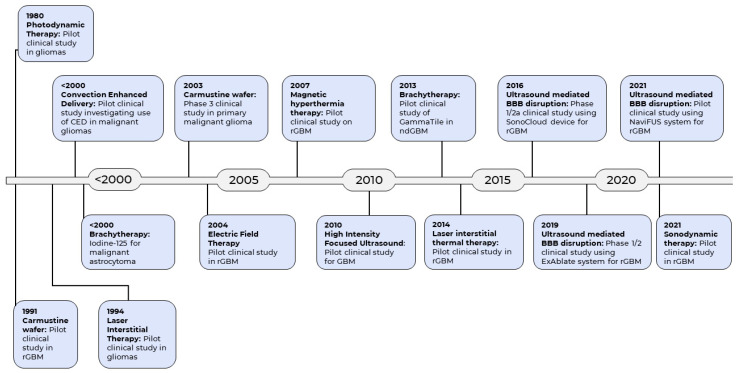
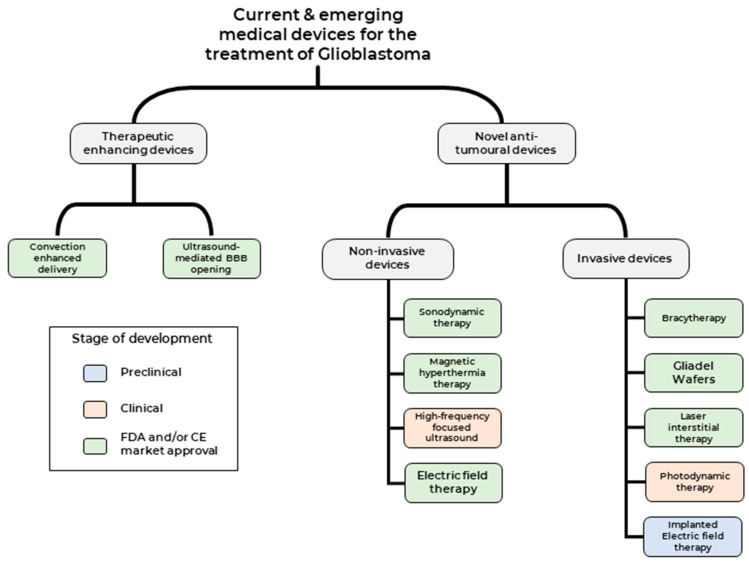
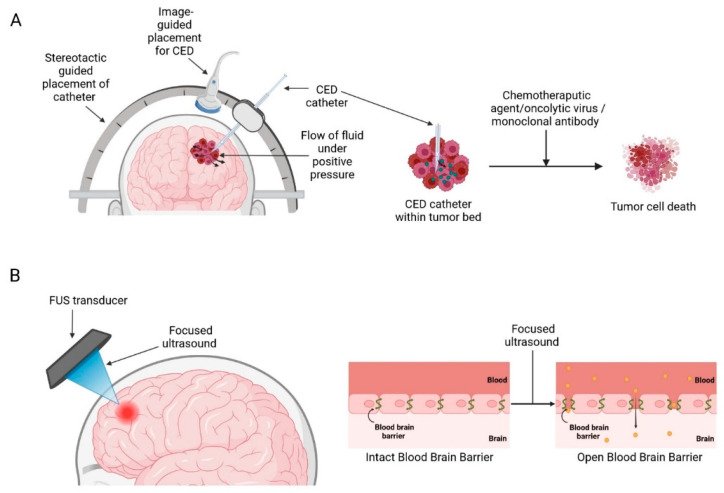
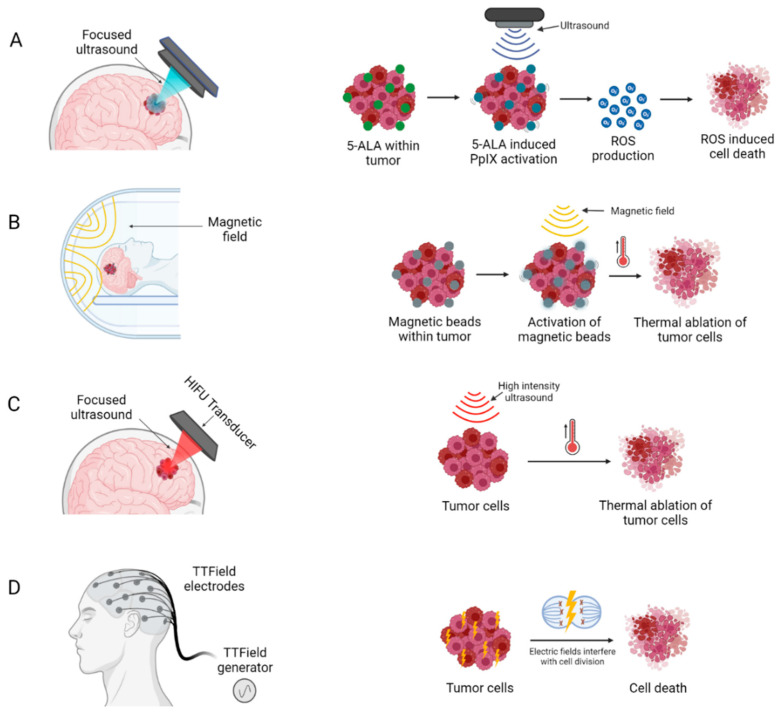
Despite decades of research and the growing emergence of new treatment modalities, Glioblastoma (GBM) frustratingly remains an incurable brain cancer with largely stagnant 5-year survival outcomes of around 5%. Historically, a significant challenge has been the effective delivery of anti-cancer treatment. This review aims to summarize key innovations in the field of medical devices, developed either to improve the delivery of existing treatments, for example that of chemo-radiotherapy, or provide novel treatments using devices, such as sonodynamic therapy, thermotherapy and electric field therapy. It will highlight current as well as emerging device technologies, non-invasive versus invasive approaches, and by doing so provide a detailed summary of evidence from clinical studies and trials undertaken to date. Potential limitations and current challenges are discussed whilst also highlighting the exciting potential of this developing field. It is hoped that this review will serve as a useful primer for clinicians, scientists, and engineers in the field, united by a shared goal to translate medical device innovations to help improve treatment outcomes for patients with this devastating disease.
尽管经过了数十年的研究以及新治疗方式的不断涌现,但令人沮丧的是,胶质母细胞瘤(GBM)仍然是一种无法治愈的脑癌,其5年生存率基本停滞在5%左右。从历史上看,一个重大挑战一直是抗癌治疗的有效递送。本综述旨在总结医疗设备领域的关键创新,这些创新要么是为了改善现有治疗(如放化疗)的递送,要么是利用设备提供新的治疗方法,如声动力疗法、热疗法和电场疗法。它将突出当前以及新兴的设备技术、非侵入性与侵入性方法,并借此详细总结迄今为止进行的临床研究和试验的证据。讨论了潜在的局限性和当前的挑战,同时也强调了这个不断发展的领域令人兴奋的潜力。希望这篇综述能为该领域的临床医生、科学家和工程师提供一份有用的入门指南,他们有着一个共同的目标,即转化医疗设备创新,以帮助改善这种毁灭性疾病患者的治疗效果。