Erne Felix, Grover Priyanka, Dreischarf Marcel, Reumann Marie K, Saul Dominik, Histing Tina, Nüssler Andreas K, Springer Fabian, Scholl Carolin
Siegfried Weller Institute for Trauma Research, BG Unfallklinik Tübingen, Eberhard Karls University Tübingen, 72076 Tübingen, Germany.
Department for Traumatology and Reconstructive Surgery, BG Unfallklinik Tübingen, Eberhard Karls University Tübingen, 72076 Tübingen, Germany.
Diagnostics (Basel). 2022 Nov 3;12(11):2679. doi: 10.3390/diagnostics12112679.
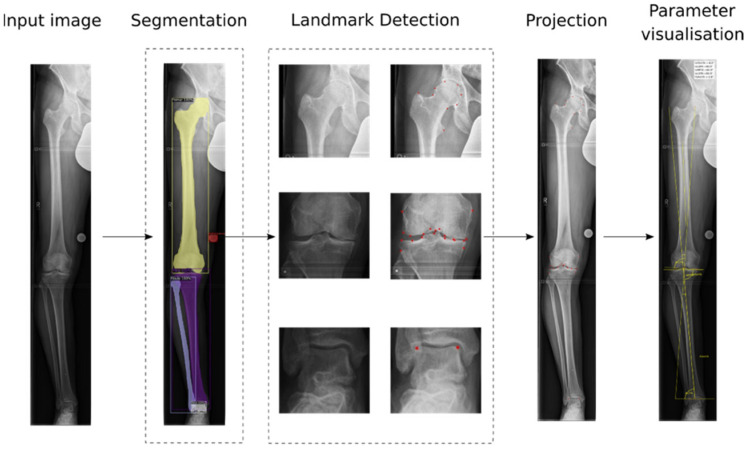
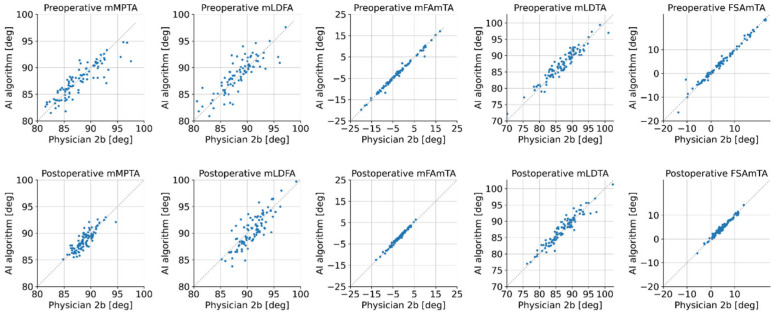
The assessment of the knee alignment using standing weight-bearing full-leg radiographs (FLR) is a standardized method. Determining the load-bearing axis of the leg requires time-consuming manual measurements. The aim of this study is to develop and validate a novel algorithm based on artificial intelligence (AI) for the automated assessment of lower limb alignment. In the first stage, a customized mask-RCNN model was trained to automatically detect and segment anatomical structures and implants in FLR. In the second stage, four region-specific neural network models (adaptations of UNet) were trained to automatically place anatomical landmarks. In the final stage, this information was used to automatically determine five key lower limb alignment angles. For the validation dataset, weight-bearing, antero-posterior FLR were captured preoperatively and 3 months postoperatively. Preoperative images were measured by the operating orthopedic surgeon and an independent physician. Postoperative images were measured by the second rater only. The final validation dataset consisted of 95 preoperative and 105 postoperative FLR. The detection rate for the different angles ranged between 92.4% and 98.9%. Human vs. human inter-(ICCs: 0.85−0.99) and intra-rater (ICCs: 0.95−1.0) reliability analysis achieved significant agreement. The ICC-values of human vs. AI inter-rater reliability analysis ranged between 0.8 and 1.0 preoperatively and between 0.83 and 0.99 postoperatively (all p < 0.001). An independent and external validation of the proposed algorithm on pre- and postoperative FLR, with excellent reliability for human measurements, could be demonstrated. Hence, the algorithm might allow for the objective and time saving analysis of large datasets and support physicians in daily routine.
使用站立位负重全腿X线片(FLR)评估膝关节对线是一种标准化方法。确定腿部的负重轴线需要耗时的手动测量。本研究的目的是开发并验证一种基于人工智能(AI)的新型算法,用于自动评估下肢对线。在第一阶段,训练了一个定制的Mask-RCNN模型,以自动检测和分割FLR中的解剖结构和植入物。在第二阶段,训练了四个特定区域的神经网络模型(U-Net的改编版),以自动放置解剖标志点。在最后阶段,利用这些信息自动确定五个关键的下肢对线角度。对于验证数据集,在术前和术后3个月拍摄负重前后位FLR。术前图像由骨科手术医生和一名独立医生测量。术后图像仅由第二名评分者测量。最终的验证数据集包括95张术前和105张术后FLR。不同角度的检测率在92.4%至98.9%之间。人与人之间的组间(组内相关系数:0.85 - 0.99)和评分者内(组内相关系数:0.95 - 1.0)可靠性分析达成了显著一致。人与人工智能之间的组间可靠性分析的组内相关系数值在术前为0.8至1.0,术后为0.83至0.99(所有p < 0.001)。可以证明,所提出的算法在术前和术后FLR上进行了独立的外部验证,且人体测量具有出色的可靠性。因此,该算法可能允许对大型数据集进行客观且节省时间的分析,并在日常工作中为医生提供支持。