Liang Xiao, Cheng Wanting, Liang Zhanhong, Zhan Yiling, McClements David Julian, Hu Kun
Food Science School, Guangdong Pharmaceutical University, Zhongshan 528458, China.
Clinical Medicine Department, Guangdong Maoming Health Vocational College, Maoming 525400, China.
Foods. 2022 Nov 2;11(21):3478. doi: 10.3390/foods11213478.
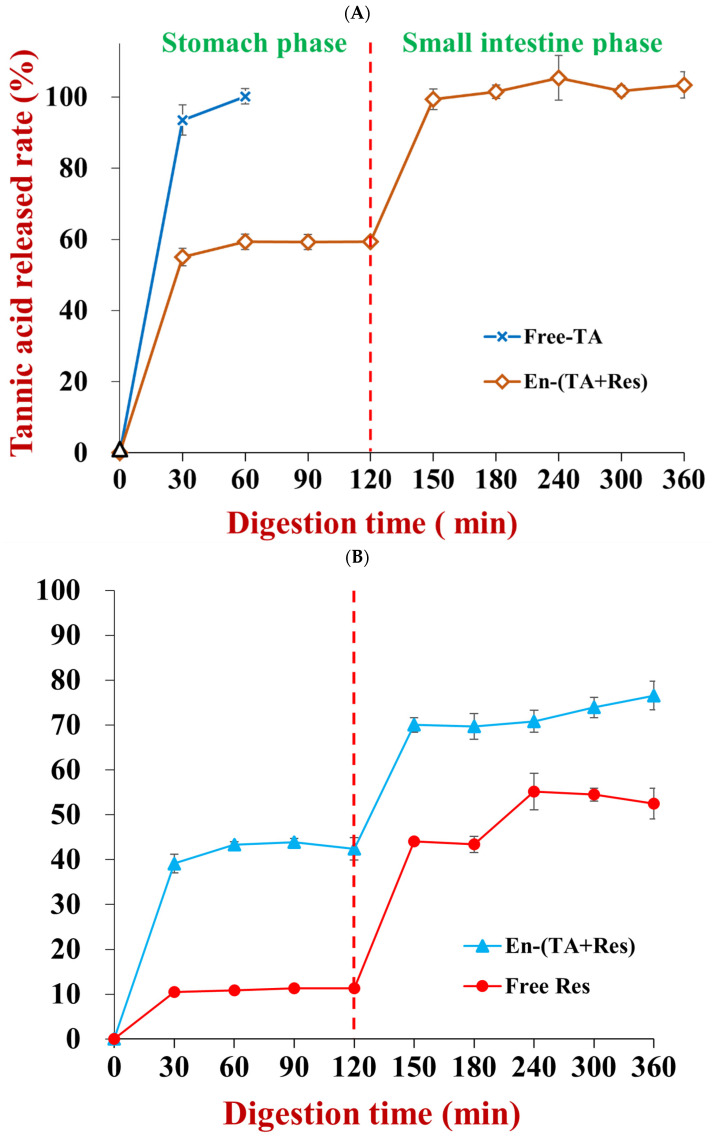
Hydrophilic tannic acid and hydrophobic resveratrol were successfully co-encapsulated in zein nanoparticles prepared using antisolvent precipitation and then coated with pectin by electrostatic deposition. The encapsulation efficiencies of the tannic acid and resveratrol were 51.5 ± 1.9% and 77.2 ± 3.2%, respectively. The co-encapsulated nanoparticles were stable against aggregation at the investigated pH range of 2.0 to 8.0 when heated at 80 °C for 2 h and when the NaCl concentration was below 50 mM. The co-encapsulated tannic acid and resveratrol exhibited stronger in vitro antioxidant activity than ascorbic acid, as determined by 1,1-diphenyl-2-picrylhydrazyl free radical (DPPH·) and 2,2'-azinobis (3-ethylberizothiazoline-6-sulfonic acid) radical cation (ABTS·) scavenging assays. The polyphenols-loaded nanoparticles significantly decreased the malondialdehyde (MDA) concentration and increased the superoxide dismutase (SOD) and catalase (CAT) activities in peroxide-treated human hepatoma cells (HepG2). An in vitro digestion model was used to study the gastrointestinal fate of the nanoparticles. In the stomach, encapsulation inhibited tannic acid release, but promoted resveratrol release. However, in the small intestine, it led to a relatively high bioaccessibility of 76% and 100% for resveratrol and tannic acid, respectively. These results suggest that pectin-coated zein nanoparticles have the potential for the co-encapsulation of both polar and nonpolar nutraceuticals or drugs.
通过反溶剂沉淀法制备的玉米醇溶蛋白纳米颗粒成功地将亲水性单宁酸和疏水性白藜芦醇共包封,然后通过静电沉积用果胶进行包衣。单宁酸和白藜芦醇的包封率分别为51.5±1.9%和77.2±3.2%。当在80℃加热2小时且NaCl浓度低于50 mM时,共包封的纳米颗粒在2.0至8.0的研究pH范围内对聚集稳定。通过1,1-二苯基-2-苦基肼自由基(DPPH·)和2,2'-偶氮双(3-乙基苯并噻唑啉-6-磺酸)自由基阳离子(ABTS·)清除试验测定,共包封的单宁酸和白藜芦醇在体外表现出比抗坏血酸更强的抗氧化活性。负载多酚的纳米颗粒显著降低了经过氧化氢处理的人肝癌细胞(HepG2)中的丙二醛(MDA)浓度,并提高了超氧化物歧化酶(SOD)和过氧化氢酶(CAT)的活性。使用体外消化模型研究纳米颗粒的胃肠道命运。在胃中,包封抑制了单宁酸的释放,但促进了白藜芦醇的释放。然而,在小肠中,它导致白藜芦醇和单宁酸的相对较高的生物可及性,分别为76%和100%。这些结果表明,果胶包衣的玉米醇溶蛋白纳米颗粒具有共包封极性和非极性营养保健品或药物的潜力。