Department of Environmental, Occupational, and Geospatial Health Sciences, CUNY Graduate School of Public Health and Health Policy, The City University of New York, New York, NY, United States.
Front Public Health. 2022 Oct 28;10:1017254. doi: 10.3389/fpubh.2022.1017254. eCollection 2022.
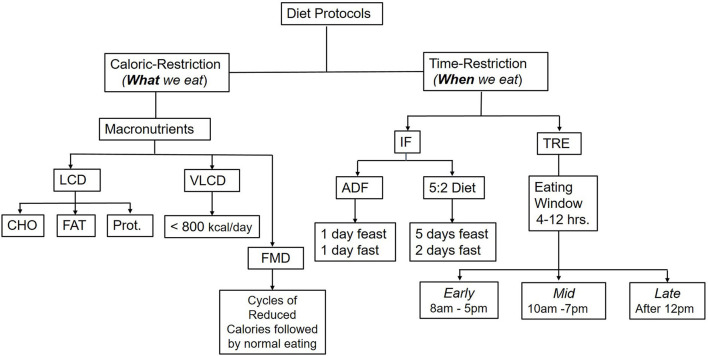
Intermittent fasting (IF), time-restricted eating (TRE) and fasting-mimicking diets (FMD) are gaining popularity as weight loss programs. As such, the timing and frequency of meals have been recognized as essential contributors to improving cardiometabolic health and a role as adjuvant therapy in cancer. Randomized controlled trials suggested that the weight loss associated with IF is due to a reduced energy intake due to time restriction. Although the supervised TRE clinical trials documented the dietary caloric intake, many free-living studies focused on the timing of meals without a complete characterization of the dietary intake, caloric density, or macronutrient composition. It is possible that both caloric-restriction diets and time-restriction protocols could work synergistically or additively to improve metabolic health outcomes. Like personalized medicine, achieving precision nutrition mandates the provision of the right nutrients to the right patient at the right time. To accomplish this goal, future studies need to evaluate the benefits of IF and TRE. Randomized controlled trials were conducted in different populations, ethnic groups, ages, geographic distribution, physical activity levels, body composition and in patients with obesity, diabetes, and cardiovascular diseases. Also, it is crucial to analyze the dietary composition and caloric density as related to circadian rhythm and timing of meals. It is conceivable that IF and TRE may contribute to precision nutrition strategies to achieve optimal health. However, more research is needed to evaluate IF and TRE effects on health outcomes and any side effects.
间歇性禁食 (IF)、限时进食 (TRE) 和模拟禁食饮食 (FMD) 作为减肥计划越来越受欢迎。因此,用餐的时间和频率已被认为是改善心脏代谢健康的重要因素,也是癌症辅助治疗的一种方法。随机对照试验表明,IF 引起的体重减轻是由于时间限制导致能量摄入减少。尽管有监督的 TRE 临床试验记录了饮食的热量摄入,但许多自由生活研究都集中在进餐时间上,而没有对饮食摄入、热量密度或宏量营养素组成进行完整描述。卡路里限制饮食和时间限制方案可能协同或累加作用,以改善代谢健康结果。就像个性化医学一样,实现精准营养需要在正确的时间为正确的患者提供正确的营养。为了实现这一目标,未来的研究需要评估 IF 和 TRE 的益处。随机对照试验在不同人群、种族群体、年龄、地理分布、身体活动水平、身体成分以及肥胖、糖尿病和心血管疾病患者中进行。此外,分析与昼夜节律和进餐时间相关的饮食成分和热量密度至关重要。可以想象,IF 和 TRE 可能有助于实现精准营养策略以达到最佳健康状态。然而,需要更多的研究来评估 IF 和 TRE 对健康结果和任何副作用的影响。