Systems Immunology Department, Weizmann Institute of Science, Rehovot, Israel.
Microbiome & Cancer Division, DKFZ, Heidelberg, Germany.
J Diabetes. 2022 Jun;14(6):377-393. doi: 10.1111/1753-0407.13288. Epub 2022 Jun 13.
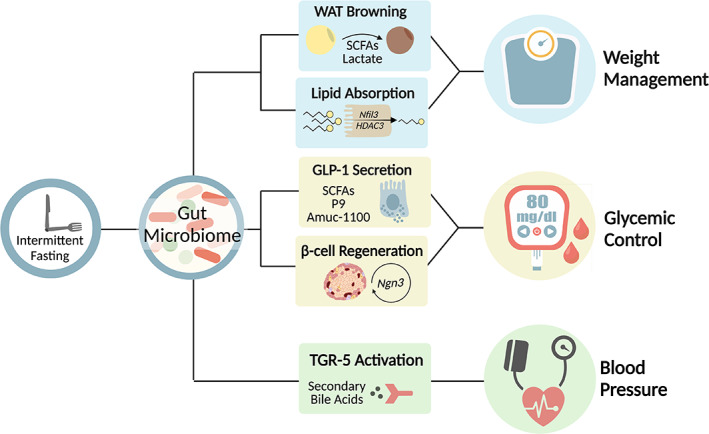
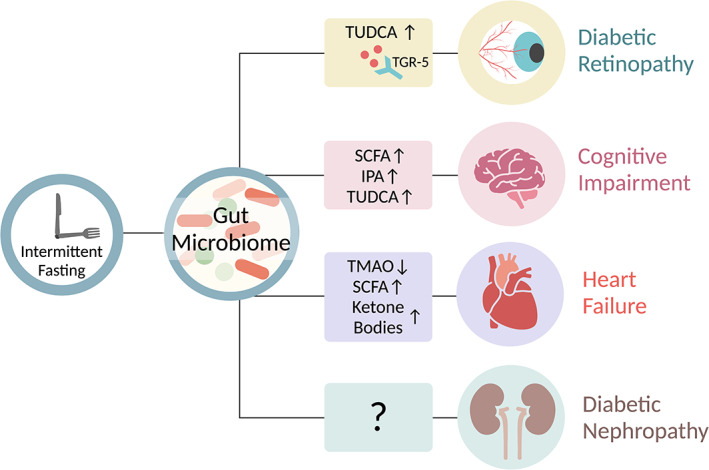
In recent years, intermittent fasting (IF), including periodic fasting and time-restricted feeding (TRF), has been increasingly suggested to constitute a promising treatment for cardiometabolic diseases (CMD). A deliberate daily pause in food consumption influences the gut microbiome and the host circadian clock, resulting in improved cardiometabolic health. Understanding the molecular mechanisms by which circadian host-microbiome interactions affect host metabolism and immunity may add a potentially important dimension to effective implementation of IF diets. In this review, we discuss emerging evidence potentially linking compositional and functional alterations of the gut microbiome with IF impacts on mammalian metabolism and risk of development of hypertension, type 2 diabetes (T2D), obesity, and their long-term micro- and macrovascular complications. We highlight the challenges and unknowns in causally linking diurnal bacterial signals with dietary cues and downstream metabolic consequences and means of harnessing these signals toward future microbiome integration into precision medicine.
近年来,间歇性禁食(IF),包括周期性禁食和时间限制喂养(TRF),被越来越多地认为是治疗心脏代谢疾病(CMD)的一种有前途的方法。有意识地每天暂停进食会影响肠道微生物组和宿主昼夜节律,从而改善心脏代谢健康。了解昼夜宿主-微生物组相互作用影响宿主代谢和免疫的分子机制,可能为有效实施 IF 饮食增加一个潜在的重要方面。在这篇综述中,我们讨论了潜在的证据,这些证据可能将肠道微生物组的组成和功能改变与 IF 对哺乳动物代谢和高血压、2 型糖尿病(T2D)、肥胖及其长期微血管和大血管并发症风险的影响联系起来。我们强调了将昼夜细菌信号与饮食线索和下游代谢后果联系起来的挑战和未知,并探讨了利用这些信号将肠道微生物组纳入精准医学的方法。