Bucher Amy, Blazek E Susanne, West Ashley B
Lirio, Knoxville, TN, United States.
JMIR Form Res. 2022 Nov 28;6(11):e42343. doi: 10.2196/42343.
Preventive screenings such as mammograms promote health and detect disease. However, mammogram attendance lags clinical guidelines, with roughly one-quarter of women not completing their recommended mammograms. A scalable digital health intervention leveraging behavioral science and reinforcement learning and delivered via email was implemented in a US health system to promote uptake of recommended mammograms among patients who were 1 or more years overdue for the screening (ie, 2 or more years from last mammogram).
The aim of this study was to establish the feasibility of a reinforcement learning-enabled mammography digital health intervention delivered via email. The research aims included understanding the intervention's reach and ability to elicit behavioral outcomes of scheduling and attending mammograms, as well as understanding reach and behavioral outcomes for women of different ages, races, educational attainment levels, and household incomes.
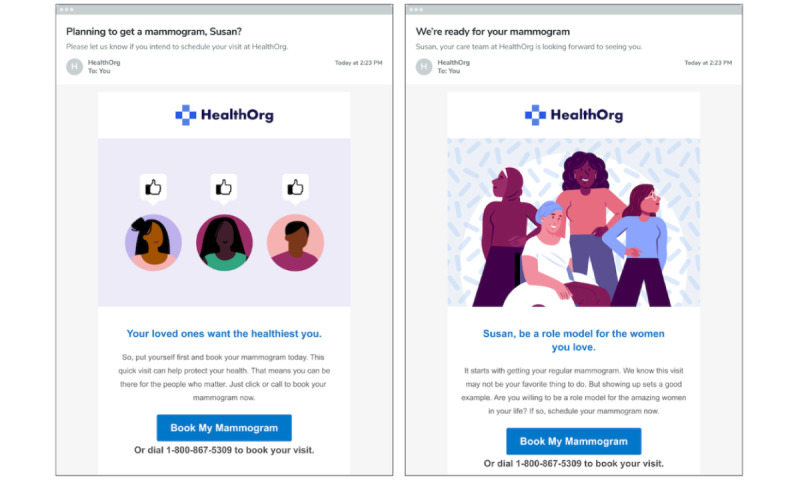
The digital health intervention was implemented in a large Catholic health system in the Midwestern United States and targeted the system's existing patients who had not received a recommended mammogram in 2 or more years. From August 2020 to July 2022, 139,164 eligible women received behavioral science-based email messages assembled and delivered by a reinforcement learning model to encourage clinically recommended mammograms. Target outcome behaviors included scheduling and ultimately attending the mammogram appointment.
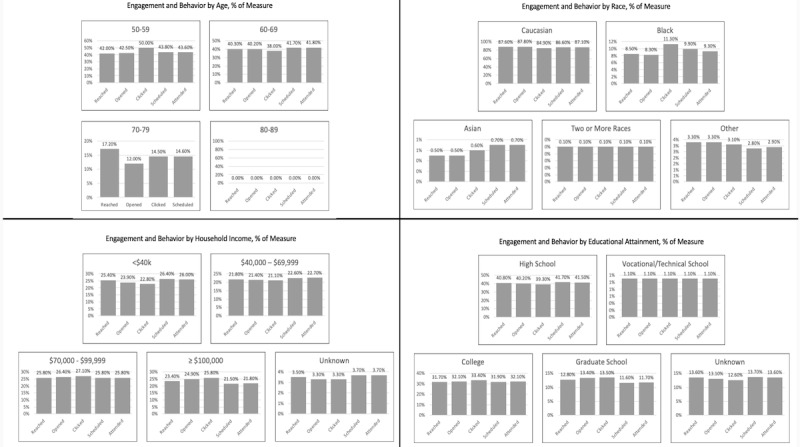
In total, 139,164 women received at least one intervention email during the study period, and 81.52% engaged with at least one email. Deliverability of emails exceeded 98%. Among message recipients, 24.99% scheduled mammograms and 22.02% attended mammograms (88.08% attendance rate among women who scheduled appointments). Results indicate no practical differences in the frequency at which people engage with the intervention or take action following a message based on their age, race, educational attainment, or household income, suggesting the intervention may equitably drive mammography across diverse populations.
The reinforcement learning-enabled email intervention is feasible to implement in a health system to engage patients who are overdue for their mammograms to schedule and attend a recommended screening. In this feasibility study, the intervention was associated with scheduling and attending mammograms for patients who were significantly overdue for recommended screening. Moreover, the intervention showed proportionate reach across demographic subpopulations. This suggests that the intervention may be effective at engaging patients of many different backgrounds who are overdue for screening. Future research will establish the effectiveness of this type of intervention compared to typical health system outreach to patients who have not had recommended screenings as well as identify ways to enhance its reach and impact.
乳房X光检查等预防性筛查可促进健康并检测疾病。然而,乳房X光检查的参与率未达临床指南要求,约四分之一的女性未完成推荐的乳房X光检查。美国一个医疗系统实施了一项可扩展的数字健康干预措施,该措施利用行为科学和强化学习,并通过电子邮件提供,以促进那些筛查逾期一年或更长时间(即距离上次乳房X光检查已过去两年或更长时间)的患者接受推荐的乳房X光检查。
本研究的目的是确定通过电子邮件提供的、基于强化学习的乳房X光检查数字健康干预措施的可行性。研究目标包括了解该干预措施的覆盖范围以及引发乳房X光检查预约和就诊行为结果的能力,同时了解不同年龄、种族、教育程度和家庭收入的女性的覆盖范围和行为结果。
该数字健康干预措施在美国中西部的一个大型天主教医疗系统中实施,目标是该系统中已有两年或更长时间未接受推荐乳房X光检查的现有患者。从2020年8月到2022年7月,139,164名符合条件的女性收到了由强化学习模型组装并发送的基于行为科学的电子邮件,以鼓励她们接受临床推荐的乳房X光检查。目标结果行为包括预约并最终参加乳房X光检查预约。
在研究期间,共有139,164名女性至少收到一封干预电子邮件,其中81.52%的女性与至少一封电子邮件进行了互动。电子邮件的可投递率超过98%。在信息接收者中,24.99%的人预约了乳房X光检查,22.02%的人参加了乳房X光检查(在预约的女性中,就诊率为88.08%)。结果表明,不同年龄、种族、教育程度或家庭收入的人在与干预措施互动或收到信息后采取行动的频率上没有实际差异,这表明该干预措施可能公平地推动不同人群进行乳房X光检查。
在医疗系统中实施基于强化学习的电子邮件干预措施,以促使逾期未进行乳房X光检查的患者预约并参加推荐的筛查是可行的。在这项可行性研究中,该干预措施与为严重逾期未进行推荐筛查的患者预约和参加乳房X光检查相关。此外,该干预措施在各人口亚群体中的覆盖范围相当。这表明该干预措施可能有效地促使许多不同背景、逾期未进行筛查的患者参与进来。未来的研究将确定这种干预措施与针对未接受推荐筛查患者的典型医疗系统外展服务相比的有效性,并确定提高其覆盖范围和影响的方法。