
电化学动力学支持金属基甲酸脱氢酶的第二个配位球机制。
Electrochemical Kinetics Support a Second Coordination Sphere Mechanism in Metal-Based Formate Dehydrogenase.
机构信息
CNRS, Aix Marseille Université, BIP, IMM, IM2B, 31 Chemin J. Aiguier, 13009, Marseille, France.
Aix Marseille Université, CNRS, Laboratoire de Chimie Bactérienne (UMR7283), IMM, IM2B, 31 Chemin J. Aiguier, 13009, Marseille, France.
出版信息
Angew Chem Int Ed Engl. 2023 Feb 1;62(6):e202212224. doi: 10.1002/anie.202212224. Epub 2023 Jan 3.
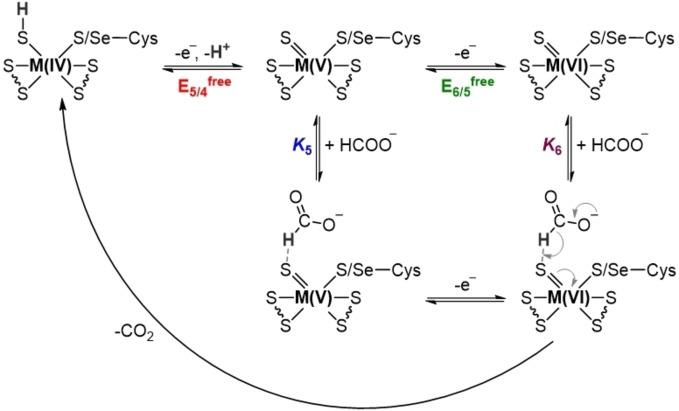
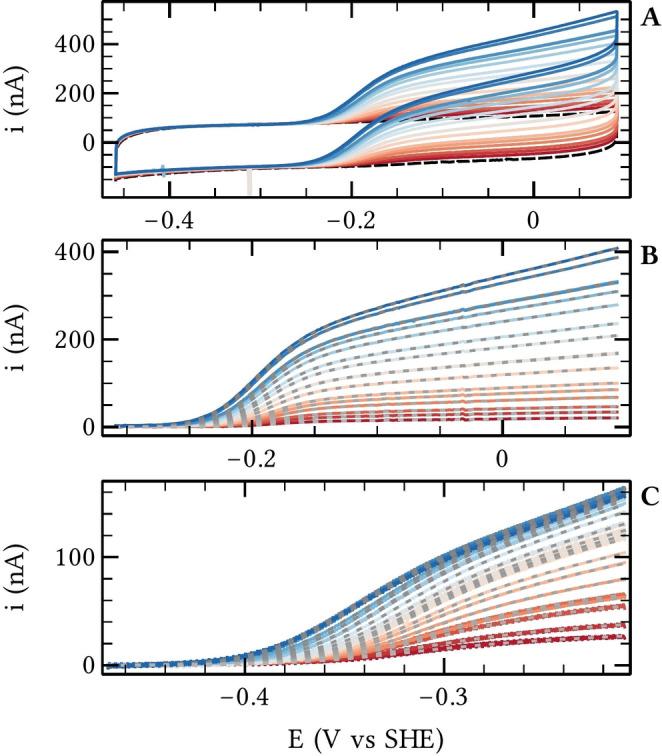
Metal-based formate dehydrogenases are molybdenum or tungsten-dependent enzymes that catalyze the interconversion between formate and CO . According to the current consensus, the metal ion of the catalytic center in its active form is coordinated by 6 S (or 5 S and 1 Se) atoms, leaving no free coordination sites to which formate could bind to the metal. Some authors have proposed that one of the active site ligands decoordinates during turnover to allow formate binding. Another proposal is that the oxidation of formate takes place in the second coordination sphere of the metal. Here, we have used electrochemical steady-state kinetics to elucidate the order of the steps in the catalytic cycle of two formate dehydrogenases. Our results strongly support the "second coordination sphere" hypothesis.
金属基甲酸盐脱氢酶是依赖钼或钨的酶,可催化甲酸盐和 CO 之间的相互转化。根据目前的共识,催化中心金属离子在其活性形式下由 6 S(或 5 S 和 1 Se)原子配位,没有游离的配位位点可以让甲酸盐与金属结合。一些作者提出,在周转过程中,活性位点的一个配体解配位以允许甲酸盐结合。另一种假设是甲酸盐的氧化发生在金属的第二配位球。在这里,我们使用电化学稳态动力学来阐明两种甲酸盐脱氢酶催化循环中步骤的顺序。我们的结果强烈支持“第二配位球”假说。


 Zotero 插件