Jahrom University of Medical Sciences (دانشگاه علوم پزشكي خدمات بهداشتی درمانی جهرم), Jahrom, Fars Province, 74148-46199, Iran.
U.S. National Tick Collection, The James H. Oliver Jr. Institute for Coastal Plain Science, Georgia Southern University, Statesboro, GA 30458, USA; Zoological Institute of Russian Academy of Sciences (Зоологический институт Российской академии наук), 199034, St. Petersburg, Russia.
Virol Sin. 2023 Apr;38(2):171-183. doi: 10.1016/j.virs.2023.01.001. Epub 2023 Jan 18.
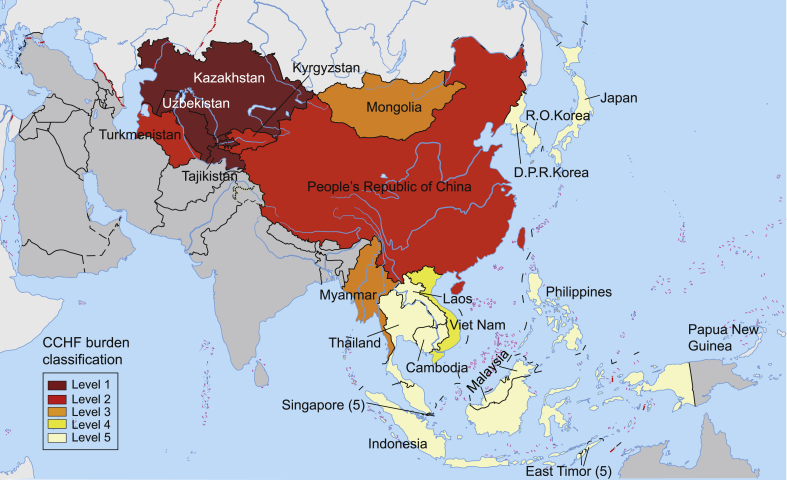
Crimean-Congo hemorrhagic fever (CCHF), caused by Crimean-Congo hemorrhagic fever virus (CCHFV), is endemic in Africa, Asia, and Europe, but CCHF epidemiology and epizootiology is only rudimentarily defined for most regions. Here we summarize what is known about CCHF in Central, Eastern, and South-eastern Asia. Searching multiple international and country-specific databases using a One Health approach, we defined disease risk and burden through identification of CCHF cases, anti-CCHFV antibody prevalence, and CCHFV isolation from vector ticks. We identified 2313 CCHF cases that occurred in 1944-2021 in the three examined regions. Central Asian countries reported the majority of cases (2,026). In Eastern Asia, China was the only country that reported CCHF cases (287). In South-eastern Asia, no cases were reported. Next, we leveraged our previously established classification scheme to assign countries to five CCHF evidence levels. Six countries (China, Kazakhstan, Kyrgyzstan, Tajikistan, Turkmenistan, and Uzbekistan) were assigned to level 1 or level 2 based on CCHF case reports and the maturity of the countries' surveillance systems. Two countries (Mongolia and Myanmar) were assigned to level 3 due to evidence of CCHFV circulation in the absence of reported CCHF cases. Thirteen countries in Eastern and South-eastern Asia were categorized in levels 4 and 5 based on prevalence of CCHFV vector ticks. Collectively, this paper describes the past and present status of CCHF reporting to inform international and local public-health agencies to strengthen or establish CCHFV surveillance systems and address shortcomings.
克里米亚-刚果出血热(CCHF)由克里米亚-刚果出血热病毒(CCHFV)引起,在非洲、亚洲和欧洲流行,但大多数地区对 CCHF 的流行病学和动物流行病学仅处于初步定义阶段。在这里,我们总结了中亚、东亚和东南亚地区对 CCHF 的了解。我们采用“One Health”方法,通过识别 CCHF 病例、抗 CCHFV 抗体流行率和从媒介蜱中分离 CCHFV,利用多个国际和国家特定数据库进行搜索,定义了疾病风险和负担。我们确定了在三个被检查地区 1944 年至 2021 年期间发生的 2313 例 CCHF 病例。中亚国家报告了大多数病例(2026 例)。在东亚,中国是唯一报告 CCHF 病例的国家(287 例)。在东南亚,没有报告病例。接下来,我们利用我们之前建立的分类方案,根据 CCHF 病例报告和国家监测系统的成熟程度,将国家分为五个 CCHF 证据水平。六个国家(中国、哈萨克斯坦、吉尔吉斯斯坦、塔吉克斯坦、土库曼斯坦和乌兹别克斯坦)根据 CCHF 病例报告和国家监测系统的成熟程度被分配到 1 级或 2 级。两个国家(蒙古和缅甸)由于在没有报告 CCHF 病例的情况下存在 CCHFV 循环的证据而被分配到 3 级。由于 CCHFV 媒介蜱的流行,东亚和东南亚的 13 个国家被归类在 4 级和 5 级。总的来说,本文描述了过去和现在 CCHF 报告的状况,以便为国际和当地公共卫生机构提供信息,以加强或建立 CCHFV 监测系统,并解决不足。