Tisch Cancer Institute, Icahn School of Medicine at Mount Sinai.
Sonic Healthcare USA.
Haematologica. 2023 Aug 1;108(8):1993-2010. doi: 10.3324/haematol.2021.280209.
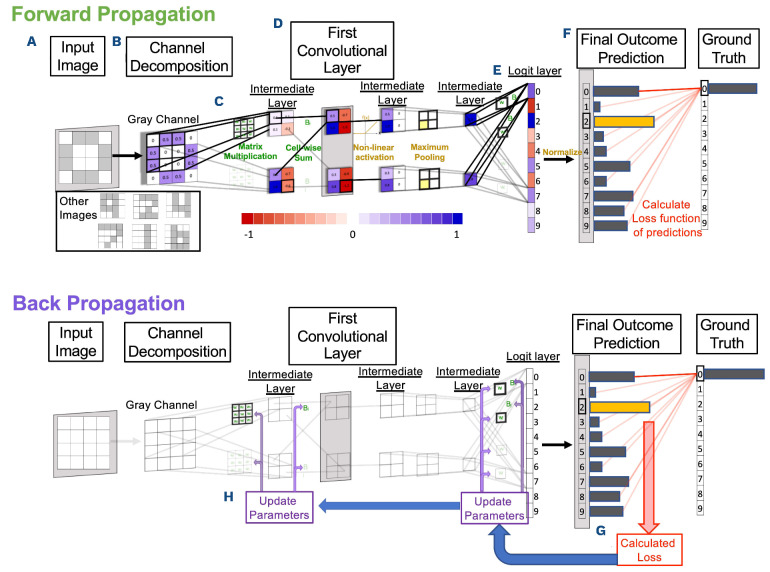
Deep learning (DL) is a subdomain of artificial intelligence algorithms capable of automatically evaluating subtle graphical features to make highly accurate predictions, which was recently popularized in multiple imaging-related tasks. Because of its capabilities to analyze medical imaging such as radiology scans and digitized pathology specimens, DL has significant clinical potential as a diagnostic or prognostic tool. Coupled with rapidly increasing quantities of digital medical data, numerous novel research questions and clinical applications of DL within medicine have already been explored. Similarly, DL research and applications within hematology are rapidly emerging, although these are still largely in their infancy. Given the exponential rise of DL research for hematologic conditions, it is essential for the practising hematologist to be familiar with the broad concepts and pitfalls related to these new computational techniques. This narrative review provides a visual glossary for key deep learning principles, as well as a systematic review of published investigations within malignant and non-malignant hematologic conditions, organized by the different phases of clinical care. In order to assist the unfamiliar reader, this review highlights key portions of current literature and summarizes important considerations for the critical understanding of deep learning development and implementations in clinical practice.
深度学习(DL)是人工智能算法的一个分支,能够自动评估细微的图形特征,从而做出高度准确的预测,最近在多个与成像相关的任务中得到了广泛应用。由于其能够分析放射学扫描和数字化病理学标本等医学成像,DL 作为诊断或预后工具具有重要的临床潜力。再加上数字医疗数据数量的快速增加,DL 在医学中的许多新的研究问题和临床应用已经得到了探索。同样,DL 在血液学中的研究和应用也在迅速兴起,尽管这些仍处于起步阶段。鉴于血液学疾病的 DL 研究呈指数级增长,对于执业血液学家来说,熟悉这些新的计算技术的广泛概念和陷阱至关重要。本叙述性综述提供了关键深度学习原理的视觉词汇表,以及按临床护理的不同阶段组织的恶性和非恶性血液学疾病的已发表研究的系统综述。为了帮助不熟悉的读者,本综述突出了当前文献的关键部分,并总结了对深度学习在临床实践中的开发和实施的关键理解的重要考虑因素。