Satpathy Megha, Jose Rose M, Duan Yuanyuan, Griggs Jason A
Biomedical Materials Science, University of Mississippi Medical Center, Jackson, MS.
JADA Found Sci. 2022;1. doi: 10.1016/j.jfscie.2022.100010. Epub 2022 May 20.
This study aimed to investigate how the predicted implant fatigue lifetime is affected by the loss of connector screw preload and the finite element analysis method used to simulate preload.
A dental implant assembly (DI1, Biomet-3i external hex; Zimmer Biomet) was scanned using microcomputed tomography and measured using Mimics software (Materialise) and an optical microscope. Digital replicas were constructed using SolidWorks software (Dassault Systèmes). The material properties were assigned in Abaqus (Dassault Systèmes). An external load was applied at 30° off-axial loading. Eight levels of connector screw preload (range, 0-32 Ncm) were simulated for DI1. This assembly and an additional model (DI2) having a longer and narrower screw were compared regarding their fatigue limits (using fe-safe software [Dassault Systèmes]) for 2 preloading methods: (1) adding preload torque or (2) adding bolt axial tension.
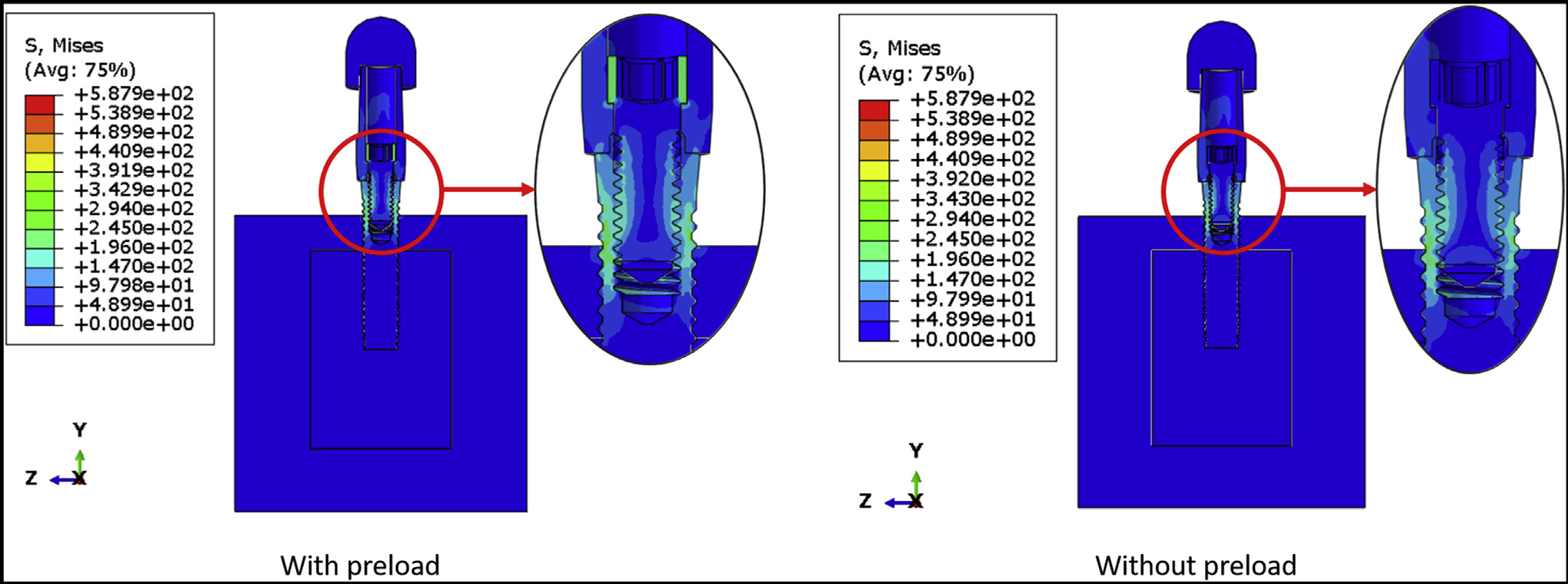
The maximum von Mises stresses of DI1 (on the connector screw threads) with and without preload were 439.90 MPa and 587.90 MPa. The predicted fatigue limit was the same for preloads from 100% through 80% of the manufacturers recommendation and dropped precipitously between 80% and 70% preload. Adding a preload torque on the screw resulted in a more uniform stress distribution on the screw compared with bolt axial tension, especially for DI2, which had a longer and narrower screw than DI1.
A substantial loss of preload can be accommodated without compromising the fatigue resistance of this dental implant. Computer models should be constructed using torque instead of a bolt axial tension.
本研究旨在探讨连接螺钉预紧力的损失以及用于模拟预紧力的有限元分析方法如何影响种植体疲劳寿命的预测。
使用微型计算机断层扫描对牙科种植体组件(DI1,Biomet-3i外六角;Zimmer Biomet)进行扫描,并使用Mimics软件(Materialise)和光学显微镜进行测量。使用SolidWorks软件(达索系统公司)构建数字模型。在Abaqus(达索系统公司)中指定材料属性。在离轴30°方向施加外部载荷。对DI1模拟了八级连接螺钉预紧力(范围为0-32 Ncm)。比较了该组件和另一个具有更长更窄螺钉的模型(DI2)在两种预紧方法下的疲劳极限(使用fe-safe软件[达索系统公司]):(1)添加预紧扭矩或(2)添加螺栓轴向拉力。
有预紧力和无预紧力时DI1(在连接螺钉螺纹上)的最大冯·米塞斯应力分别为439.90 MPa和587.90 MPa。从制造商推荐值的100%到80%的预紧力,预测的疲劳极限相同,而在80%到70%预紧力之间急剧下降。与螺栓轴向拉力相比,在螺钉上添加预紧扭矩会使螺钉上的应力分布更均匀,尤其是对于DI2,其螺钉比DI1更长更窄。
在不影响该牙科种植体抗疲劳性能的情况下,可以承受相当大的预紧力损失。计算机模型应使用扭矩而不是螺栓轴向拉力来构建。