Smoluchowski Institute of Physics, Jagiellonian University, Łojasiewicza 11, 30-348 Kraków, Poland.
Lviv Polytechnic National University, St. George's Square 2, 79013 Lviv, Ukraine.
ACS Appl Mater Interfaces. 2023 Feb 15;15(6):8676-8690. doi: 10.1021/acsami.2c20395. Epub 2023 Feb 3.
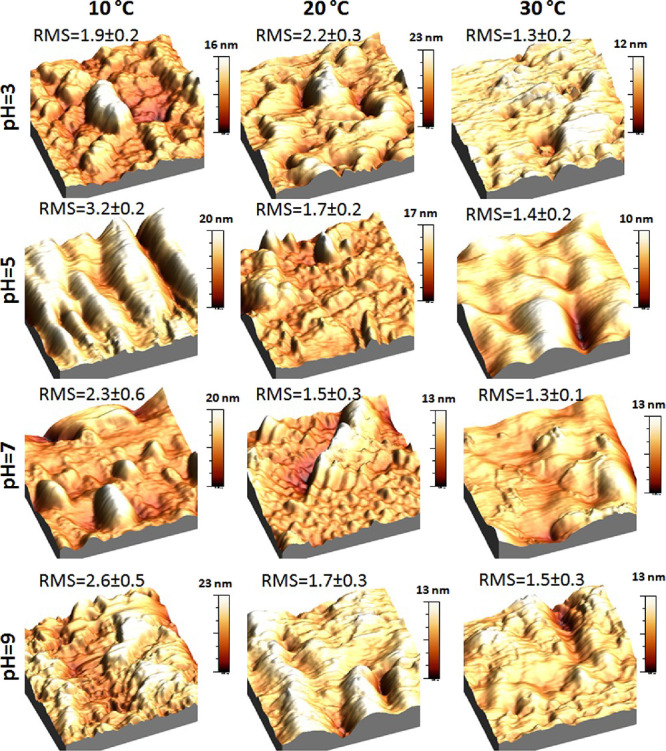
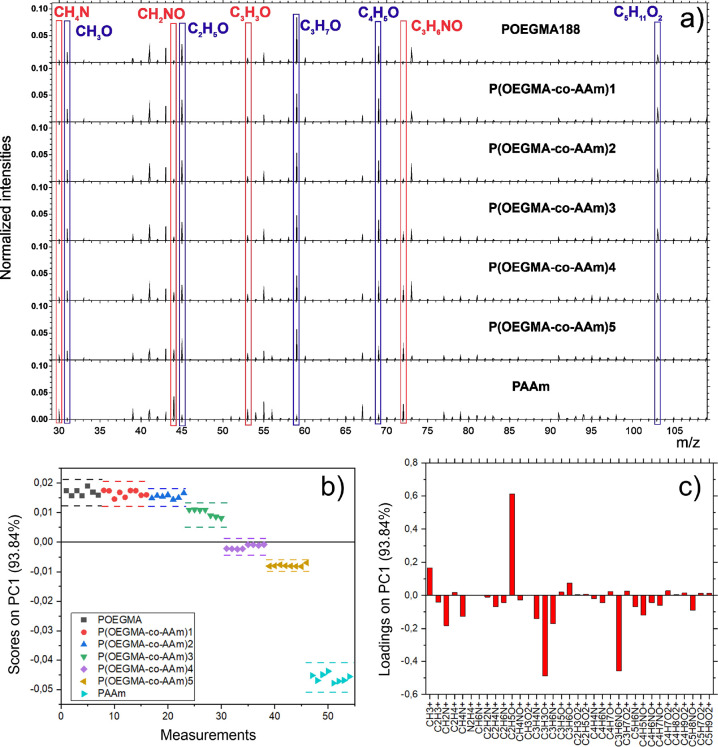
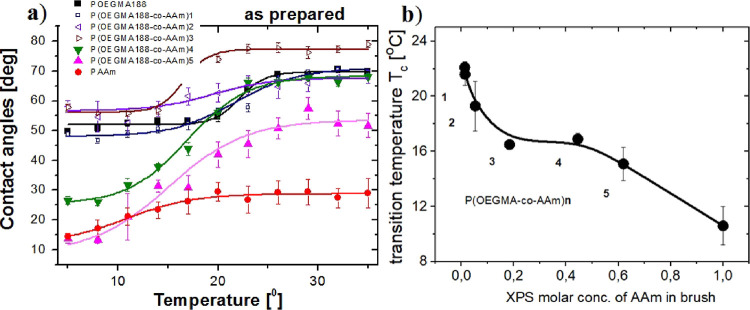
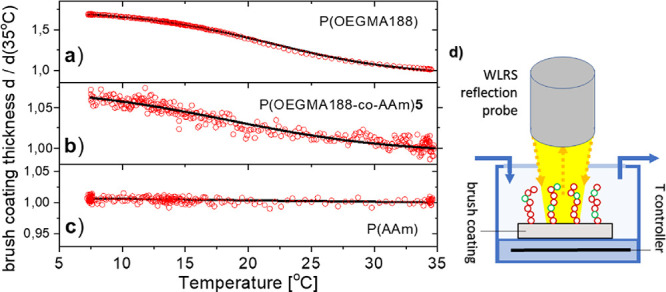
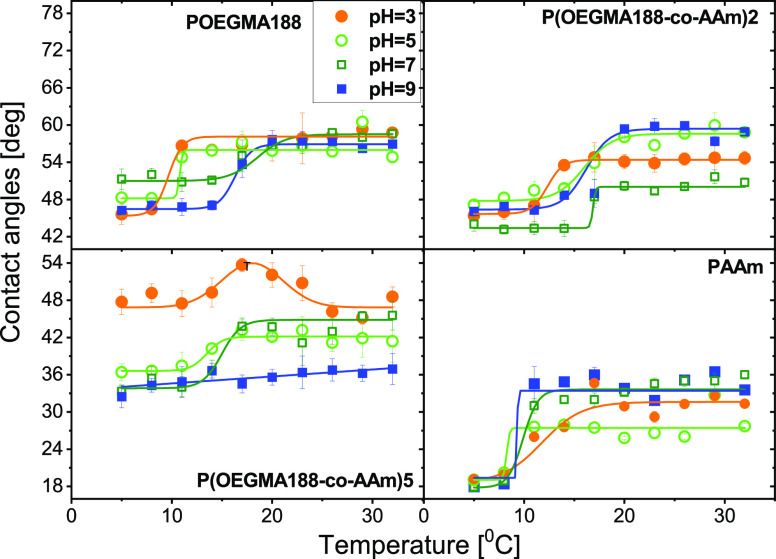
Novel brush coatings were fabricated with glass surface-grafted chains copolymerized using surface-initiated atom transfer radical polymerization (SI-ATRP) from 2-(2-methoxyethoxy)ethyl methacrylate (OEGMA188) and acrylamide (AAm), taken in different proportions. P(OEGMA188--AAm) brushes with AAm mole fraction >44% (determined with XPS and TOF-SIMS spectroscopy) and nearly constant with the depth copolymer composition (TOF-SIMS profiling) exhibit unusual temperature-induced transformations: The contact angle of water droplets on P(OEGMA188--AAm) coatings increases by ∼45° with temperature, compared to 17-18° for POEGMA188 and PAAm. The thickness of coatings immersed in water and the morphology of coatings imaged in air show a temperature response for POEGMA188 (using reflectance spectroscopy and AFM, respectively), but this response is weak for P(OEGMA188--AAm) and absent for PAAm. This suggests mechanisms more complex than a simple transition between hydrated loose coils and hydrophobic collapsed chains. For POEGMA188, the hydrogen bonds between the ether oxygens of poly(ethylene glycol) and water hydrogens are formed below the transition temperature and disrupted above when polymer-polymer interactions are favored. Different hydrogen bond structures of PAAm include free amide groups, -multimers, and -multimers of amide groups. Here, hydrogen bonds between free amide groups and water dominate at < but structures favored at > , such as -multimers and -multimers of amide groups, can still be hydrated. The enhanced temperature-dependent response of wettability for P(OEGMA188--AAm) with a high mole fraction of AAm suggests the formation at of more hydrophobic structures, realized by hydrogen bonding between the ether oxygens of OEGMA188 and the amide fragments of AAm, where water molecules are caged. Furthermore, P(OEGMA188--AAm) coatings immersed in pH buffer solutions exhibit a 'schizophrenic' behavior in wettability, with transitions that mimic LCST and UCST for pH = 3, LCST for pH = 5 and 7, and any transition blocked for pH = 9.
新型刷状涂层是通过表面引发原子转移自由基聚合(SI-ATRP)从 2-(2-甲氧基乙氧基)乙基甲基丙烯酸酯(OEGMA188)和丙烯酰胺(AAm)共聚合成的玻璃表面接枝链,两者的比例不同。AAm 摩尔分数大于 44%的 P(OEGMA188-AAm)刷(通过 XPS 和 TOF-SIMS 光谱确定),且深度共聚组成几乎保持不变(TOF-SIMS 剖析),表现出异常的温度诱导转变:与 POEGMA188(17-18°)和 PAAm(17-18°)相比,水在 P(OEGMA188-AAm)涂层上的接触角随温度升高增加约 45°。分别用水浸泡的涂层厚度和在空气中成像的涂层形貌(分别使用反射光谱和 AFM)显示出 POEGMA188 的温度响应,但对于 P(OEGMA188-AAm)和 PAAm 则响应较弱。这表明机制比简单的水合疏松线圈和疏水性塌陷链之间的转变更为复杂。对于 POEGMA188,聚(乙二醇)醚氧与水氢之间的氢键在低于转变温度时形成,当聚合物-聚合物相互作用有利时,在高于转变温度时被破坏。PAAm 的不同氢键结构包括游离酰胺基、-多聚体和酰胺基的-多聚体。在这里,在 < 时,游离酰胺基与水之间的氢键占主导地位,但在 > 时,如酰胺基的-多聚体和-多聚体等结构仍然可以水合。高 AAm 摩尔分数的 P(OEGMA188-AAm)的润湿性对温度的依赖性增强表明,在 时形成了更多的疏水性结构,这是通过 OEGMA188 的醚氧与 AAm 的酰胺片段之间的氢键实现的,其中水分子被笼状困住。此外,浸入 pH 缓冲溶液中的 P(OEGMA188-AAm)涂层在润湿性方面表现出“分裂”行为,其转变类似于 pH = 3 时的 LCST 和 UCST、pH = 5 和 7 时的 LCST,以及 pH = 9 时的任何转变都被阻止。