National Crime Victims Research and Treatment Center, Medical University of South Carolina, Charleston, SC, USA.
National Crime Victims Research and Treatment Center, Medical University of South Carolina, Charleston, SC, USA.
J Psychiatr Res. 2023 Apr;160:180-186. doi: 10.1016/j.jpsychires.2023.02.018. Epub 2023 Feb 16.
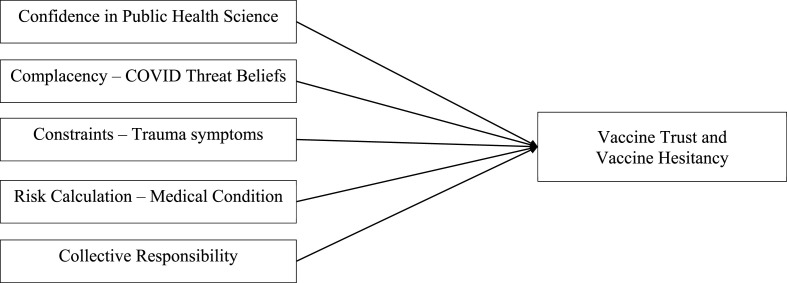
Vaccine hesitancy is a serious threat to global health; however, significant COVID-19 vaccine hesitancy exists throughout the United States. The 5C model, which postulates five person-level determinants for vaccine hesitancy - confidence, complacency, constraints, risk calculation, and collective responsibility - provides one theoretical way of understanding COVID-19 vaccine hesitancy. The present study examined the effects of these 5C drivers of vaccine behavior on early vaccine adoption and vaccine intentions above and beyond theoretically salient demographic characteristics and compared these associations across a National sample (n = 1634) and a statewide sample from South Carolina (n = 784) - a state with documented low levels of COVID-19 vaccination uptake. This study used quantitative and qualitative data collected in October 2020 to January 2021 from the MFour-Mobile Research Panel, a large, representative non-probability sample of adult smartphone users. Overall, the South Carolina sample reported lower COVID-19 vaccine intentions and higher levels of 5C barriers to vaccine uptake compared to the National sample. Findings further indicated that both demographic characteristics (race) and certain drivers of vaccine behavior (confidence and collective responsibility) are associated with vaccine trust and intentions across samples above and beyond other variables. Qualitative data indicated that COVID-19 vaccine hesitancy was driven by fears about the quick vaccine development, limited research, and potential side effects. Although there are some limitations to the cross-sectional survey data, the present study offers valuable insight into factors associated with early COVID-19 vaccine hesitancy across the United States.
疫苗犹豫是全球健康的严重威胁;然而,美国各地都存在着严重的 COVID-19 疫苗犹豫情绪。5C 模型假设了疫苗犹豫的五个个人层面的决定因素 - 信心、自满、限制、风险计算和集体责任 - 为理解 COVID-19 疫苗犹豫提供了一种理论方法。本研究考察了这些疫苗行为的 5C 驱动因素对早期疫苗接种和疫苗接种意愿的影响,超出了理论上显著的人口特征,并在全国样本(n=1634)和南卡罗来纳州的全州样本(n=784)中比较了这些关联 - 一个有记录表明 COVID-19 疫苗接种率低的州。本研究使用了 2020 年 10 月至 2021 年 1 月期间从 MFour-Mobile Research Panel 收集的定量和定性数据,这是一个大型、代表性的成年智能手机用户的非概率样本。总体而言,与全国样本相比,南卡罗来纳州的样本报告的 COVID-19 疫苗接种意愿较低,而 5C 疫苗接种障碍水平较高。研究结果进一步表明,除了其他变量之外,人口特征(种族)和某些疫苗行为驱动因素(信心和集体责任)与疫苗信任和意愿在样本中均有关联。定性数据表明,COVID-19 疫苗犹豫是由对快速疫苗开发、有限的研究和潜在副作用的担忧所驱动。尽管横断面调查数据存在一些局限性,但本研究为理解美国各地与早期 COVID-19 疫苗犹豫相关的因素提供了有价值的见解。