Beyer Robert C M, Jain Tarun, Sinha Sonalika
World Bank, India.
Indian Institute of Management Ahmedabad, India.
J Asian Econ. 2023 Apr;85:101589. doi: 10.1016/j.asieco.2023.101589. Epub 2023 Feb 15.
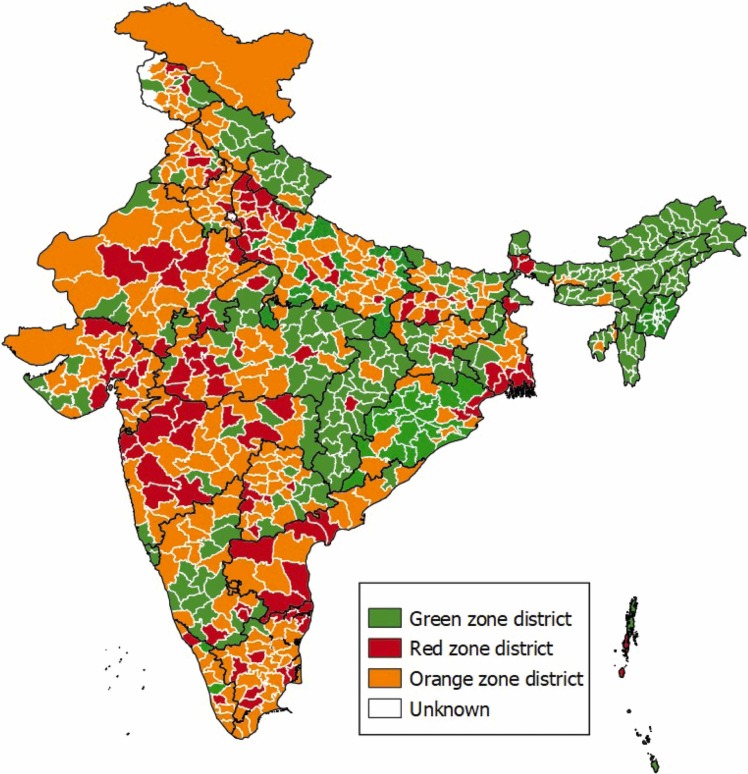
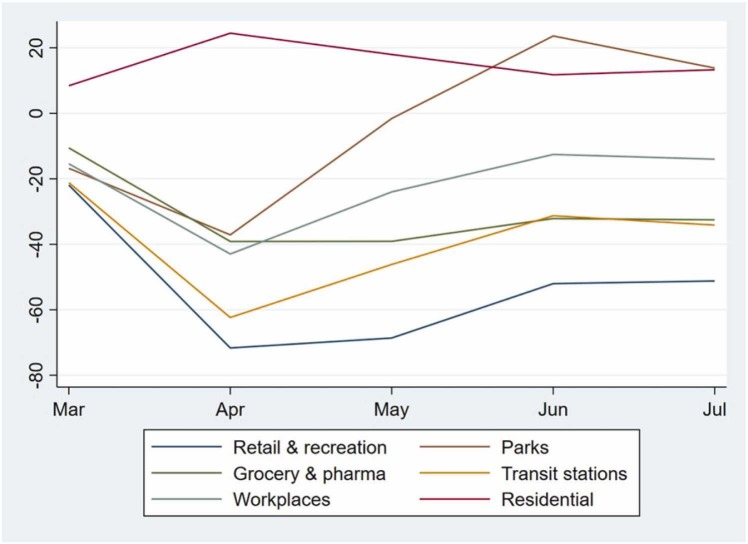
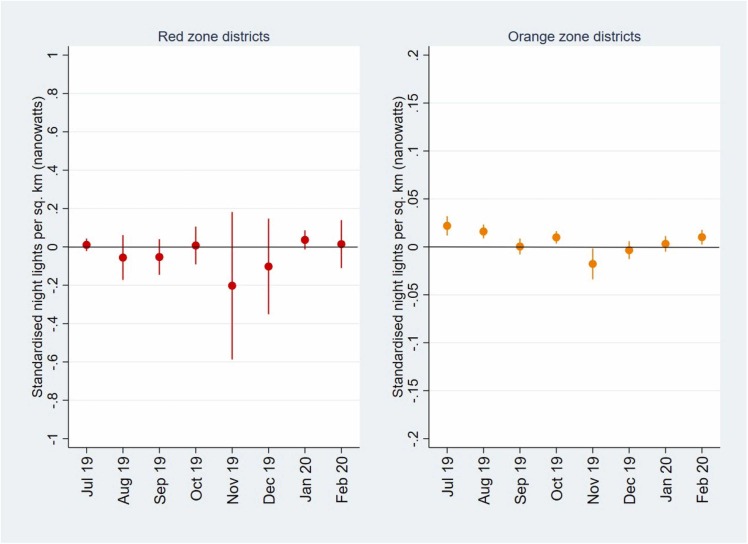
This paper estimates how strongly COVID-19 containment policies have impacted aggregate economic activity. We use a difference-in-differences methodology to estimate how containment zones of different severity across India impacted district-level nighttime light intensity, as well as household income and consumption. From May to July 2020, nighttime light intensity was 9.1 % lower in districts with the most severe restrictions compared with districts with the least severe restrictions, which could imply between 5.8 % and 6.6 % lower GDP. Nighttime light intensity was only 1.6 % lower in districts with intermediate restrictions. The differences were largest in May during the graded lockdown, and tapered in June and July. Lower house-hold income and consumption corresponding to zone-wise restrictions corroborate these results. Stricter containment measures had larger impacts in districts with greater population density, older residents, and more services employment. The large magnitudes of the findings suggest that governments should carefully consider the economic costs of country-wide pandemic containment policies while weighing the trade-offs against public health benefits. Keywords: Containment policies, COVID-19, Nighttime lights, India.
本文估计了新冠疫情防控政策对总体经济活动的影响程度。我们采用双重差分法来估计印度不同严重程度的防控区域对地区层面夜间灯光强度以及家庭收入和消费的影响。2020年5月至7月,与限制最宽松的地区相比,限制最严格地区的夜间灯光强度低9.1%,这可能意味着GDP降低5.8%至6.6%。限制程度中等的地区夜间灯光强度仅低1.6%。这些差异在分阶段封锁的5月份最大,在6月和7月逐渐缩小。与分区限制相对应的家庭收入和消费降低证实了这些结果。在人口密度更大、居民年龄更大以及服务业就业更多的地区,更严格的防控措施产生的影响更大。研究结果的巨大幅度表明,政府在权衡全国性疫情防控政策与公共卫生效益之间的利弊时,应仔细考虑这些政策的经济成本。关键词:防控政策;新冠疫情;夜间灯光;印度