Centre for Nanotechnology, Indian Institute of Technology Guwahati, Guwahati 781039, India.
Department of Physics, Indian Institute of Technology Guwahati, Guwahati 781039, India.
Biosensors (Basel). 2023 Jan 21;13(2):169. doi: 10.3390/bios13020169.
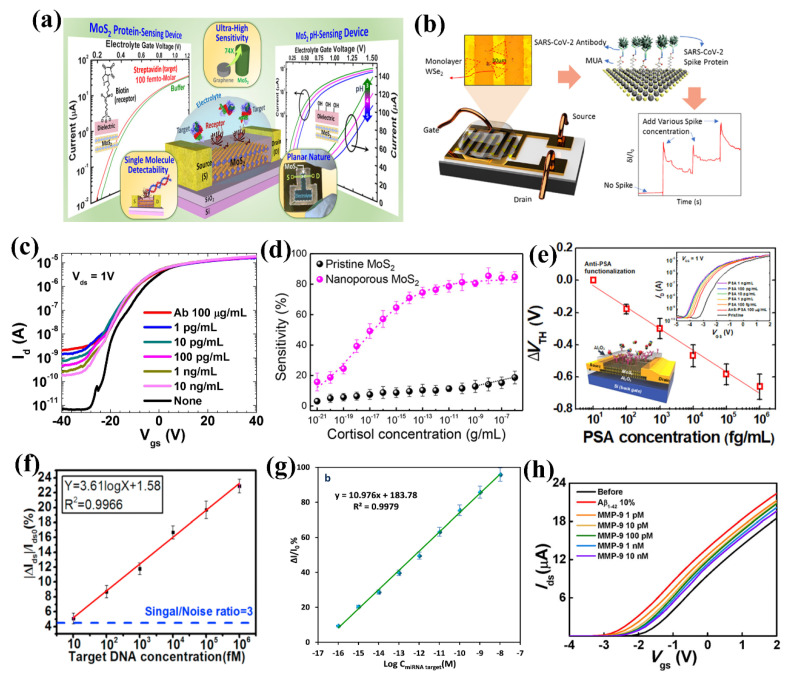
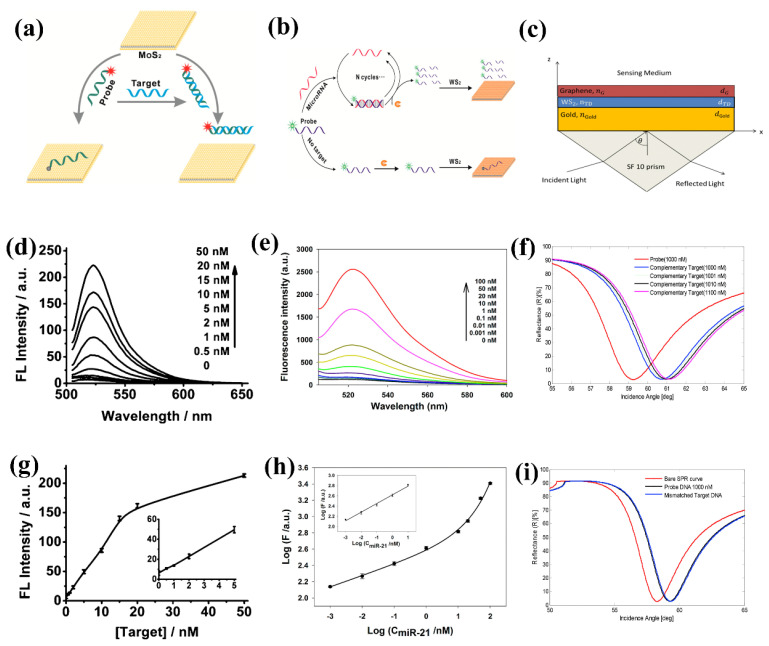
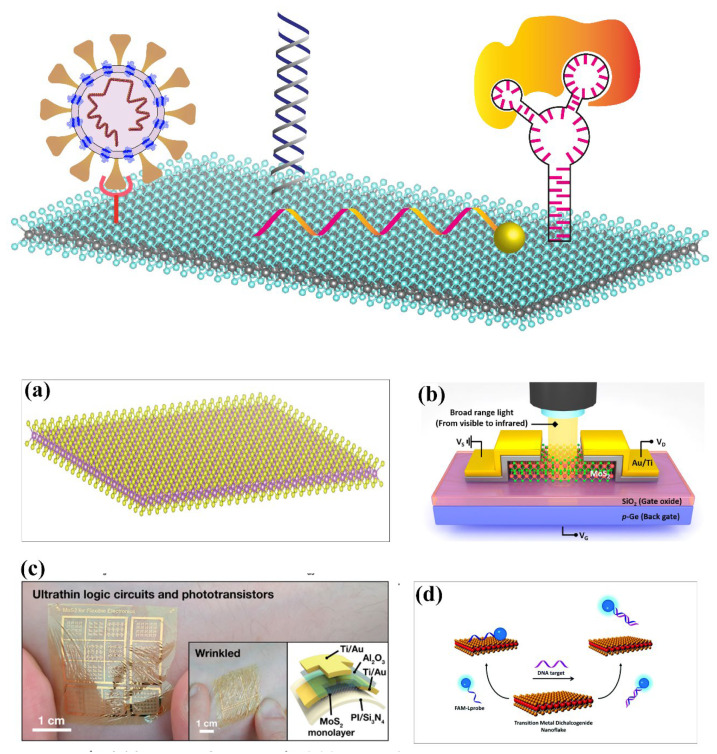
There has been an exponential surge in reports on two-dimensional (2D) materials ever since the discovery of graphene in 2004. Transition metal dichalcogenides (TMDs) are a class of 2D materials where weak van der Waals force binds individual covalently bonded X-M-X layers (where M is the transition metal and X is the chalcogen), making layer-controlled synthesis possible. These individual building blocks (single-layer TMDs) transition from indirect to direct band gaps and have fascinating optical and electronic properties. Layer-dependent opto-electrical properties, along with the existence of finite band gaps, make single-layer TMDs superior to the well-known graphene that paves the way for their applications in many areas. Ultra-fast response, high on/off ratio, planar structure, low operational voltage, wafer scale synthesis capabilities, high surface-to-volume ratio, and compatibility with standard fabrication processes makes TMDs ideal candidates to replace conventional semiconductors, such as silicon, etc., in the new-age electrical, electronic, and opto-electronic devices. Besides, TMDs can be potentially utilized in single molecular sensing for early detection of different biomarkers, gas sensors, photodetector, and catalytic applications. The impact of COVID-19 has given rise to an upsurge in demand for biosensors with real-time detection capabilities. TMDs as active or supporting biosensing elements exhibit potential for real-time detection of single biomarkers and, hence, show promise in the development of point-of-care healthcare devices. In this review, we provide a historical survey of 2D TMD-based biosensors for the detection of bio analytes ranging from bacteria, viruses, and whole cells to molecular biomarkers via optical, electronic, and electrochemical sensing mechanisms. Current approaches and the latest developments in the study of healthcare devices using 2D TMDs are discussed. Additionally, this review presents an overview of the challenges in the area and discusses the future perspective of 2D TMDs in the field of biosensing for healthcare devices.
自 2004 年发现石墨烯以来,二维(2D)材料的报道呈指数级增长。过渡金属二卤化物(TMDs)是一类 2D 材料,其中较弱的范德华力将单个共价键合的 X-M-X 层(其中 M 是过渡金属,X 是卤族元素)结合在一起,从而实现层控合成。这些单个构建块(单层 TMDs)从间接带隙转变为直接带隙,具有迷人的光学和电子特性。依赖于层的光电特性以及有限的带隙的存在,使得单层 TMDs 优于众所周知的石墨烯,为它们在许多领域的应用铺平了道路。超快速响应、高开关比、平面结构、低工作电压、晶圆级合成能力、高表面积与体积比以及与标准制造工艺的兼容性,使得 TMDs 成为替代传统半导体(如硅等)的理想候选材料,用于新型电气、电子和光电子器件。此外,TMDs 可潜在用于单分子传感,以实现对不同生物标志物、气体传感器、光电探测器和催化应用的早期检测。COVID-19 的影响导致对具有实时检测能力的生物传感器的需求激增。TMDs 作为活性或支持生物传感元件,在实时检测单个生物标志物方面表现出潜力,因此在开发即时医疗保健设备方面具有广阔的前景。在本综述中,我们提供了基于二维 TMD 的生物传感器用于检测生物分析物的历史调查,这些生物分析物的范围从细菌、病毒和整个细胞到分子生物标志物,通过光学、电子和电化学传感机制。讨论了当前的方法和使用二维 TMDs 研究医疗保健设备的最新进展。此外,本文综述了该领域面临的挑战,并讨论了二维 TMDs 在医疗保健设备生物传感领域的未来前景。