Qi Qiaoyun, Hu Bichun, Jiang Weiyu, Wang Yixiong, Yan Jinjiao, Ma Fengwang, Guan Qingmei, Xu Jidi
State Key Laboratory of Crop Stress Biology for Arid Areas/Shaanxi Key Laboratory of Apple, College of Horticulture, Northwest A&F University, Xianyang 712100, China.
College of Forestry, Northwest A&F University, Xianyang 712100, China.
Int J Mol Sci. 2023 Feb 8;24(4):3442. doi: 10.3390/ijms24043442.
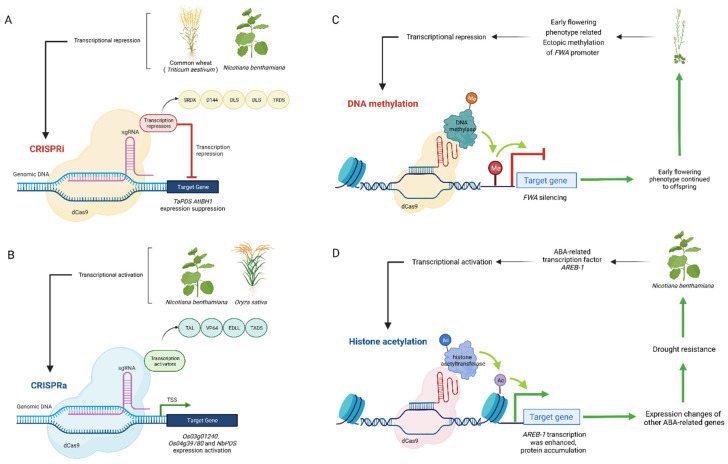
Plant epistatic regulation is the DNA methylation, non-coding RNA regulation, and histone modification of gene sequences without altering the genome sequence, thus regulating gene expression patterns and the growth process of plants to produce heritable changes. Epistatic regulation in plants can regulate plant responses to different environmental stresses, regulate fruit growth and development, etc. Genome editing can effectively improve plant genetic efficiency by targeting the design and efficient editing of genome-specific loci with specific nucleases, such as zinc finger nucleases (ZFNs), transcription activator-like effector nucleases (TALEN), and clustered regularly interspaced short palindromic repeats/CRISPR-associated 9 (CRISPR/Cas9). As research progresses, the CRISPR/Cas9 system has been widely used in crop breeding, gene expression, and epistatic modification due to its high editing efficiency and rapid translation of results. In this review, we summarize the recent progress of CRISPR/Cas9 in epigenome editing and look forward to the future development direction of this system in plant epigenetic modification to provide a reference for the application of CRISPR/Cas9 in genome editing.
植物上位性调控是指在不改变基因组序列的情况下,对基因序列进行DNA甲基化、非编码RNA调控和组蛋白修饰,从而调控基因表达模式和植物的生长过程,产生可遗传的变化。植物中的上位性调控可以调节植物对不同环境胁迫的反应,调控果实的生长发育等。基因组编辑可以通过使用特定核酸酶(如锌指核酸酶(ZFNs)、转录激活样效应物核酸酶(TALEN)和成簇规律间隔短回文重复序列/CRISPR相关蛋白9(CRISPR/Cas9))对基因组特定位点进行靶向设计和高效编辑,有效地提高植物遗传效率。随着研究的进展,CRISPR/Cas9系统因其高编辑效率和结果快速转化,已广泛应用于作物育种、基因表达和上位性修饰。在本综述中,我们总结了CRISPR/Cas9在表观基因组编辑方面的最新进展,并展望了该系统在植物表观遗传修饰中的未来发展方向,为CRISPR/Cas9在基因组编辑中的应用提供参考。