Fernandes Vanessa, Rodrigues Filipe, Jacinto Miguel, Teixeira Diogo, Cid Luís, Antunes Raul, Matos Rui, Reigal Rafael, Hernández-Mendo Antonio, Morales-Sánchez Verónica, Monteiro Diogo
ESECS-Polytechnic of Leiria, 2411-901 Leiria, Portugal.
Life Quality Research Centre (CIEQV), 2040-413 Leiria, Portugal.
Life (Basel). 2023 Jan 20;13(2):298. doi: 10.3390/life13020298.
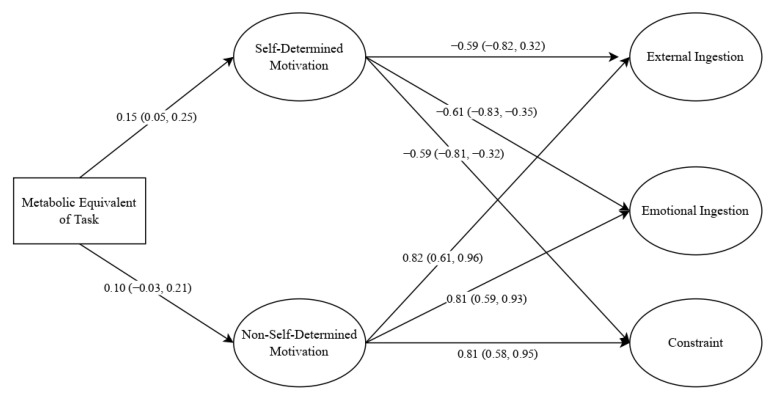
Physical activity and diet are two predominant determinants of population health status that may influence each other. Physical activity has been identified as a behavior that may lead to a healthier diet and regulates eating behaviors. This research aimed to investigate how the level of physical activity is associated with the motivation related to eating behaviors and, consequently, the eating style individuals have on a daily basis. This was a cross-sectional study in which participants completed an online questionnaire that assessed the following variables: the level of physical activity, the motivation toward eating behavior, and the type of eating behavior. In total, 440 individuals (180 men and 260 women) who regularly exercised in gyms and fitness centers aged between 19 and 64 years (M = 33.84; SD = 10.09) took part in the study. The data were collected following the Declaration of Helsinki and with the approval of the Ethics Committee of the Polytechnic of Leiria. For the statistical analysis, mean and standard deviations were first calculated, as well as bivariate correlations between all the variables of interest. Then, structural equation model analyses were performed considering the levels of physical activity as the independent variable, motivations toward eating behavior as the mediators, and eating styles as the dependent variables. It was concluded that a greater level of physical activity leads to a more self-determined type of eating regulation, which in turn results in less constricted eating behaviors that are influenced by external factors and emotional factors.
身体活动和饮食是可能相互影响的人口健康状况的两个主要决定因素。身体活动已被确定为一种可能导致更健康饮食并调节饮食行为的行为。本研究旨在调查身体活动水平如何与饮食行为相关动机相关联,进而与个体日常的饮食方式相关联。这是一项横断面研究,参与者完成了一份在线问卷,该问卷评估了以下变量:身体活动水平、饮食行为动机和饮食行为类型。共有440名年龄在19至64岁之间(M = 33.84;SD = 10.09)、经常在健身房和健身中心锻炼的人(180名男性和260名女性)参与了该研究。数据收集遵循《赫尔辛基宣言》并获得了莱里亚理工学院伦理委员会的批准。对于统计分析,首先计算均值和标准差,以及所有感兴趣变量之间的双变量相关性。然后进行结构方程模型分析,将身体活动水平作为自变量,饮食行为动机作为中介变量,饮食方式作为因变量。研究得出结论,更高水平的身体活动会导致更自主的饮食调节类型,进而导致受外部因素和情绪因素影响的受限饮食行为减少。