Khakpour Elnaz, Salehi Saba, Naghib Seyed Morteza, Ghorbanzadeh Sadegh, Zhang Wei
Nanotechnology Department, School of Advanced Technologies, Iran University of Science and Technology and Biomaterials and Tissue Engineering Department, Breast Cancer Research Center, Motamed Cancer Institute, IUST, ACECR, Tehran, Iran.
State Key Laboratory of Structure Analysis for Industrial Equipment, Department of Engineering Mechanics, Dalian University of Technology, Dalian, China.
Front Bioeng Biotechnol. 2023 Feb 9;11:1129768. doi: 10.3389/fbioe.2023.1129768. eCollection 2023.
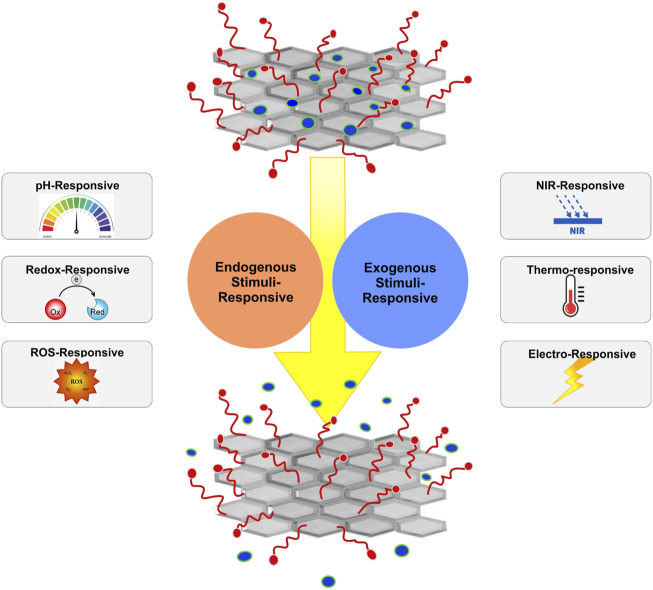
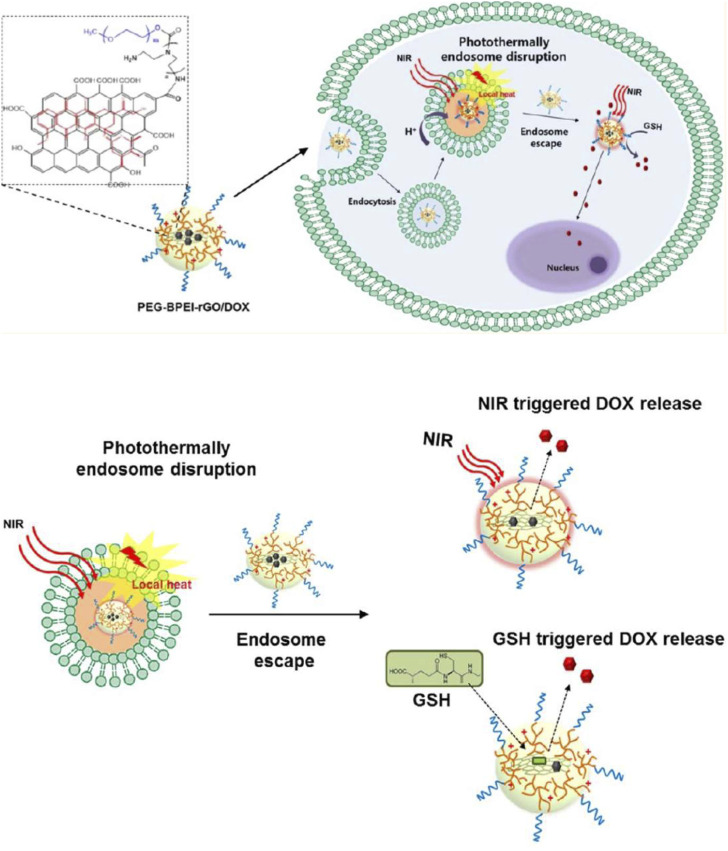
Stimuli-responsive drug delivery has attracted tremendous attention in the past decades. It provides a spatial- and temporal-controlled release in response to different triggers, thus enabling highly efficient drug delivery and minimizing drug side effects. Graphene-based nanomaterials have been broadly explored, and they show great potential in smart drug delivery due to their stimuli-responsive behavior and high loading capacity for an extended range of drug molecules. These characteristics are a result of high surface area, mechanical stability and chemical stability, and excellent optical, electrical, and thermal properties. Their great and infinite functionalization potential also allows them to be integrated into several types of polymers, macromolecules, or other nanoparticles, leading to the fabrication of novel nanocarriers with enhanced biocompatibility and trigger-sensitive properties. Thus, numerous studies have been dedicated to graphene modification and functionalization. In the current review, we introduce graphene derivatives and different graphene-based nanomaterials utilized in drug delivery and discuss the most important advances in their functionalization and modification. Also, their potential and progress in an intelligent drug release in response to different types of stimuli either endogenous (pH, redox conditions, and reactive oxygen species (ROS)) or exogenous (temperature, near-infrared (NIR) radiation, and electric field) will be debated.
在过去几十年中,刺激响应型药物递送引起了极大关注。它能够根据不同触发因素实现空间和时间上的可控释放,从而实现高效药物递送并将药物副作用降至最低。基于石墨烯的纳米材料已得到广泛研究,由于其刺激响应行为以及对多种药物分子的高负载能力,它们在智能药物递送方面展现出巨大潜力。这些特性源于其高比表面积、机械稳定性和化学稳定性,以及优异的光学、电学和热学性能。它们巨大且无限的功能化潜力还使其能够与多种类型的聚合物、大分子或其他纳米颗粒整合,从而制备出具有增强生物相容性和触发敏感性的新型纳米载体。因此,众多研究致力于石墨烯的修饰和功能化。在本综述中,我们介绍了用于药物递送的石墨烯衍生物和不同的基于石墨烯的纳米材料,并讨论了它们功能化和修饰方面最重要的进展。此外,还将探讨它们在响应内源性(pH值、氧化还原条件和活性氧(ROS))或外源性(温度、近红外(NIR)辐射和电场)不同类型刺激时实现智能药物释放的潜力和进展。