Tolstova Tatiana, Drozdova Maria, Popyrina Tatiana, Matveeva Diana, Demina Tatiana, Akopova Tatiana, Andreeva Elena, Markvicheva Elena
Shemyakin-Ovchinnikov Institute of Bioorganic Chemistry, Russian Academy of Sciences, 16/10 Miklukho-Maklaya Str., 117997 Moscow, Russia.
Institute of Biomedical Chemistry, 10 bld. 8, Pogodinskaya Str., 119121 Moscow, Russia.
Polymers (Basel). 2023 Feb 11;15(4):907. doi: 10.3390/polym15040907.
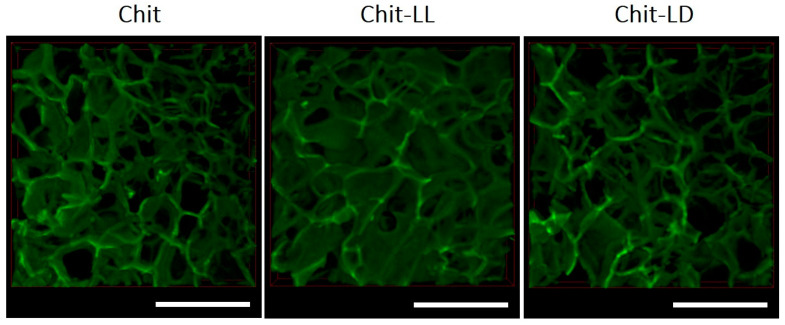
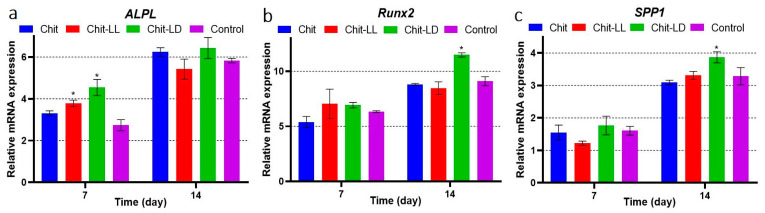
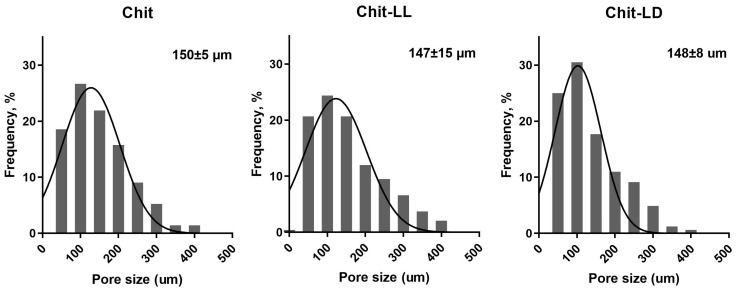
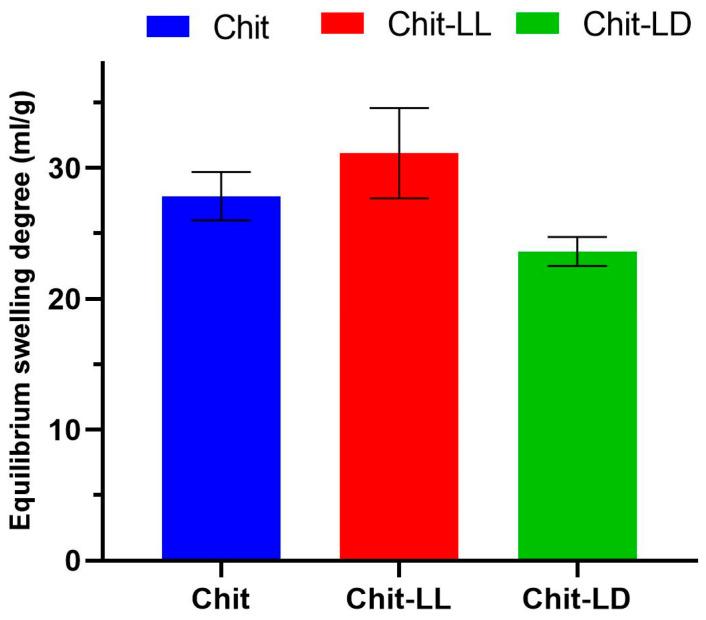
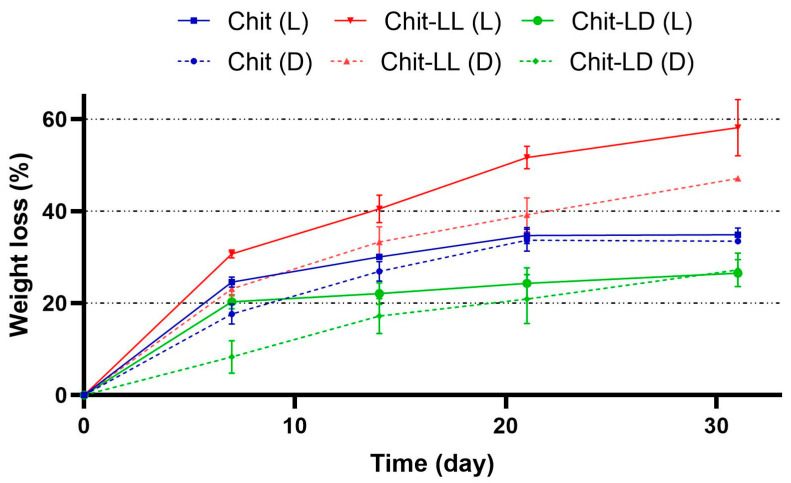
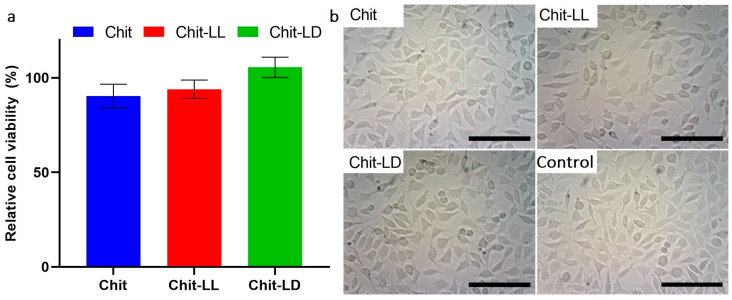
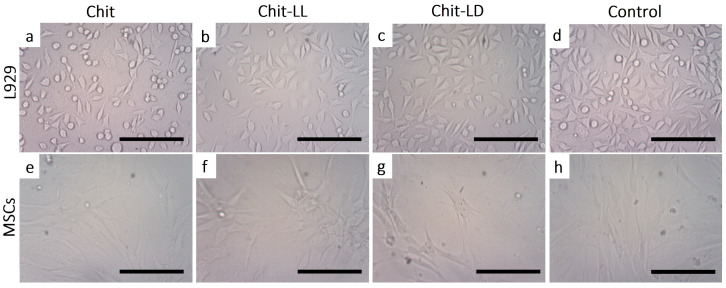
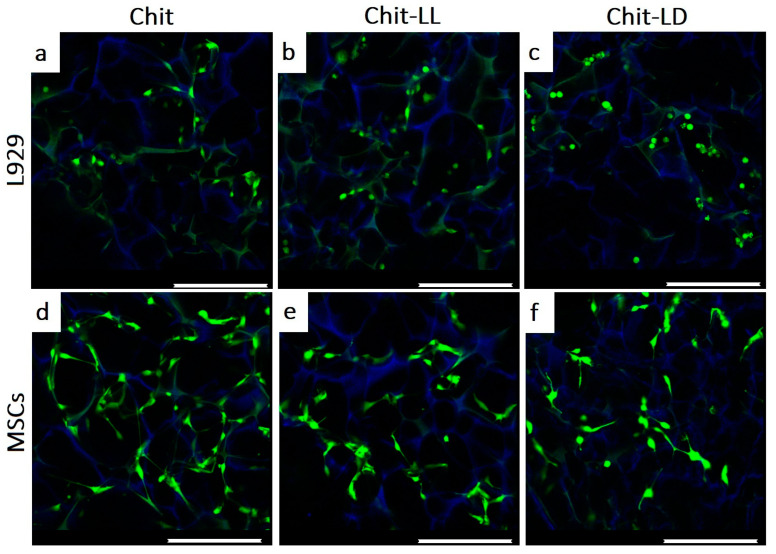
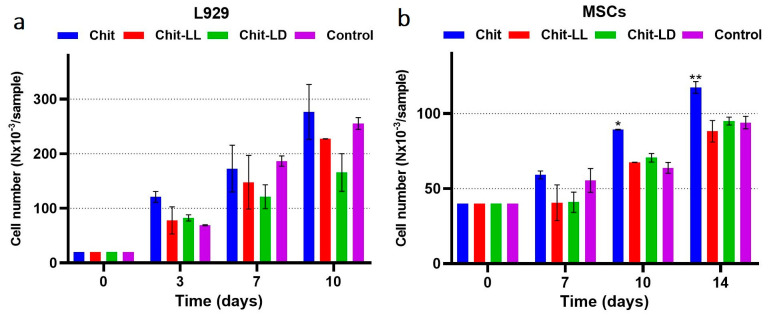
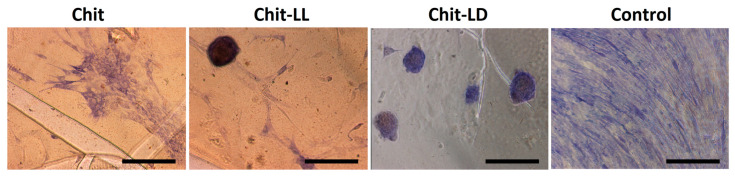
In the current study, novel matrices based on chitosan-g-oligo (L,L-/L,D-lactide) copolymers were fabricated. In particular, 2D films were prepared by solvent casting, while 3D macroporous hydrogels were obtained by lyophilization of copolymer solutions. Copolymers of chitosan (Chit) with semi-crystalline oligo (L,L-lactide) (Chit-LL) or amorphous oligo (L,D-lactide) (Chit-LD) were obtained by solid-state mechanochemical synthesis. The structure of the hydrogels was found to be a system of interconnected macropores with an average size of 150 μm. In vitro degradation of these copolymer-based matrices was shown to increase in the case of the Chit-LL-based hydrogel by 34% and decrease for the Chit-LD-based hydrogel by 23% compared to the parameter of the Chit sample. Localization and distribution of mouse fibroblast L929 cells and adipose tissue-derived mesenchymal stromal cells (MSCs) within the hydrogels was studied by confocal laser scanning microscopy (CLSM). Moreover, cellular response, namely cell adhesion, spreading, growth, proliferation, as well as cell differentiation in vitro were also evaluated in the hydrogels for 10-14 days. Both the Chit-LL and Chit-LD matrices were shown to support cell growth and proliferation, while they had improved swelling compared to the Chit matrix. Osteogenic MSCs differentiation on the copolymer-based films was studied by quantitative reverse-transcriptase polymerase chain reaction (qRT-PCR). Maximal expression levels of osteogenesis markers (alkaline phosphatase (), bone transcription factor (2), and osteopontin (1) were revealed for the Chit-LD films. Thus, osteodifferentiation was demonstrated to depend on the film composition. Both Chit-LL and Chit-LD copolymer-based matrices are promising for tissue engineering.
在当前研究中,制备了基于壳聚糖-g-寡聚(L,L-/L,D-丙交酯)共聚物的新型基质。具体而言,通过溶剂浇铸制备二维薄膜,而通过共聚物溶液冻干获得三维大孔水凝胶。壳聚糖(Chit)与半结晶寡聚(L,L-丙交酯)(Chit-LL)或无定形寡聚(L,D-丙交酯)(Chit-LD)的共聚物通过固态机械化学合成获得。发现水凝胶的结构是一个相互连接的大孔系统,平均尺寸为150μm。与Chit样品的参数相比,基于Chit-LL的水凝胶中这些基于共聚物的基质的体外降解显示增加了34%,而基于Chit-LD的水凝胶则减少了23%。通过共聚焦激光扫描显微镜(CLSM)研究了小鼠成纤维细胞L929和脂肪组织来源的间充质基质细胞(MSCs)在水凝胶中的定位和分布。此外,还在水凝胶中评估了10-14天的细胞反应,即细胞粘附、铺展、生长、增殖以及体外细胞分化。Chit-LL和Chit-LD基质均显示支持细胞生长和增殖,同时与Chit基质相比具有改善的溶胀性能。通过定量逆转录酶聚合酶链反应(qRT-PCR)研究了基于共聚物的薄膜上成骨MSCs的分化。Chit-LD薄膜显示出成骨标志物(碱性磷酸酶()、骨转录因子(2)和骨桥蛋白(1)的最大表达水平。因此,证明骨分化取决于薄膜组成。基于Chit-LL和Chit-LD共聚物的基质在组织工程中都很有前景。