Ghosh Soumya, Rusyn Iryna, Dmytruk Olena V, Dmytruk Kostyantyn V, Onyeaka Helen, Gryzenhout Marieka, Gafforov Yusufjon
Department of Genetics, Faculty of Natural and Agricultural Sciences, University of the Free State, Bloemfontein, South Africa.
Department of Ecology and Sustainaible Environmental Management, Viacheslav Chornovil Institute of Sustainable Development, Lviv Polytechnic National University, Lviv, Ukraine.
Front Bioeng Biotechnol. 2023 Feb 14;11:1106973. doi: 10.3389/fbioe.2023.1106973. eCollection 2023.
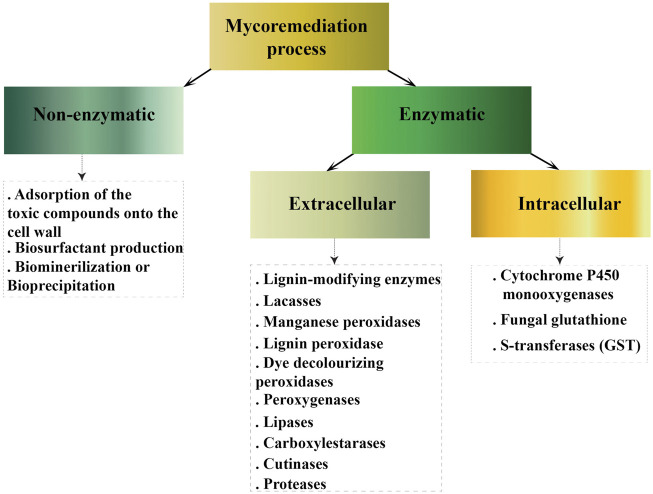
This review presents a comprehensive summary of the latest research in the field of bioremediation with filamentous fungi. The main focus is on the issue of recent progress in remediation of pharmaceutical compounds, heavy metal treatment and oil hydrocarbons mycoremediation that are usually insufficiently represented in other reviews. It encompasses a variety of cellular mechanisms involved in bioremediation used by filamentous fungi, including bio-adsorption, bio-surfactant production, bio-mineralization, bio-precipitation, as well as extracellular and intracellular enzymatic processes Processes for wastewater treatment accomplished through physical, biological, and chemical processes are briefly described. The species diversity of filamentous fungi used in pollutant removal, including widely studied species of , , , , and other species of Basidiomycota and Zygomycota are summarized. The removal efficiency of filamentous fungi and time of elimination of a wide variety of pollutant compounds and their easy handling make them excellent tools for the bioremediation of emerging contaminants. Various types of beneficial byproducts made by filamentous fungi, such as raw material for feed and food production, chitosan, ethanol, lignocellulolytic enzymes, organic acids, as well as nanoparticles, are discussed. Finally, challenges faced, future prospects, and how innovative technologies can be used to further exploit and enhance the abilities of fungi in wastewater remediation, are mentioned.
本综述全面总结了丝状真菌在生物修复领域的最新研究。主要关注药物化合物修复、重金属处理和石油烃真菌修复方面的最新进展,这些内容在其他综述中通常较少涉及。它涵盖了丝状真菌用于生物修复的多种细胞机制,包括生物吸附、生物表面活性剂产生、生物矿化、生物沉淀以及细胞外和细胞内酶促过程。简要描述了通过物理、生物和化学过程实现的废水处理工艺。总结了用于去除污染物的丝状真菌的物种多样性,包括广泛研究的曲霉属、青霉属、根霉属、毛霉属、木霉属以及担子菌门和接合菌门的其他物种。丝状真菌对各种污染物化合物的去除效率和消除时间以及其易于处理的特点,使其成为新兴污染物生物修复的优秀工具。讨论了丝状真菌产生的各种有益副产物,如饲料和食品生产原料、壳聚糖、乙醇、木质纤维素分解酶、有机酸以及纳米颗粒。最后,提及了面临的挑战、未来前景以及如何利用创新技术进一步开发和增强真菌在废水修复中的能力。