Department of Sense Organs, Sapienza University of Rome, Viale del Policlinico 155, 00186, Rome, Italy.
Department of Oral and Maxillofacial Sciences, Sapienza University of Rome, Rome, Italy.
Eur Arch Otorhinolaryngol. 2023 Jul;280(7):3329-3335. doi: 10.1007/s00405-023-07897-y. Epub 2023 Mar 6.
Pleomorphic adenoma (mixed tumor) is the most common neoplasm of the parotid gland and one of the most frequent types of salivary gland tumor, generally with benign behavior and relatively slow growing. The adenomas could arise from the superficial, deep or from both superficial and deep parotid's lobes.
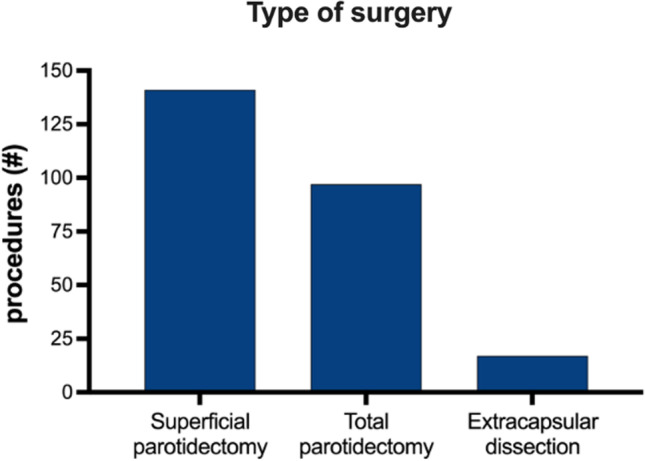
The aim of this review is to retrospectively analyze the surgical management of patients with pleomorphic adenoma of the parotid gland performed at the Department of Otorhinolaryngology (Department of Sense Organs of "Azienda Policlinico Umberto I" in Rome), from 2010 to 2020, with a focus on the percentage of recurrence and on the complication related to surgery to suggest an optimal diagnostic and therapeutic algorithm for patients with recurrent pleomorphic adenoma. The analysis of the complications observed in case of different surgical approaches was performed using the X test.
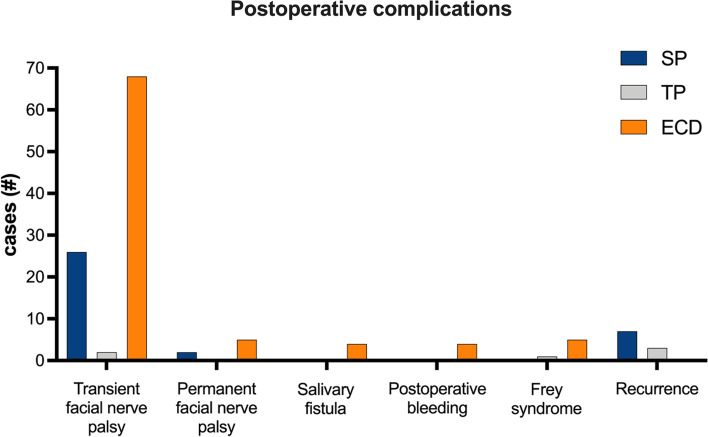
The choice of a surgical approach (superficial parotidectomy-SP, total parotidectomy-TP, extracapsular dissection-ECD) depends on several elements, such as the location and the size of the adenoma, the availability of existing technical facilities and the professional experience of the surgeon. A transient facial palsy was present in 37.6%, 2.7% reported a permanent facial nerve palsy, 1.6% developed a salivary fistula, 1.6% a post-operative bleeding and 2.3% showed Frey Syndrome.
The surgical management of this benign lesion is required, even in asymptomatic cases, to prevent the progressive growing and to reduce the risk of malignant transformation. The goal of surgical excision is to obtain the complete resection to minimize the risk of tumor recurrence and avoiding facial nerve disability. Therefore, an accurate preoperative study of the lesion and the choice of the most appropriate surgical treatment are essential to minimize the rate of recurrence.
多形性腺瘤(混合瘤)是腮腺最常见的肿瘤,也是最常见的涎腺肿瘤类型之一,通常具有良性行为且生长相对缓慢。这些腺瘤可能起源于腮腺浅叶、深叶或浅深两叶。
本回顾性研究旨在分析 2010 年至 2020 年期间在罗马“乌姆伯托一世综合医院”耳鼻喉科(感觉器官科)接受腮腺多形性腺瘤手术治疗的患者的外科治疗方法,重点关注复发率和手术相关并发症,以提出适用于复发性多形性腺瘤患者的最佳诊断和治疗方案。使用 X 检验分析不同手术方法观察到的并发症。
手术方法(腮腺浅叶切除术-SP、腮腺全切除术-TP、囊外剥离术-ECD)的选择取决于多个因素,如腺瘤的位置和大小、现有技术设备的可用性以及外科医生的专业经验。暂时性面瘫发生率为 37.6%,永久性面瘫发生率为 2.7%,涎瘘发生率为 1.6%,术后出血发生率为 1.6%,Frey 综合征发生率为 2.3%。
即使是无症状患者,也需要对这种良性病变进行手术治疗,以防止其进行性生长并降低恶性转化的风险。手术切除的目的是获得完全切除,以最大程度地降低肿瘤复发的风险并避免面神经损伤。因此,术前准确研究病变并选择最合适的手术治疗方法对于最大限度地降低复发率至关重要。