Rosner Ann Kristin, van der Sluis Pieter C, Meyer Lena, Wittenmeier Eva, Engelhard Kristin, Grimminger Peter P, Griemert Eva-Verena
Department of Anesthesiology, University Medical Center Mainz, Germany.
Department of General, Visceral- and Transplant Surgery, University Medical Center Mainz, Germany.
Heliyon. 2023 Feb 17;9(3):e13842. doi: 10.1016/j.heliyon.2023.e13842. eCollection 2023 Mar.
Adequate pain control after open esophagectomy is associated with reduced complications, earlier recovery and higher patient satisfaction. While further developing surgical procedures like robot-assisted minimally invasive esophagectomy (RAMIE) it is relevant to adapt postoperative pain management. The primary question of this observational survey was whether one of the two standard treatments, thoracic epidural analgesia (TEA) or intravenous patient-controlled analgesia (PCA), is superior for pain control after RAMIE as the optimal pain management for these patients still remains unclear. Use of additional analgesics, changes in forced expiratory volume in 1 s (FEV1), postoperative complications and duration of intensive care and hospital stay were also analyzed.
This prospective observational pilot study analyzed 50 patients undergoing RAMIE (postoperative PCA with piritramide or TEA using bupivacaine; each n = 25). Patient reported pain using the numeric rating scale score and differences in FEV1 using a micro spirometer were measured at postoperative day 1, 3 and 7. Additional data of secondary endpoints were collected from patient charts.
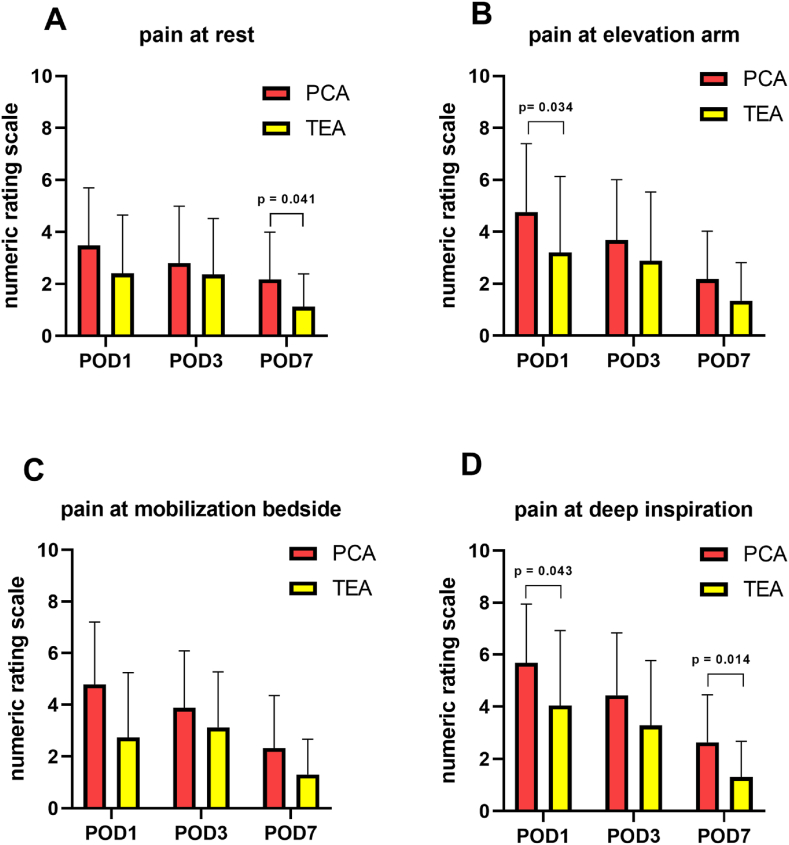
Key demographics, comorbidity, clinical and operative variables were equivalently distributed. Patients receiving TEA had lower pain scores and a longer-lasting pain relief. Moreover, TEA was an independent predictive variable for reduced length of hospital stay (HR -3.560 (95% CI: -6.838 to -0.282), p = 0.034).
Although RAMIE leads to reduced surgical trauma, a less invasive pain therapy with PCA appears to be inferior compared to TEA in case of sufficient postoperative analgesia and length of hospital stay. According to the results of this observational pilot study analgesia with TEA provided better and longer-lasting pain relief compared to PCA. Further randomized controlled trials should be conducted to evaluate the optimal postoperative analgesic treatment for RAMIE.
开放性食管切除术后充分的疼痛控制与并发症减少、恢复加快及患者满意度提高相关。在进一步发展诸如机器人辅助微创食管切除术(RAMIE)等外科手术时,调整术后疼痛管理至关重要。这项观察性调查的主要问题是,对于RAMIE术后的疼痛控制,两种标准治疗方法之一,即胸段硬膜外镇痛(TEA)或静脉自控镇痛(PCA),是否更具优势,因为这些患者的最佳疼痛管理仍不明确。还分析了额外镇痛药的使用、一秒用力呼气量(FEV1)的变化、术后并发症以及重症监护和住院时间。
这项前瞻性观察性试点研究分析了50例行RAMIE的患者(术后使用匹米诺定进行PCA或使用布比卡因进行TEA;每组n = 25)。在术后第1、3和7天,使用数字评分量表评估患者报告的疼痛,并使用微型肺活量计测量FEV1的差异。从患者病历中收集次要终点的其他数据。
关键人口统计学、合并症、临床和手术变量分布均衡。接受TEA的患者疼痛评分更低,疼痛缓解持续时间更长。此外,TEA是住院时间缩短的独立预测变量(HR -3.560(95% CI:-6.838至-0.282),p = 0.034)。
尽管RAMIE导致手术创伤减少,但在术后镇痛充分和住院时间方面,PCA这种侵入性较小的疼痛治疗方法似乎不如TEA。根据这项观察性试点研究的结果,与PCA相比,TEA镇痛效果更好且持续时间更长。应进行进一步的随机对照试验,以评估RAMIE术后的最佳镇痛治疗方法。