• 文献检索
  • 文档翻译
  • 深度研究
  • 学术资讯
  • Suppr Zotero 插件Zotero 插件
  • 邀请有礼
  • 套餐&价格
  • 历史记录
应用&插件
Suppr Zotero 插件Zotero 插件浏览器插件Mac 客户端Windows 客户端微信小程序
定价
高级版会员购买积分包购买API积分包
服务
文献检索文档翻译深度研究API 文档MCP 服务
关于我们
关于 Suppr公司介绍联系我们用户协议隐私条款
关注我们

Suppr 超能文献

核心技术专利:CN118964589B侵权必究
粤ICP备2023148730 号-1Suppr @ 2026

文献检索

告别复杂PubMed语法,用中文像聊天一样搜索,搜遍4000万医学文献。AI智能推荐,让科研检索更轻松。

立即免费搜索

文件翻译

保留排版,准确专业,支持PDF/Word/PPT等文件格式,支持 12+语言互译。

免费翻译文档

深度研究

AI帮你快速写综述,25分钟生成高质量综述,智能提取关键信息,辅助科研写作。

立即免费体验

与巴西原生无刺蜂幼虫食物相关的细菌、酵母和真菌。

Bacteria, yeasts, and fungi associated with larval food of Brazilian native stingless bees.

机构信息

Laboratory of Genetics, Institute of Biotechnology, Federal University of Uberlândia, Uberlândia, Brazil.

Department of Molecular Medicine, University of Rome La Sapienza, Rome, Italy.

出版信息

Sci Rep. 2023 Mar 29;13(1):5147. doi: 10.1038/s41598-023-32298-w.

DOI:10.1038/s41598-023-32298-w
PMID:36991089
原文链接:https://pmc.ncbi.nlm.nih.gov/articles/PMC10060228/
Abstract

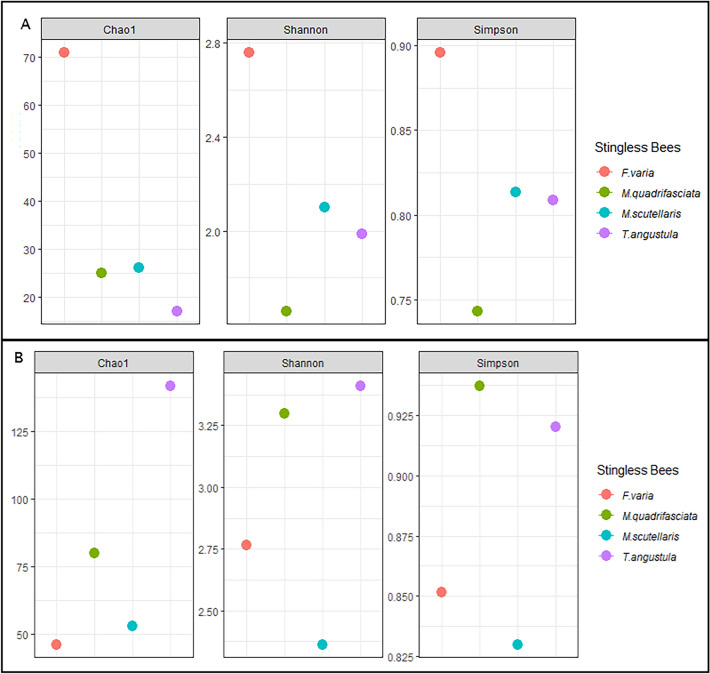
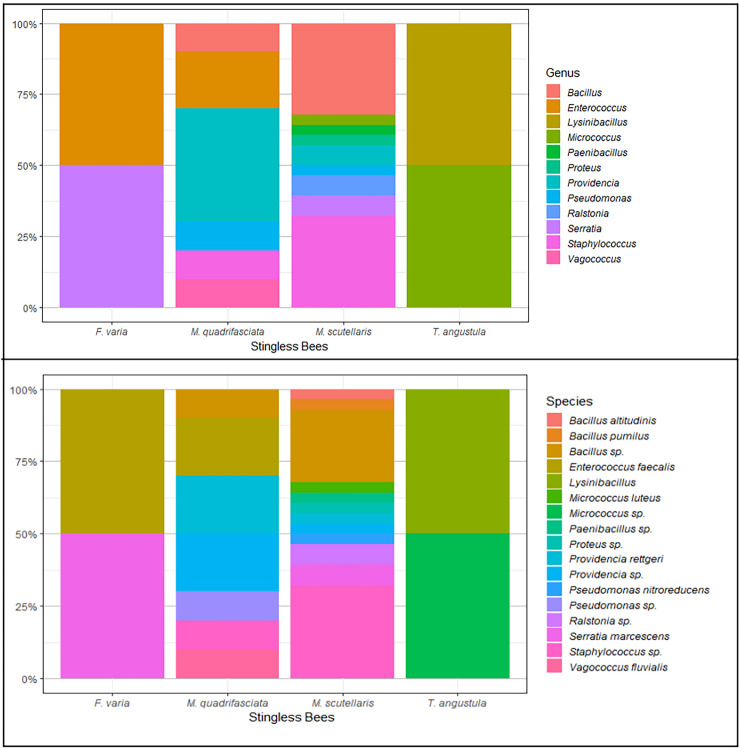
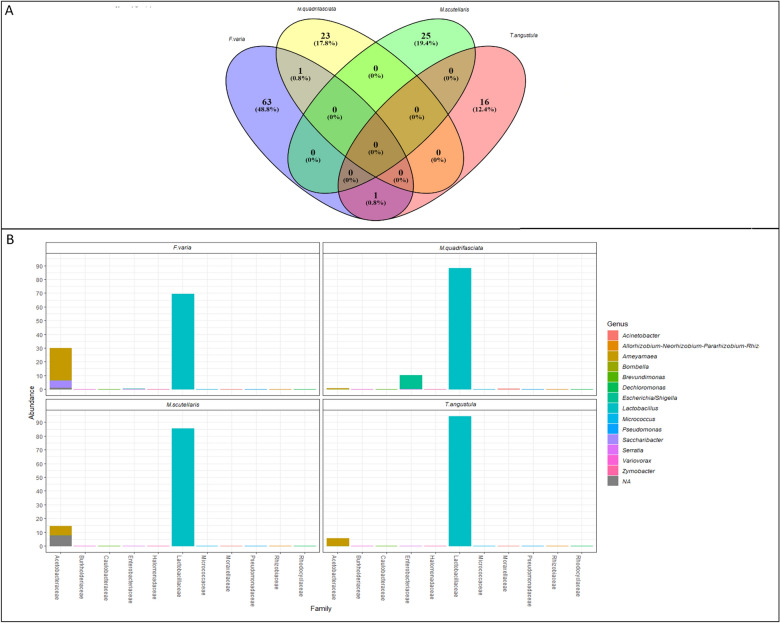
Stingless bees are a diverse group with a relevant role in pollinating native species. Its diet is rich in carbohydrates and proteins, by collecting pollen and nectar supplies the development of its offspring. Fermentation of these products is associated with microorganisms in the colony. However, the composition of microorganisms that comprise this microbiome and its fundamental role in colony development is still unclear. To characterize the colonizing microorganisms of larval food in the brood cells of stingless bees Frieseomelitta varia, Melipona quadrifasciata, Melipona scutellaris, and Tetragonisca angustula, we have utilized molecular and culture-based techniques. Bacteria of the phyla Firmicutes, Proteobacteria, Actinobacteria, and fungi of the phyla Ascomycota, Basidiomycota, Mucoromycota, and Mortierellomycota were found. Diversity analysis showed that F. varia had a greater diversity of bacteria in its microbiota, and T. angustula had a greater diversity of fungi. The isolation technique allowed the identification of 189 bacteria and 75 fungi. In summary, this research showed bacteria and fungi associated with the species F. varia, M. quadrifasciata, M. scutellaris, and T. angustula, which may play an essential role in the survival of these organisms. Besides that, a biobank with bacteria and fungus isolates from LF of Brazilian stingless bees was created, which can be used for different studies and the prospection of biotechnology compounds.

摘要

无刺蜂是一个多样化的群体,在为本地物种授粉方面发挥着重要作用。它们的饮食中富含碳水化合物和蛋白质,通过收集花粉和花蜜来为后代的发育提供营养。这些产物的发酵与群体中的微生物有关。然而,构成这个微生物组的微生物组成及其在群体发育中的基本作用仍不清楚。为了描述幼虫食物中定植微生物的特征,我们利用分子和基于培养的技术,对无刺蜂 Frieseomelitta varia、Melipona quadrifasciata、Melipona scutellaris 和 Tetragonisca angustula 的育雏细胞中的幼虫食物进行了研究。发现了厚壁菌门、变形菌门、放线菌门和子囊菌门、担子菌门、毛霉门和被孢霉门的真菌。多样性分析表明,F. varia 的微生物群中具有更多种类的细菌,而 T. angustula 的真菌多样性更大。分离技术允许鉴定出 189 种细菌和 75 种真菌。总之,这项研究表明,与 F. varia、M. quadrifasciata、M. scutellaris 和 T. angustula 相关的细菌和真菌可能对这些生物的生存起着重要作用。此外,还创建了一个包含巴西无刺蜂 LF 中细菌和真菌分离物的生物库,可用于不同的研究和生物技术化合物的探索。
https://cdn.ncbi.nlm.nih.gov/pmc/blobs/71cf/10060228/46e761a5aabb/41598_2023_32298_Fig6_HTML.jpg
https://cdn.ncbi.nlm.nih.gov/pmc/blobs/71cf/10060228/4c7723f7614c/41598_2023_32298_Fig1_HTML.jpg
https://cdn.ncbi.nlm.nih.gov/pmc/blobs/71cf/10060228/5d19af9c4dda/41598_2023_32298_Fig2_HTML.jpg
https://cdn.ncbi.nlm.nih.gov/pmc/blobs/71cf/10060228/4356f98d5c62/41598_2023_32298_Fig3_HTML.jpg
https://cdn.ncbi.nlm.nih.gov/pmc/blobs/71cf/10060228/ce32f695dc85/41598_2023_32298_Fig4_HTML.jpg
https://cdn.ncbi.nlm.nih.gov/pmc/blobs/71cf/10060228/c4968b243bb1/41598_2023_32298_Fig5_HTML.jpg
https://cdn.ncbi.nlm.nih.gov/pmc/blobs/71cf/10060228/46e761a5aabb/41598_2023_32298_Fig6_HTML.jpg
https://cdn.ncbi.nlm.nih.gov/pmc/blobs/71cf/10060228/4c7723f7614c/41598_2023_32298_Fig1_HTML.jpg
https://cdn.ncbi.nlm.nih.gov/pmc/blobs/71cf/10060228/5d19af9c4dda/41598_2023_32298_Fig2_HTML.jpg
https://cdn.ncbi.nlm.nih.gov/pmc/blobs/71cf/10060228/4356f98d5c62/41598_2023_32298_Fig3_HTML.jpg
https://cdn.ncbi.nlm.nih.gov/pmc/blobs/71cf/10060228/ce32f695dc85/41598_2023_32298_Fig4_HTML.jpg
https://cdn.ncbi.nlm.nih.gov/pmc/blobs/71cf/10060228/c4968b243bb1/41598_2023_32298_Fig5_HTML.jpg
https://cdn.ncbi.nlm.nih.gov/pmc/blobs/71cf/10060228/46e761a5aabb/41598_2023_32298_Fig6_HTML.jpg

相似文献

1
Bacteria, yeasts, and fungi associated with larval food of Brazilian native stingless bees.与巴西原生无刺蜂幼虫食物相关的细菌、酵母和真菌。
Sci Rep. 2023 Mar 29;13(1):5147. doi: 10.1038/s41598-023-32298-w.
2
Yeast communities associated with stingless bees.与无刺蜂相关的酵母群落。
FEMS Yeast Res. 2003 Dec;4(3):271-5. doi: 10.1016/S1567-1356(03)00173-9.
3
Phylogenetic analyses of antibiotic-producing Streptomyces sp. isolates obtained from the stingless-bee Tetragonisca angustula (Apidae: Meliponini).从无刺蜜蜂 Tetragonisca angustula(Apidae:Meliponini)中分离出的产抗生素放线菌 Streptomyces sp. 的系统发育分析。
Microbiology (Reading). 2019 Mar;165(3):292-301. doi: 10.1099/mic.0.000754. Epub 2019 Jan 24.
4
Bacterial communities of indoor surface of stingless bee nests.室内无刺蜂巢表面的细菌群落。
PLoS One. 2021 Jul 9;16(7):e0252933. doi: 10.1371/journal.pone.0252933. eCollection 2021.
5
Antimicrobial Activity of Volatile Oils from Brazilian Stingless Bees Melipona quadrifasciata quadrifasciata and Tetragonisca angustula Propolis.巴西无刺蜜蜂(Melipona quadrifasciata quadrifasciata)和狭叶胡蜂(Tetragonisca angustula)蜂胶挥发油的抗菌活性。
Chem Biodivers. 2022 Aug;19(8):e202200369. doi: 10.1002/cbdv.202200369. Epub 2022 Jul 4.
6
Chemical characterization, antioxidant and antimicrobial activity of propolis obtained from Melipona quadrifasciata quadrifasciata and Tetragonisca angustula stingless bees.从四纹无刺蜂和窄胸小蜜蜂采集的蜂胶的化学特征、抗氧化及抗菌活性
Braz J Med Biol Res. 2018;51(6):e7118. doi: 10.1590/1414-431x20187118. Epub 2018 May 21.
7
Hygienic behaviour in Brazilian stingless bees.巴西无刺蜂的卫生行为。
Biol Open. 2016 Nov 15;5(11):1712-1718. doi: 10.1242/bio.018549.
8
In vitro larval rearing protocol for the stingless bee species Melipona scutellaris for toxicological studies.用于毒理学研究的无刺蜂物种 Melipona scutellaris 的体外幼虫饲养方案。
PLoS One. 2019 Mar 20;14(3):e0213109. doi: 10.1371/journal.pone.0213109. eCollection 2019.
9
Temporal Changes in Gut Microbiota Composition and Pollen Diet Associated with Colony Weakness of a Stingless Bee.与无刺蜂蜂群衰弱相关的肠道微生物群组成和花粉饮食的时间变化
Microb Ecol. 2023 May;85(4):1514-1526. doi: 10.1007/s00248-022-02027-3. Epub 2022 May 6.
10
Surrogate species in pesticide risk assessments: Toxicological data of three stingless bees species.农药风险评估中的替代物种:三种无刺蜜蜂物种的毒理学数据。
Environ Pollut. 2023 Feb 1;318:120842. doi: 10.1016/j.envpol.2022.120842. Epub 2022 Dec 9.

引用本文的文献

1
Diversity, antibacterial and antioxidant activities of fungi associated with .与……相关的真菌的多样性、抗菌和抗氧化活性。 (原句不完整,翻译可能存在一定局限性)
PeerJ. 2025 Aug 1;13:e19762. doi: 10.7717/peerj.19762. eCollection 2025.
2
Screening of Microorganisms Isolated from Stingless Bees' Larval Food in the Biocontrol of .从无刺蜂幼虫食物中分离的微生物在生物防治中的筛选。 (原文结尾不完整,推测补充了完整信息后翻译会更准确)
J Nematol. 2025 Jun 21;57(1):20250028. doi: 10.2478/jofnem-2025-0028. eCollection 2025 Feb.
3
External morphometric and microscopic analysis of the reproductive system in in- vitro reared stingless bee queens, Heterotrigona itama, and their mating frequency.

本文引用的文献

1
Exploring the MALDI Biotyper for the Identification of biovar Ovis and Equi.探讨 MALDI Biotyper 用于鉴定 Ovis 和 Equi 生物型。
J Am Soc Mass Spectrom. 2022 Nov 2;33(11):2055-2062. doi: 10.1021/jasms.2c00174. Epub 2022 Oct 14.
2
Antimicrobial activity of supernatants produced by bacteria isolated from Brazilian stingless bee's larval food.巴西无刺蜂幼虫食物中分离的细菌所产生的上清液的抗菌活性。
BMC Microbiol. 2022 May 12;22(1):127. doi: 10.1186/s12866-022-02548-4.
3
Opportunities and challenges of using metagenomic data to bring uncultured microbes into cultivation.
体外饲养的无刺蜜蜂蜂王生殖系统的外部形态和微观分析及其交配频率。
PLoS One. 2024 Sep 24;19(9):e0306085. doi: 10.1371/journal.pone.0306085. eCollection 2024.
4
The Resistance of Bacillus Spores: Implications for the Strain-Specific Response to High-Performance Disinfectants.芽孢杆菌的抗药性:对高性能消毒剂的菌株特异性反应的影响。
Curr Microbiol. 2024 Sep 3;81(10):339. doi: 10.1007/s00284-024-03872-w.
5
Green synthesis of silver nanoparticle using pollen extract from Tetragonisca angustula a stingless bee.利用无刺蜂四角切叶蜂的花粉提取物绿色合成银纳米颗粒。
Discov Nano. 2024 May 27;19(1):92. doi: 10.1186/s11671-024-04038-0.
6
Distinct fungal microbiomes of two Thai commercial stingless bee species, and suggest a possible niche separation in a shared habitat.两种泰国商业无刺蜂的独特真菌微生物群表明在共享栖息地中可能存在生态位分离。
Front Cell Infect Microbiol. 2024 Feb 26;14:1367010. doi: 10.3389/fcimb.2024.1367010. eCollection 2024.
7
Bees just wanna have fungi: a review of bee associations with nonpathogenic fungi.蜜蜂只想拥有真菌:非病原真菌与蜜蜂共生关系综述。
FEMS Microbiol Ecol. 2023 Jul 21;99(8). doi: 10.1093/femsec/fiad077.
利用宏基因组数据将未培养微生物带入培养的机遇与挑战。
Microbiome. 2022 May 12;10(1):76. doi: 10.1186/s40168-022-01272-5.
4
A watershed impacted by anthropogenic activities: Microbial community alterations and reservoir of antimicrobial resistance genes.受人为活动影响的分水岭:微生物群落变化和抗微生物药物耐药基因库。
Sci Total Environ. 2021 Nov 1;793:148552. doi: 10.1016/j.scitotenv.2021.148552. Epub 2021 Jun 19.
5
Bacterial communities of indoor surface of stingless bee nests.室内无刺蜂巢表面的细菌群落。
PLoS One. 2021 Jul 9;16(7):e0252933. doi: 10.1371/journal.pone.0252933. eCollection 2021.
6
The potentials of secondary metabolites from Bacillus cereus SN7 and Vagococcus fluvialis CT21 against fish pathogenic bacteria.蜡样芽胞杆菌 SN7 和弗氏柠檬酸杆菌 CT21 次生代谢产物对鱼类病原菌的作用。
Microb Pathog. 2021 Sep;158:105062. doi: 10.1016/j.micpath.2021.105062. Epub 2021 Jun 27.
7
Extinction of anciently associated gut bacterial symbionts in a clade of stingless bees.绝灭的古生伴生肠道细菌共生体在无刺蜜蜂的一个分支中。
ISME J. 2021 Sep;15(9):2813-2816. doi: 10.1038/s41396-021-01000-1. Epub 2021 May 18.
8
10-hydroxy-2E-decenoic acid (10HDA) does not promote caste differentiation in Melipona scutellaris stingless bees.10-羟基-2E-癸烯酸(10HDA)不会促进无刺蜜蜂 Melipona scutellaris 的分蜂。
Sci Rep. 2021 May 10;11(1):9882. doi: 10.1038/s41598-021-89212-5.
9
Yeast biodiversity in honey produced by stingless bees raised in the highlands of southern Brazil.巴西南部高地饲养的无刺蜜蜂所产蜂蜜中的酵母生物多样性。
Int J Food Microbiol. 2021 Jun 2;347:109200. doi: 10.1016/j.ijfoodmicro.2021.109200. Epub 2021 Apr 15.
10
Stingless bees and microbial interactions.无刺蜂与微生物的相互作用。
Curr Opin Insect Sci. 2021 Apr;44:41-47. doi: 10.1016/j.cois.2020.11.006. Epub 2020 Nov 30.