Departamento de Endocrinología, Instituto Nacional de Cardiología Ignacio Chávez, Juan Badiano 1, Col. Sección XVI, C.P. 14080, Ciudad de Mexico, Tlalpan, México.
Cardiovasc Diabetol. 2023 Apr 3;22(1):81. doi: 10.1186/s12933-023-01807-6.
Coronary artery calcium (CAC) improves cardiovascular event prediction. Visceral adipose tissue (VAT) is a cardiometabolic risk factor that may directly or through its related comorbidities determine the obesity-related risk. A clinical VAT estimator could allow an efficient evaluation of obesity-related risk. We aimed to analyze the effect of VAT and its related cardiometabolic risk factors on CAC progression.
CAC was quantified at baseline and after 5 years by computed tomography (CT), determining its progression. VAT and pericardial fat were measured by CT and estimated by a clinical surrogate (METS-VF). Considered cardiometabolic risk factors were: peripheral insulin resistance (IR), HOMA-IR, adipose tissue IR (ADIPO-IR), and adiponectin. Factors independently associated to CAC progression were analyzed by adjusted Cox proportional hazard models, including statin use and ASCVD risk score as covariates. We performed interaction and mediation models to propose possible pathways for CAC progression.
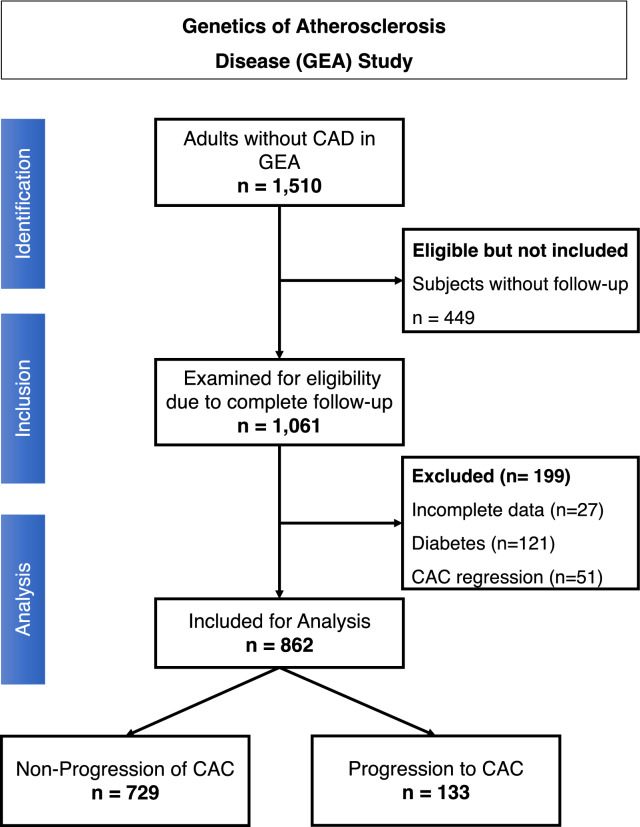
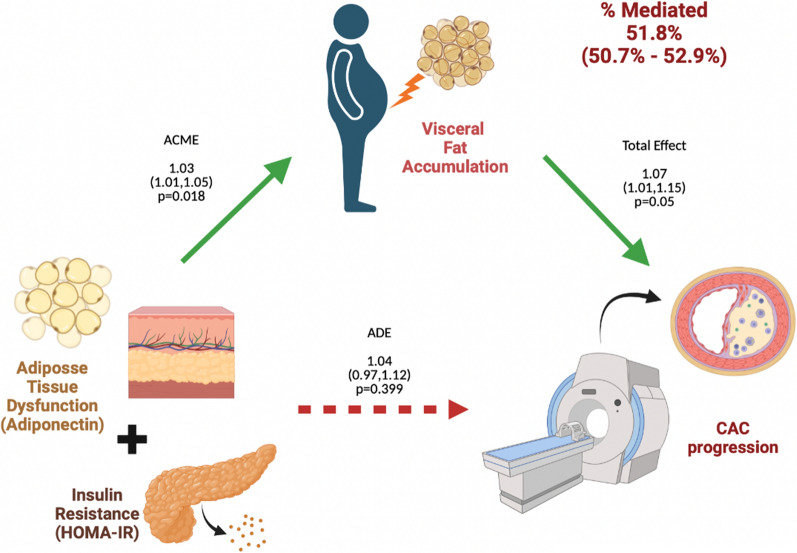
The study included 862 adults (53 ± 9 years, 53% women), incidence CAC progression rate: 30.2 (95% CI 25.3-35.8)/1000 person-years. VAT (HR: 1.004, 95% CI 1.001-1.007, p < 0.01) and METS-VF (HR: 1.001, 95% CI 1.0-1.001, p < 0.05) independently predicted CAC progression. VAT-associated CAC progression risk was evident among low-risk ASCVD subjects, and attenuated among medium-high-risk subjects, suggesting that traditional risk factors overcome adiposity in the latter. VAT mediates 51.8% (95% CI 44.5-58.8%) of the effect attributable to IR together with adipose tissue dysfunction on CAC progression.
This study supports the hypothesis that VAT is a mediator of the risk conferred by subcutaneous adipose tissue dysfunction. METS-VF is an efficient clinical surrogate that could facilitate the identification of at-risk adiposity subjects in daily clinical practice.
冠状动脉钙(CAC)可改善心血管事件预测。内脏脂肪组织(VAT)是一种代谢相关的心血管危险因素,它可能通过直接或相关合并症来决定肥胖相关的风险。临床 VAT 估算器可实现对肥胖相关风险的有效评估。本研究旨在分析 VAT 及其相关代谢相关危险因素对 CAC 进展的影响。
通过计算机断层扫描(CT)在基线和 5 年后定量 CAC,以确定其进展情况。通过 CT 测量 VAT 和心包脂肪,并通过临床替代物(METS-VF)进行估算。考虑的代谢相关危险因素包括外周胰岛素抵抗(IR)、HOMA-IR、脂肪组织 IR(ADIPO-IR)和脂联素。通过调整 Cox 比例风险模型分析与 CAC 进展相关的独立因素,包括他汀类药物的使用和 ASCVD 风险评分作为协变量。我们进行了交互和中介模型,以提出 CAC 进展的可能途径。
该研究纳入了 862 名成年人(53±9 岁,53%为女性),CAC 进展发生率为 30.2(95%CI 25.3-35.8)/1000 人年。VAT(HR:1.004,95%CI 1.001-1.007,p<0.01)和 METS-VF(HR:1.001,95%CI 1.0-1.001,p<0.05)独立预测 CAC 进展。在低 ASCVD 风险患者中,VAT 相关的 CAC 进展风险明显,而在中高危患者中则减弱,表明后者的传统危险因素可克服肥胖。VAT 介导了 51.8%(95%CI 44.5-58.8%)的 IR 以及脂肪组织功能障碍对 CAC 进展的归因风险。
本研究支持 VAT 是皮下脂肪组织功能障碍所致风险的中介的假设。METS-VF 是一种有效的临床替代物,可在日常临床实践中方便地识别处于危险中的肥胖人群。