Liu Chia-Jung, Tsai Cheng Che, Kuo Lu-Cheng, Kuo Po-Chih, Lee Meng-Rui, Wang Jann-Yuan, Ko Jen-Chung, Shih Jin-Yuan, Wang Hao-Chien, Yu Chong-Jen
Department of Internal Medicine, National Taiwan University Hospital, Hsin-Chu Branch, Hsinchu, Taiwan.
Graduate Institute of Clinical Medicine, College of Medicine, National Taiwan University, Taipei, Taiwan.
Insights Imaging. 2023 Apr 15;14(1):67. doi: 10.1186/s13244-023-01395-9.
Timely differentiating between pulmonary tuberculosis (TB) and nontuberculous mycobacterial lung disease (NTM-LD), which are radiographically similar, is important because infectiousness and treatment differ. This study aimed to evaluate whether artificial intelligence could distinguish between TB or NTM-LD patients by chest X-rays (CXRs) from suspects of mycobacterial lung disease.
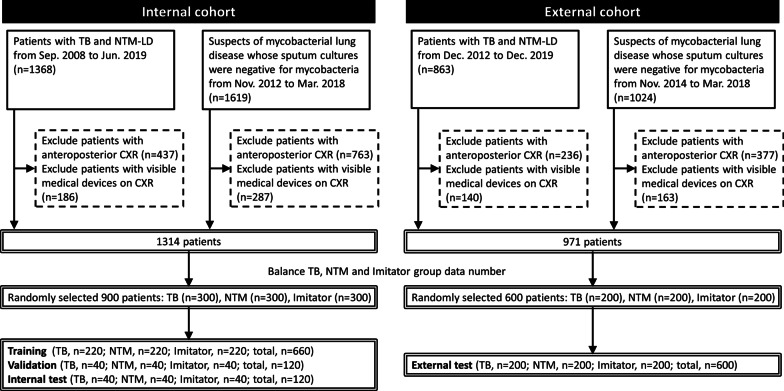
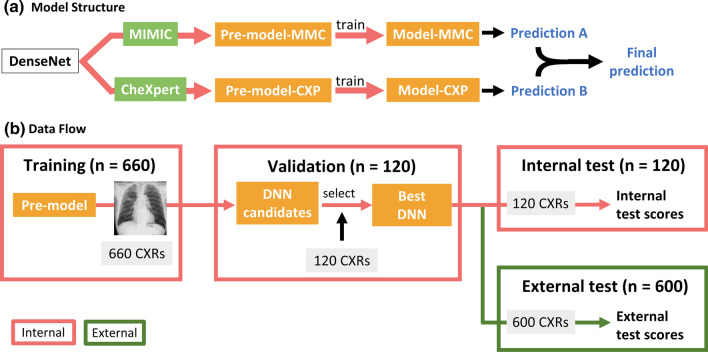
A total of 1500 CXRs, including 500 each from patients with pulmonary TB, NTM-LD, and patients with clinical suspicion but negative mycobacterial culture (Imitator) from two hospitals, were retrospectively collected and evaluated in this study. We developed a deep neural network (DNN) and evaluated model performance using the area under the receiver operating characteristic curves (AUC) in both internal and external test sets. Furthermore, we conducted a reader study and tested our model under three scenarios of different mycobacteria prevalence.
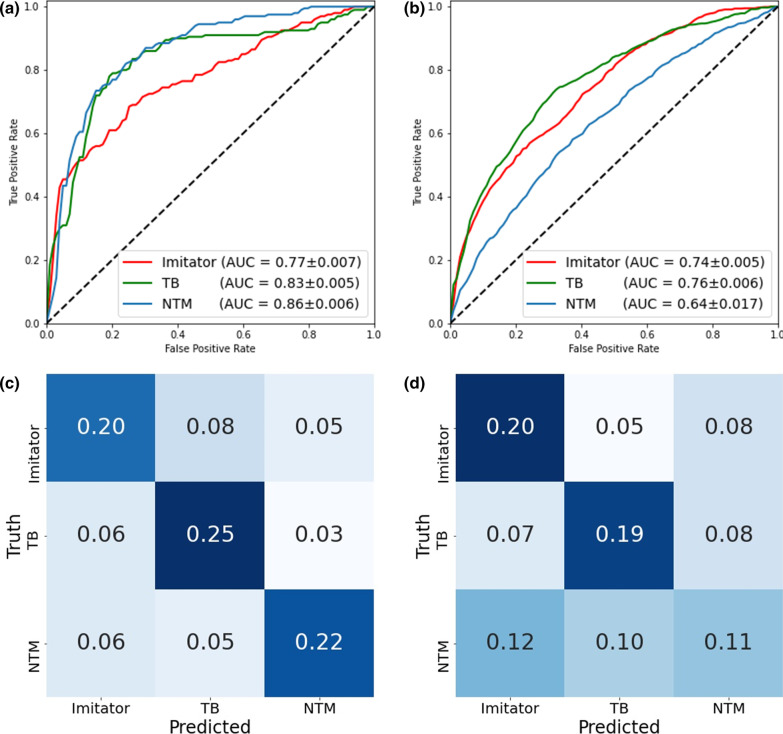
Among the internal and external test sets, the AUCs of our DNN model were 0.83 ± 0.005 and 0.76 ± 0.006 for pulmonary TB, 0.86 ± 0.006 and 0.64 ± 0.017 for NTM-LD, and 0.77 ± 0.007 and 0.74 ± 0.005 for Imitator. The DNN model showed higher performance on the internal test set in classification accuracy (66.5 ± 2.5%) than senior (50.8 ± 3.0%, p < 0.001) and junior pulmonologists (47.5 ± 2.8%, p < 0.001). Among different prevalence scenarios, the DNN model has stable performance in terms of AUC to detect TB and mycobacterial lung disease.
DNN model had satisfactory performance and a higher accuracy than pulmonologists on classifying patients with presumptive mycobacterial lung diseases. DNN model could be a complementary first-line screening tool.
及时区分影像学表现相似的肺结核(TB)和非结核分枝杆菌肺病(NTM-LD)很重要,因为二者的传染性和治疗方法不同。本研究旨在评估人工智能是否能够通过来自分枝杆菌肺病疑似患者的胸部X光片(CXR)区分TB或NTM-LD患者。
本研究回顾性收集并评估了共1500张CXR,其中500张来自两家医院的肺结核患者、500张来自NTM-LD患者,以及500张来自临床疑似但分枝杆菌培养阴性的患者(模拟者)。我们开发了一个深度神经网络(DNN),并使用受试者工作特征曲线下面积(AUC)在内外部测试集中评估模型性能。此外,我们进行了一项阅片者研究,并在三种不同分枝杆菌患病率的场景下测试了我们的模型。
在内外部测试集中,我们的DNN模型对于肺结核的AUC分别为0.83±0.005和0.76±0.006,对于NTM-LD的AUC分别为0.86±0.006和0.64±0.017,对于模拟者的AUC分别为0.77±0.007和0.74±0.005。DNN模型在内测试集中的分类准确率(66.5±2.5%)高于资深肺科医生(50.8±3.0%,p<0.001)和初级肺科医生(47.5±2.8%,p<0.001)。在不同患病率场景中,DNN模型在检测TB和分枝杆菌肺病的AUC方面具有稳定的性能。
DNN模型在对疑似分枝杆菌肺病患者进行分类时具有令人满意的性能且比肺科医生具有更高的准确率。DNN模型可以成为一种辅助一线筛查工具。