Institute of Applied Health Research, College of Medical and Dental Sciences, University of Birmingham, Birmingham, UK.
Department of Health Sciences, University of Leicester, Leicester, UK.
BMC Health Serv Res. 2023 Apr 19;23(1):376. doi: 10.1186/s12913-023-09242-9.
The coronavirus pandemic has had a profound impact on organization and delivery of care. The challenges faced by healthcare organizations in dealing with the pandemic have intensified interest in the concept of resilience. While effort has gone into conceptualising resilience, there has been relatively little work on how to evaluate organizational resilience. This paper reports on an extensive review of approaches to resilience measurement and assessment in empirical healthcare studies, and examines their usefulness for researchers, policymakers and healthcare managers.
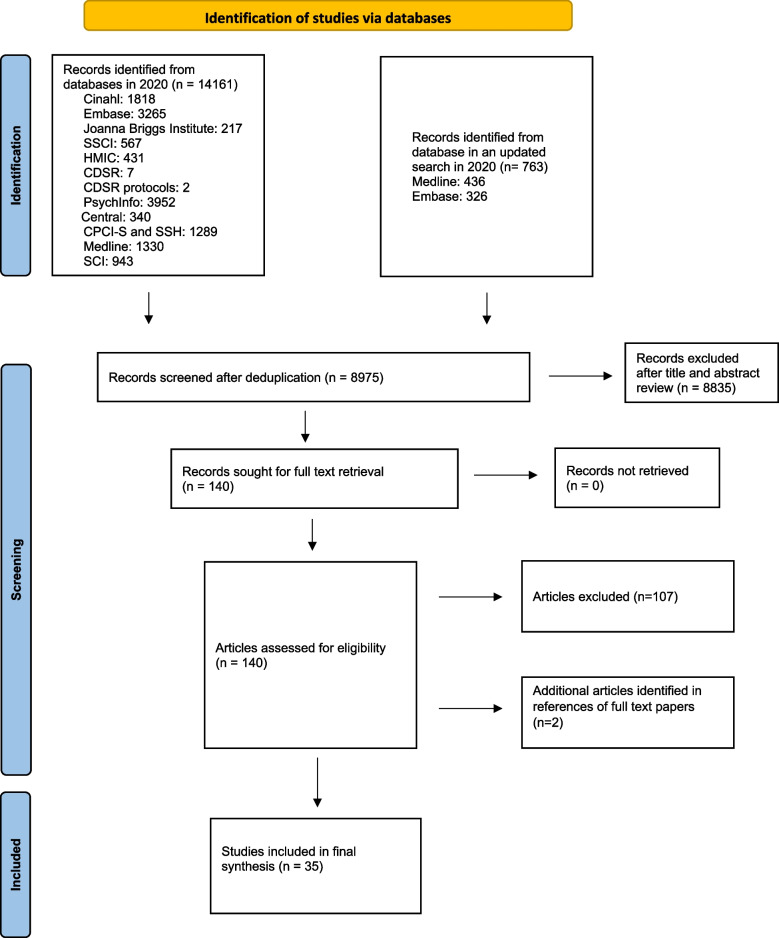
Various databases (MEDLINE, EMBASE, PsycINFO, CINAHL (EBSCO host), Cochrane CENTRAL (Wiley), CDSR, Science Citation Index, and Social Science Citation Index) were searched from January 2000 to September 2021. We included quantitative, qualitative and modelling studies that focused on measuring or qualitatively assessing organizational resilience in a healthcare context. All studies were screened based on titles, abstracts and full text. For each approach, information on the format of measurement or assessment, method of data collection and analysis, and other relevant information were extracted. We classified the approaches to organizational resilience into five thematic areas of contrast: (1) type of shock; (2) stage of resilience; (3) included characteristics or indicators; (4) nature of output; and (5) purpose. The approaches were summarised narratively within these thematic areas.
Thirty-five studies met the inclusion criteria. We identified a lack of consensus on how to evaluate organizational resilience in healthcare, what should be measured or assessed and when, and using what resilience characteristic and indicators. The measurement and assessment approaches varied in scope, format, content and purpose. Approaches varied in terms of whether they were prospective (resilience pre-shock) or retrospective (during or post-shock), and the extent to which they addressed a pre-defined and shock-specific set of characteristics and indicators.
A range of approaches with differing characteristics and indicators has been developed to evaluate organizational resilience in healthcare, and may be of value to researchers, policymakers and healthcare managers. The choice of an approach to use in practice should be determined by the type of shock, the purpose of the evaluation, the intended use of results, and the availability of data and resources.
冠状病毒大流行对医疗保健的组织和提供产生了深远的影响。医疗机构在应对大流行方面面临的挑战加剧了对弹性概念的兴趣。虽然已经努力对弹性进行概念化,但在如何评估组织弹性方面的工作相对较少。本文报告了对实证医疗保健研究中弹性测量和评估方法的广泛审查,并探讨了它们对研究人员、政策制定者和医疗保健管理人员的有用性。
从 2000 年 1 月到 2021 年 9 月,我们在各种数据库(MEDLINE、EMBASE、PsycINFO、CINAHL(EBSCO 主机)、Cochrane CENTRAL(Wiley)、CDSR、Science Citation Index 和 Social Science Citation Index)中进行了搜索。我们纳入了定量、定性和建模研究,这些研究侧重于在医疗保健背景下测量或定性评估组织弹性。所有研究均基于标题、摘要和全文进行筛选。对于每种方法,我们都提取了测量或评估的格式、数据收集和分析的方法以及其他相关信息。我们将组织弹性的方法分为五个对比主题领域:(1)冲击类型;(2)弹性阶段;(3)包含的特征或指标;(4)输出性质;和(5)目的。在这些主题领域内,我们以叙述的方式对方法进行了总结。
有 35 项研究符合纳入标准。我们发现,如何在医疗保健中评估组织弹性、应该测量或评估什么以及何时使用哪些弹性特征和指标方面缺乏共识。测量和评估方法在范围、格式、内容和目的上存在差异。这些方法在是否前瞻性(冲击前弹性)或回顾性(冲击时或冲击后)以及在多大程度上解决了预先定义的和冲击特定的特征和指标方面有所不同。
已经开发了一系列具有不同特征和指标的方法来评估医疗保健中的组织弹性,这些方法可能对研究人员、政策制定者和医疗保健管理人员有价值。在实践中选择使用哪种方法应取决于冲击类型、评估目的、结果的预期用途以及数据和资源的可用性。