Zhang Penglong, Liu Jing, Jia Nan, Wang Meng, Lu Yi, Wang Dongsheng, Zhang Jingzheng, Zhang Haie, Wang Xuan
Engineering Research Center of Chestnut Industry Technology, Ministry of Education, Qinhuangdao, Hebei, China.
Hebei Key Laboratory of Horticultural Germplasm Excavation and Innovative Utilization, College of Horticulture Science and Technology, Hebei Normal University of Science and Technology, Changli, Hebei, China.
Front Plant Sci. 2023 Apr 3;14:1166717. doi: 10.3389/fpls.2023.1166717. eCollection 2023.
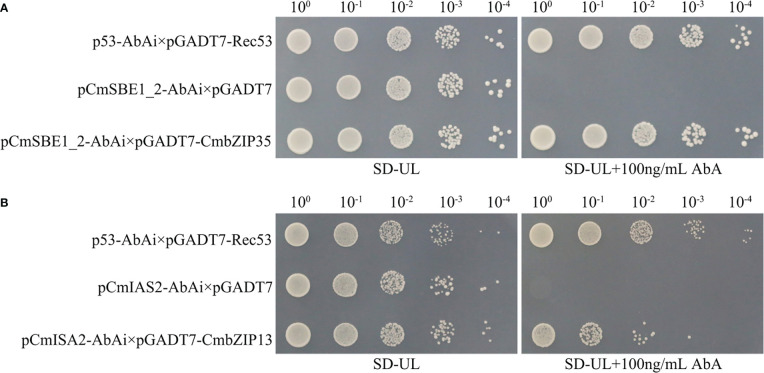
The transcription factors of basic leucine zipper (bZIP) family genes play significant roles in stress response as well as growth and development in plants. However, little is known about the gene family in Chinese chestnut ( Blume). To better understand the characteristics of s in chestnut and their function in starch accumulation, a series of analyses were performed including phylogenetic, synteny, co-expression and yeast one-hybrid analyses. Totally, we identified 59 genes that were unevenly distributed in the chestnut genome and named them to . These s were clustered into 13 clades with clade-specific motifs and structures. A synteny analysis revealed that segmental duplication was the major driving force of expansion of the gene family. A total of 41 genes had syntenic relationships with four other species. The results from the co-expression analyses indicated that seven s in three key modules may be important in regulating starch accumulation in chestnut seeds. Yeast one-hybrid assays showed that transcription factors CmbZIP13 and CmbZIP35 might participate in starch accumulation in the chestnut seed by binding to the promoters of and , respectively. Our study provided basic information on genes, which can be utilized in future functional analysis and breeding studies.
碱性亮氨酸拉链(bZIP)家族基因的转录因子在植物的胁迫响应以及生长发育过程中发挥着重要作用。然而,对于中国板栗(Castanea mollissima Blume)中的该基因家族,人们了解甚少。为了更好地理解板栗中bZIP基因的特征及其在淀粉积累中的功能,我们进行了一系列分析,包括系统发育分析、共线性分析、共表达分析和酵母单杂交分析。我们总共鉴定出59个bZIP基因,它们在板栗基因组中分布不均,并将其命名为CmbZIP1至CmbZIP59。这些bZIP基因被聚类为13个分支,每个分支具有特定的基序和结构。共线性分析表明,片段重复是bZIP基因家族扩张的主要驱动力。共有41个bZIP基因与其他四个物种存在共线性关系。共表达分析结果表明,三个关键模块中的七个bZIP基因可能在调控板栗种子淀粉积累方面具有重要作用。酵母单杂交试验表明,转录因子CmbZIP13和CmbZIP35可能分别通过与CmaAGPL2和CmaISA2的启动子结合来参与板栗种子中的淀粉积累。我们的研究提供了关于bZIP基因的基础信息,可用于未来的功能分析和育种研究。