• 文献检索
  • 文档翻译
  • 深度研究
  • 学术资讯
  • Suppr Zotero 插件Zotero 插件
  • 邀请有礼
  • 套餐&价格
  • 历史记录
应用&插件
Suppr Zotero 插件Zotero 插件浏览器插件Mac 客户端Windows 客户端微信小程序
定价
高级版会员购买积分包购买API积分包
服务
文献检索文档翻译深度研究API 文档MCP 服务
关于我们
关于 Suppr公司介绍联系我们用户协议隐私条款
关注我们

Suppr 超能文献

核心技术专利:CN118964589B侵权必究
粤ICP备2023148730 号-1Suppr @ 2026

文献检索

告别复杂PubMed语法,用中文像聊天一样搜索,搜遍4000万医学文献。AI智能推荐,让科研检索更轻松。

立即免费搜索

文件翻译

保留排版,准确专业,支持PDF/Word/PPT等文件格式,支持 12+语言互译。

免费翻译文档

深度研究

AI帮你快速写综述,25分钟生成高质量综述,智能提取关键信息,辅助科研写作。

立即免费体验

机器学习预测住院期间脓毒症相关性急性肾损伤患者的全因死亡率。

Machine learning for the prediction of all-cause mortality in patients with sepsis-associated acute kidney injury during hospitalization.

机构信息

Department of Nephrology, Xiangya Hospital of Central South University, Changsha, Hunan, China.

Department of Pediatrics, The Third Xiangya Hospital, Central South University, Changsha, China.

出版信息

Front Immunol. 2023 Apr 3;14:1140755. doi: 10.3389/fimmu.2023.1140755. eCollection 2023.

DOI:10.3389/fimmu.2023.1140755
PMID:37077912
原文链接:https://pmc.ncbi.nlm.nih.gov/articles/PMC10106833/
Abstract

BACKGROUND

Sepsis-associated acute kidney injury (S-AKI) is considered to be associated with high morbidity and mortality, a commonly accepted model to predict mortality is urged consequently. This study used a machine learning model to identify vital variables associated with mortality in S-AKI patients in the hospital and predict the risk of death in the hospital. We hope that this model can help identify high-risk patients early and reasonably allocate medical resources in the intensive care unit (ICU).

METHODS

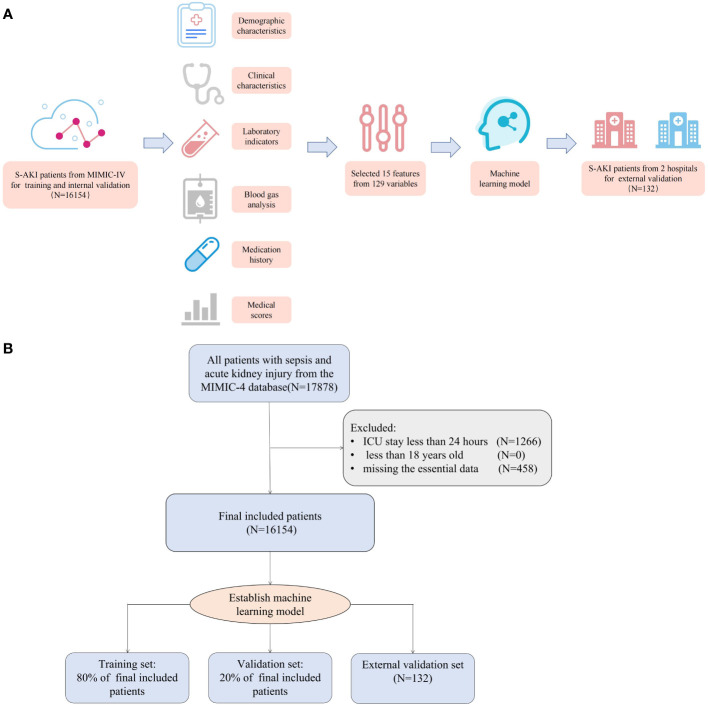
A total of 16,154 S-AKI patients from the Medical Information Mart for Intensive Care IV database were examined as the training set (80%) and the validation set (20%). Variables (129 in total) were collected, including basic patient information, diagnosis, clinical data, and medication records. We developed and validated machine learning models using 11 different algorithms and selected the one that performed the best. Afterward, recursive feature elimination was used to select key variables. Different indicators were used to compare the prediction performance of each model. The SHapley Additive exPlanations package was applied to interpret the best machine learning model in a web tool for clinicians to use. Finally, we collected clinical data of S-AKI patients from two hospitals for external validation.

RESULTS

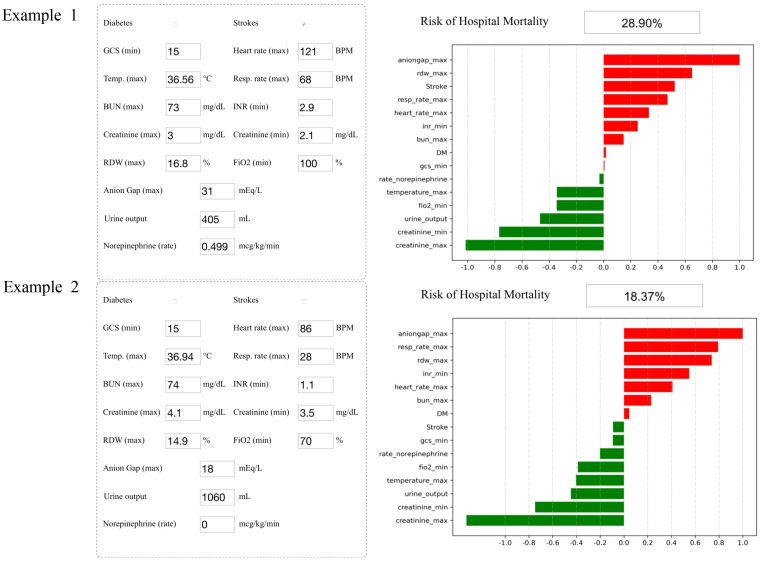
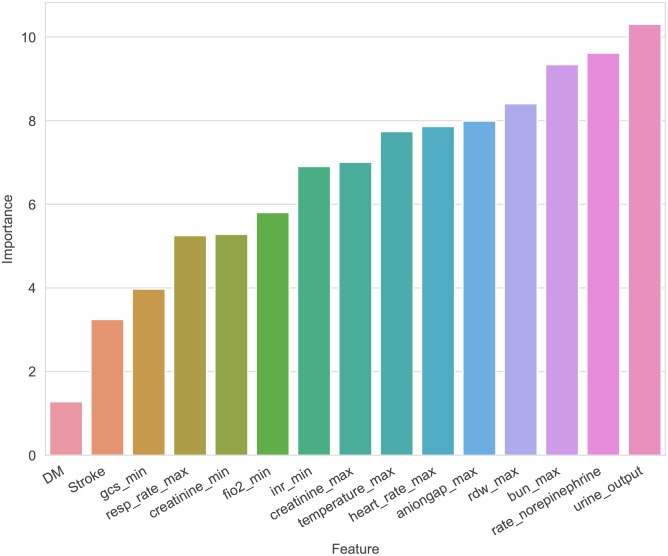
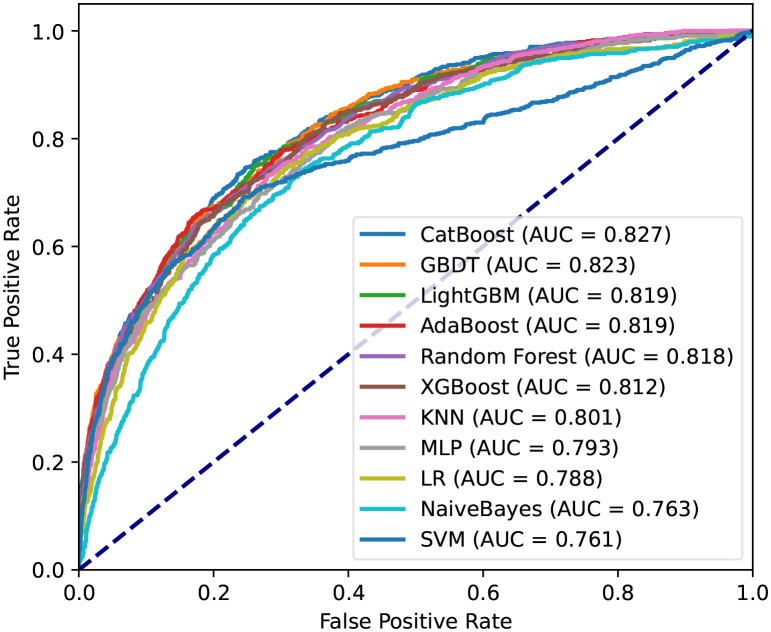
In this study, 15 critical variables were finally selected, namely, urine output, maximum blood urea nitrogen, rate of injection of norepinephrine, maximum anion gap, maximum creatinine, maximum red blood cell volume distribution width, minimum international normalized ratio, maximum heart rate, maximum temperature, maximum respiratory rate, minimum fraction of inspired O, minimum creatinine, minimum Glasgow Coma Scale, and diagnosis of diabetes and stroke. The categorical boosting algorithm model presented significantly better predictive performance [receiver operating characteristic (ROC): 0.83] than other models [accuracy (ACC): 75%, Youden index: 50%, sensitivity: 75%, specificity: 75%, F1 score: 0.56, positive predictive value (PPV): 44%, and negative predictive value (NPV): 92%]. External validation data from two hospitals in China were also well validated (ROC: 0.75).

CONCLUSIONS

After selecting 15 crucial variables, a machine learning-based model for predicting the mortality of S-AKI patients was successfully established and the CatBoost model demonstrated best predictive performance.

摘要

背景

脓毒症相关性急性肾损伤(S-AKI)被认为与高发病率和死亡率相关,因此迫切需要建立一种公认的预测死亡率的模型。本研究使用机器学习模型来识别与医院中 S-AKI 患者死亡率相关的重要变量,并预测住院期间的死亡风险。我们希望该模型能够帮助早期识别高危患者,并合理分配重症监护病房(ICU)的医疗资源。

方法

从医疗信息集市重症监护 IV 数据库中检查了 16154 名 S-AKI 患者作为训练集(80%)和验证集(20%)。共收集了 129 个变量,包括基本患者信息、诊断、临床数据和药物记录。我们使用 11 种不同的算法开发和验证了机器学习模型,并选择了性能最佳的模型。然后,使用递归特征消除选择关键变量。使用不同的指标比较每个模型的预测性能。使用 SHapley Additive exPlanations 包在一个临床医生使用的网络工具中解释最佳机器学习模型。最后,我们从两家医院收集了 S-AKI 患者的临床数据进行外部验证。

结果

本研究最终选择了 15 个关键变量,即尿量、最大血尿素氮、去甲肾上腺素注射率、最大阴离子间隙、最大肌酐、最大红细胞体积分布宽度、最小国际标准化比值、最大心率、最高温度、最大呼吸频率、最低吸入氧分数、最低肌酐、最低格拉斯哥昏迷量表和糖尿病和中风的诊断。分类提升算法模型的预测性能明显优于其他模型[接收者操作特征(ROC):0.83] [准确性(ACC):75%、约登指数:50%、灵敏度:75%、特异性:75%、F1 评分:0.56、阳性预测值(PPV):44%、阴性预测值(NPV):92%]。来自中国两家医院的外部验证数据也得到了很好的验证(ROC:0.75)。

结论

在选择 15 个关键变量后,成功建立了基于机器学习的预测 S-AKI 患者死亡率的模型,CatBoost 模型表现出最佳的预测性能。
https://cdn.ncbi.nlm.nih.gov/pmc/blobs/ed87/10106833/a9a6c790264c/fimmu-14-1140755-g004.jpg
https://cdn.ncbi.nlm.nih.gov/pmc/blobs/ed87/10106833/59a40c675015/fimmu-14-1140755-g001.jpg
https://cdn.ncbi.nlm.nih.gov/pmc/blobs/ed87/10106833/f5699be1a939/fimmu-14-1140755-g002.jpg
https://cdn.ncbi.nlm.nih.gov/pmc/blobs/ed87/10106833/2d603e85a4dc/fimmu-14-1140755-g003.jpg
https://cdn.ncbi.nlm.nih.gov/pmc/blobs/ed87/10106833/a9a6c790264c/fimmu-14-1140755-g004.jpg
https://cdn.ncbi.nlm.nih.gov/pmc/blobs/ed87/10106833/59a40c675015/fimmu-14-1140755-g001.jpg
https://cdn.ncbi.nlm.nih.gov/pmc/blobs/ed87/10106833/f5699be1a939/fimmu-14-1140755-g002.jpg
https://cdn.ncbi.nlm.nih.gov/pmc/blobs/ed87/10106833/2d603e85a4dc/fimmu-14-1140755-g003.jpg
https://cdn.ncbi.nlm.nih.gov/pmc/blobs/ed87/10106833/a9a6c790264c/fimmu-14-1140755-g004.jpg

相似文献

1
Machine learning for the prediction of all-cause mortality in patients with sepsis-associated acute kidney injury during hospitalization.机器学习预测住院期间脓毒症相关性急性肾损伤患者的全因死亡率。
Front Immunol. 2023 Apr 3;14:1140755. doi: 10.3389/fimmu.2023.1140755. eCollection 2023.
2
Machine learning-based prediction of in-hospital mortality for critically ill patients with sepsis-associated acute kidney injury.基于机器学习的脓毒症相关性急性肾损伤危重症患者院内死亡率预测。
Ren Fail. 2024 Dec;46(1):2316267. doi: 10.1080/0886022X.2024.2316267. Epub 2024 Feb 18.
3
Machine Learning for the Prediction of Complications in Patients After Mitral Valve Surgery.用于预测二尖瓣置换术后患者并发症的机器学习
Front Cardiovasc Med. 2021 Dec 16;8:771246. doi: 10.3389/fcvm.2021.771246. eCollection 2021.
4
Construction and validation of prognostic models in critically Ill patients with sepsis-associated acute kidney injury: interpretable machine learning approach.建立和验证脓毒症相关性急性肾损伤危重症患者的预后模型:可解释的机器学习方法。
J Transl Med. 2023 Jun 22;21(1):406. doi: 10.1186/s12967-023-04205-4.
5
Machine Learning for Predicting Risk and Prognosis of Acute Kidney Disease in Critically Ill Elderly Patients During Hospitalization: Internet-Based and Interpretable Model Study.基于互联网的可解释模型研究:机器学习在预测住院期间危重症老年患者急性肾损伤风险和预后中的应用。
J Med Internet Res. 2024 May 1;26:e51354. doi: 10.2196/51354.
6
[Comparison of machine learning method and logistic regression model in prediction of acute kidney injury in severely burned patients].[机器学习方法与逻辑回归模型在预测重度烧伤患者急性肾损伤中的比较]
Zhonghua Shao Shang Za Zhi. 2018 Jun 20;34(6):343-348. doi: 10.3760/cma.j.issn.1009-2587.2018.06.006.
7
Interpretable machine learning model for early prediction of 28-day mortality in ICU patients with sepsis-induced coagulopathy: development and validation.用于脓毒症诱导性凝血病 ICU 患者 28 天死亡率早期预测的可解释机器学习模型:开发与验证。
Eur J Med Res. 2024 Jan 3;29(1):14. doi: 10.1186/s40001-023-01593-7.
8
[Construction of a predictive model for in-hospital mortality of sepsis patients in intensive care unit based on machine learning].基于机器学习构建重症监护病房脓毒症患者院内死亡率预测模型
Zhonghua Wei Zhong Bing Ji Jiu Yi Xue. 2023 Jul;35(7):696-701. doi: 10.3760/cma.j.cn121430-20221219-01104.
9
Illness severity assessment of older adults in critical illness using machine learning (ELDER-ICU): an international multicentre study with subgroup bias evaluation.使用机器学习评估危重症老年患者的疾病严重程度(ELDER-ICU):一项具有亚组偏倚评估的国际多中心研究。
Lancet Digit Health. 2023 Oct;5(10):e657-e667. doi: 10.1016/S2589-7500(23)00128-0. Epub 2023 Aug 18.
10
AKIML: An interpretable machine learning model for predicting acute kidney injury within seven days in critically ill patients based on a prospective cohort study.AKIML:基于一项前瞻性队列研究的用于预测危重症患者7天内急性肾损伤的可解释机器学习模型。
Clin Chim Acta. 2024 Jun 1;559:119705. doi: 10.1016/j.cca.2024.119705. Epub 2024 May 1.

引用本文的文献

1
A w-ACT model for sarcopenia among community-dwelling older adults based on National Basic Public Health Services: development and validation study.基于国家基本公共卫生服务的社区老年人肌少症w-ACT模型:开发与验证研究
Front Public Health. 2025 Aug 26;13:1522903. doi: 10.3389/fpubh.2025.1522903. eCollection 2025.
2
Prediction of the mortality rate in the intensive care unit for early sepsis patients with combined hypoalbuminemia based on machine learning.基于机器学习对合并低白蛋白血症的早期脓毒症患者重症监护病房死亡率的预测
Medicine (Baltimore). 2025 Aug 1;104(31):e43610. doi: 10.1097/MD.0000000000043610.
3

本文引用的文献

1
Application of Machine Learning to Predict Acute Kidney Disease in Patients With Sepsis Associated Acute Kidney Injury.机器学习在脓毒症相关性急性肾损伤患者急性肾疾病预测中的应用
Front Med (Lausanne). 2021 Dec 10;8:792974. doi: 10.3389/fmed.2021.792974. eCollection 2021.
2
Machine learning for early discrimination between transient and persistent acute kidney injury in critically ill patients with sepsis.机器学习在鉴别脓毒症危重症患者急性肾损伤的一过性与持续性中的作用。
Sci Rep. 2021 Oct 12;11(1):20269. doi: 10.1038/s41598-021-99840-6.
3
A Machine-Learning Approach for Dynamic Prediction of Sepsis-Induced Coagulopathy in Critically Ill Patients With Sepsis.
Mapping Artificial Intelligence Research Trends in Critical Care Nursing: A Bibliometric Analysis.
危重症护理中人工智能研究趋势的文献计量分析
J Multidiscip Healthc. 2025 May 19;18:2799-2811. doi: 10.2147/JMDH.S522731. eCollection 2025.
4
Machine learning for predicting all-cause mortality of metabolic dysfunction-associated fatty liver disease: a longitudinal study based on NHANES.用于预测代谢功能障碍相关脂肪性肝病全因死亡率的机器学习:一项基于美国国家健康与营养检查调查(NHANES)的纵向研究
BMC Gastroenterol. 2025 May 15;25(1):376. doi: 10.1186/s12876-025-03946-4.
5
Machine learning for grading prediction and survival analysis in high grade glioma.用于高级别胶质瘤分级预测和生存分析的机器学习
Sci Rep. 2025 May 15;15(1):16955. doi: 10.1038/s41598-025-01413-4.
6
Correlation between baseline anion gap and early acute kidney injury in patients with acute pancreatitis in the intensive care unit: A single-center retrospective cohort study.重症监护病房中急性胰腺炎患者基线阴离子间隙与早期急性肾损伤的相关性:一项单中心回顾性队列研究。
PLoS One. 2025 Feb 11;20(2):e0315386. doi: 10.1371/journal.pone.0315386. eCollection 2025.
7
Individualized drug therapy and survival prediction in ICU patients with acute kidney injury: construction and validation of a nomogram.重症监护病房急性肾损伤患者的个体化药物治疗与生存预测:列线图的构建与验证
Eur J Med Res. 2025 Feb 3;30(1):65. doi: 10.1186/s40001-025-02300-4.
8
Machine Learning Models in Sepsis Outcome Prediction for ICU Patients: Integrating Routine Laboratory Tests-A Systematic Review.用于重症监护病房患者脓毒症预后预测的机器学习模型:整合常规实验室检查——一项系统综述
Biomedicines. 2024 Dec 19;12(12):2892. doi: 10.3390/biomedicines12122892.
9
Acute Kidney Injury Prognosis Prediction Using Machine Learning Methods: A Systematic Review.使用机器学习方法预测急性肾损伤的预后:一项系统评价。
Kidney Med. 2024 Nov 15;7(1):100936. doi: 10.1016/j.xkme.2024.100936. eCollection 2025 Jan.
10
Machine learning for the prediction of mortality in patients with sepsis-associated acute kidney injury: a systematic review and meta-analysis.机器学习用于预测脓毒症相关性急性肾损伤患者的死亡率:一项系统评价和荟萃分析。
BMC Infect Dis. 2024 Dec 21;24(1):1454. doi: 10.1186/s12879-024-10380-6.
一种用于脓毒症重症患者脓毒症诱导凝血病动态预测的机器学习方法。
Front Med (Lausanne). 2021 Jan 21;7:637434. doi: 10.3389/fmed.2020.637434. eCollection 2020.
4
CatBoost for big data: an interdisciplinary review.用于大数据的CatBoost:跨学科综述
J Big Data. 2020;7(1):94. doi: 10.1186/s40537-020-00369-8. Epub 2020 Nov 4.
5
Utilization of Deep Learning for Subphenotype Identification in Sepsis-Associated Acute Kidney Injury.利用深度学习对脓毒症相关性急性肾损伤进行亚表型识别。
Clin J Am Soc Nephrol. 2020 Nov 6;15(11):1557-1565. doi: 10.2215/CJN.09330819. Epub 2020 Oct 8.
6
Rates, predictors, and mortality of sepsis-associated acute kidney injury: a systematic review and meta-analysis.脓毒症相关性急性肾损伤的发生率、预测因素和死亡率:系统评价和荟萃分析。
BMC Nephrol. 2020 Jul 31;21(1):318. doi: 10.1186/s12882-020-01974-8.
7
From Local Explanations to Global Understanding with Explainable AI for Trees.利用可解释人工智能实现从局部解释到树木的全局理解
Nat Mach Intell. 2020 Jan;2(1):56-67. doi: 10.1038/s42256-019-0138-9. Epub 2020 Jan 17.
8
THAI-ICU score as a simplified severity score for critically ill patients in a resource limited setting: Result from SEA-AKI study group.泰国重症监护病房评分作为资源有限环境下危重症患者简化严重程度评分:SEA-AKI 研究组的结果。
J Crit Care. 2020 Feb;55:56-63. doi: 10.1016/j.jcrc.2019.10.010. Epub 2019 Nov 1.
9
Acute kidney injury from sepsis: current concepts, epidemiology, pathophysiology, prevention and treatment.脓毒症导致的急性肾损伤:当前概念、流行病学、病理生理学、预防和治疗。
Kidney Int. 2019 Nov;96(5):1083-1099. doi: 10.1016/j.kint.2019.05.026. Epub 2019 Jun 7.
10
Global epidemiology and outcomes of acute kidney injury.全球急性肾损伤的流行病学和结局。
Nat Rev Nephrol. 2018 Oct;14(10):607-625. doi: 10.1038/s41581-018-0052-0.