Zeng Guixing, You Dongxin, Ye Lingyan, Wu Yuchi, Shi Hualin, Lin Jiarong, Jiang Ziyan, Wei Junping
Guang'anmen Hospital, China Academy of Chinese Medical Sciences, Beijing, China.
The Second Clinical College, Guangzhou University of Chinese Medicine, Guangzhou, China.
Front Nutr. 2023 Apr 4;10:1075877. doi: 10.3389/fnut.2023.1075877. eCollection 2023.
Gout, the most prevalent inflammatory arthritis, has undesirable effects on the quality of life. Omega-3 polyunsaturated fatty acids (n-3 PUFA) has a strong link with anti-inflammatory impacts. However, whether the harmful effects of seafood in relation to gout may vary owing to different levels of n-3 PUFA in seafood is still unclear. It was the goal of this study to examine the relationship between n-3 PUFA poor/rich seafood consumption and gout.
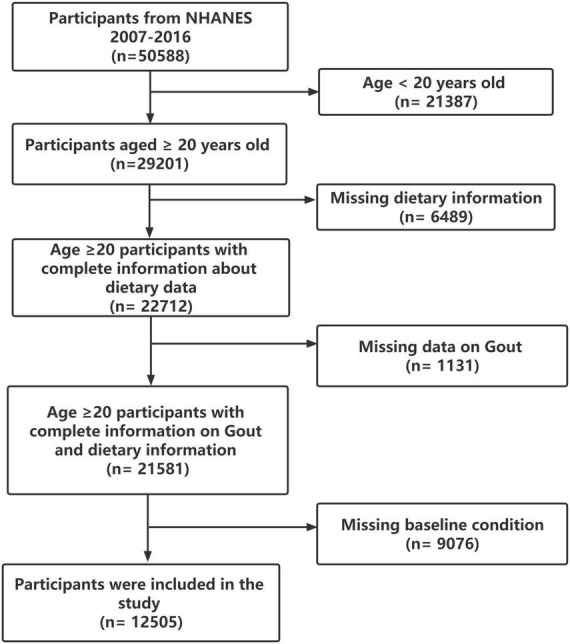
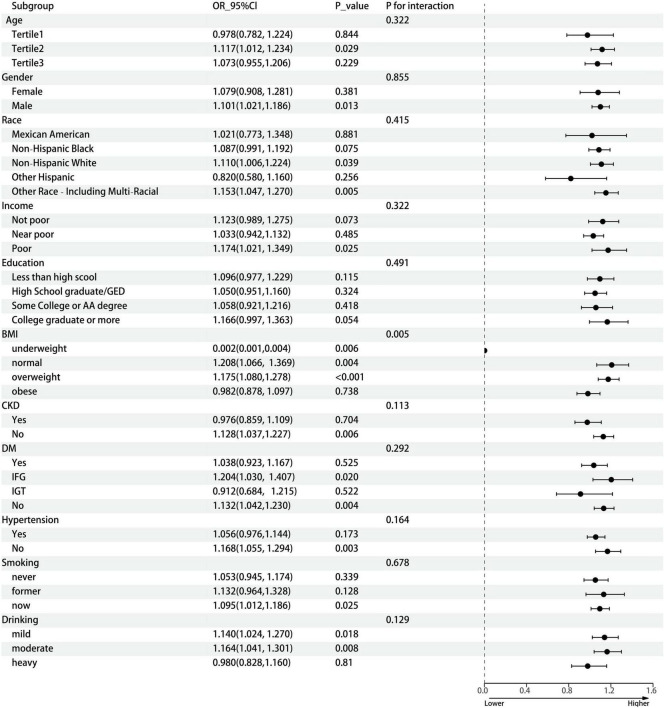
Between 2007 and 2016, five NHANES cycles were performed, with 12,505 subjects having complete data for gout and two 24-h dietary intake interviews. The 24-h dietary recalls were utilized to evaluate dietary habits. Gout was defined based on questionnaires. Weighted logistic regression models were conducted to investigate the association between n-3 PUFA poor/rich seafood consumption and gout. Moreover, subgroup analysis was utilized to estimate the stability of results. Covariates including age, gender, race/ethnicity, income, education, body mass index, chronic kidney disease, diabetes mellitus, hypertension, smoking status, and drinking status were stratified in different models.
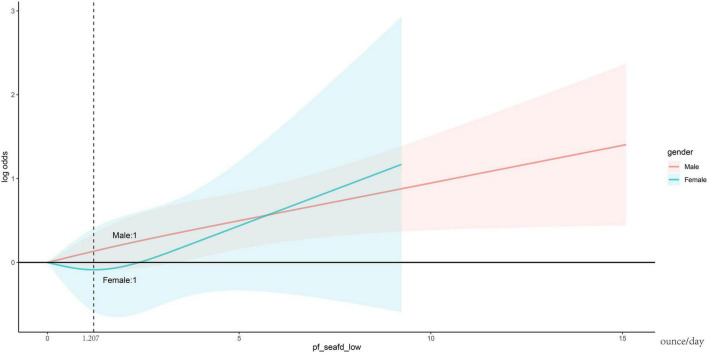
In the fully adjusted model, each unit of increase of n-3 PUFA poor seafood intake was associated with an 8.7% increased risk of gout (OR = 1.087, 95% CI: 1.039, 1.138, < 0.001), whereas, no correlation was found between n-3 PUFA rich seafood consumption and gout. It also provided a proof-of-concept regarding the potential for n-3 PUFA rich seafood to counteract harmful effects of purines in relation to gout. A dose-response analysis showed that there was a non-linear relationship between n-3 PUFA rich seafood intake and the risk of gout in the female group.
Findings suggest that n-3 PUFA poor seafood consumption is associated with higher risk of gout, whereas n-3 PUFA rich seafood is not.
痛风是最常见的炎性关节炎,对生活质量有不良影响。ω-3多不饱和脂肪酸(n-3 PUFA)与抗炎作用密切相关。然而,海产品中n-3 PUFA水平不同,其与痛风相关的有害影响是否存在差异仍不明确。本研究旨在探讨食用富含或缺乏n-3 PUFA的海产品与痛风之间的关系。
在2007年至2016年期间进行了五个周期的美国国家健康与营养检查调查(NHANES),12,505名受试者有完整的痛风数据以及两次24小时饮食摄入访谈记录。利用24小时饮食回忆法评估饮食习惯。根据问卷确定痛风。采用加权逻辑回归模型研究食用富含或缺乏n-3 PUFA的海产品与痛风之间的关联。此外,进行亚组分析以评估结果的稳定性。在不同模型中对年龄、性别、种族/民族、收入、教育程度、体重指数、慢性肾病、糖尿病、高血压、吸烟状况和饮酒状况等协变量进行分层。
在完全调整模型中,每增加一个单位缺乏n-3 PUFA的海产品摄入量,痛风风险增加8.7%(OR = 1.087,95%CI:1.039,1.138,P < 0.001),而食用富含n-3 PUFA的海产品与痛风之间未发现相关性。这也为富含n-3 PUFA的海产品抵消嘌呤与痛风相关有害影响的潜力提供了概念验证。剂量反应分析表明,在女性组中,富含n-3 PUFA的海产品摄入量与痛风风险之间存在非线性关系。
研究结果表明,食用缺乏n-3 PUFA的海产品与痛风风险较高相关,而食用富含n-3 PUFA的海产品则不然。