Cancer Epidemiology Unit, Nuffield Department of Population Health, University of Oxford, Oxford, UK.
Alzheimers Dement. 2023 Nov;19(11):4978-4986. doi: 10.1002/alz.13009. Epub 2023 Apr 21.
There is inconsistent evidence on the associations of sleep duration and daytime napping with dementia risk.
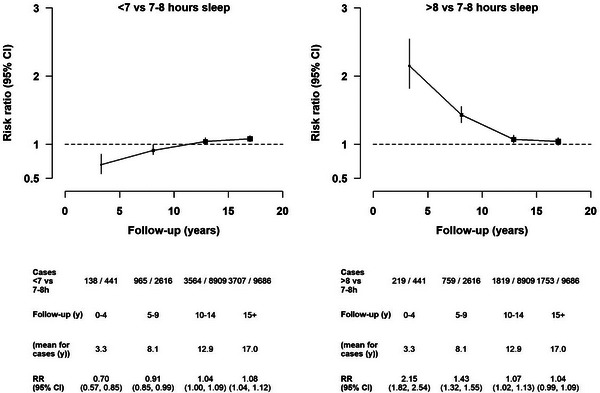
In the Million Women Study, a total of 830,716 women (mean age, 60 years) were asked about sleep duration (<7, 7-8, >8 hours) and daytime napping (rarely/never, sometimes, usually) in median year 2001, and were followed for the first hospital record with any mention of dementia. Cox regression estimated dementia detection risk ratios (RRs) during 17-year follow-up in 5-year intervals.
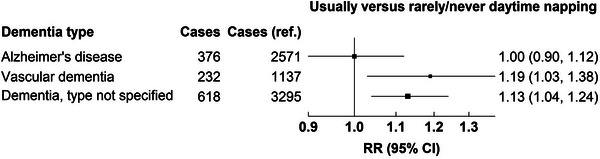
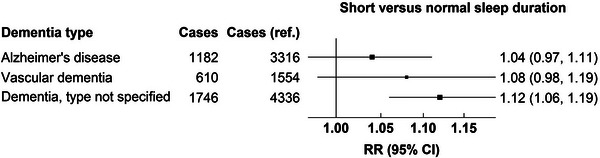
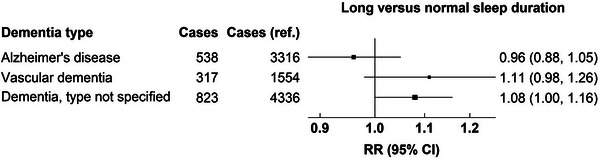
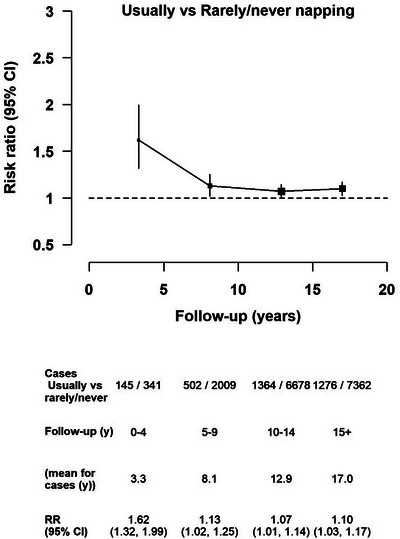
With 34,576 dementia cases, there was strong attenuation over follow-up in the RRs related to long sleep duration (>8 vs 7-8 hours) and usually napping (vs rarely/never). Short sleep duration was modestly, positively associated with dementia in the long term (RR = 1.08, 95% confidence interval [CI] 1.04-1.12).
There was little evidence to suggest that long sleep duration and regular napping are associated with long-term dementia risk. Short sleep duration was modestly associated with dementia risk, but residual confounding cannot be excluded.
Long sleep duration was not associated with long-term dementia risk. Daytime napping was not associated with long-term dementia risk. There is some evidence for a small higher risk of dementia related to short sleep.
关于睡眠时间和白天小睡与痴呆风险的关联,证据并不一致。
在“百万妇女研究”中,共有 830716 名女性(平均年龄 60 岁)在 2001 年中位数年份被问及睡眠时间(<7、7-8、>8 小时)和白天小睡(很少/从不、有时、经常),随访至首次出现任何提及痴呆的医院记录。Cox 回归估计了在 17 年随访期间,每 5 年间隔内的痴呆检测风险比(RR)。
在 34576 例痴呆病例中,随着随访时间的延长,长睡眠时间(>8 小时与 7-8 小时)和经常小睡(与很少/从不)与痴呆的 RR 明显减弱。长期来看,短睡眠时间与痴呆呈适度正相关(RR=1.08,95%置信区间 [CI] 1.04-1.12)。
几乎没有证据表明长睡眠时间和定期小睡与长期痴呆风险有关。短睡眠时间与痴呆风险适度相关,但不能排除残余混杂因素。
长睡眠时间与长期痴呆风险无关。白天小睡与长期痴呆风险无关。有一些证据表明,与短睡眠相关的痴呆风险略高。