Leonard Davis Institute of Health Economics, University of Pennsylvania, Philadelphia.
Department of Medicine, Division of General Internal Medicine, University of Pennsylvania Perelman School of Medicine, Philadelphia.
JAMA Netw Open. 2023 May 1;6(5):e2311253. doi: 10.1001/jamanetworkopen.2023.11253.
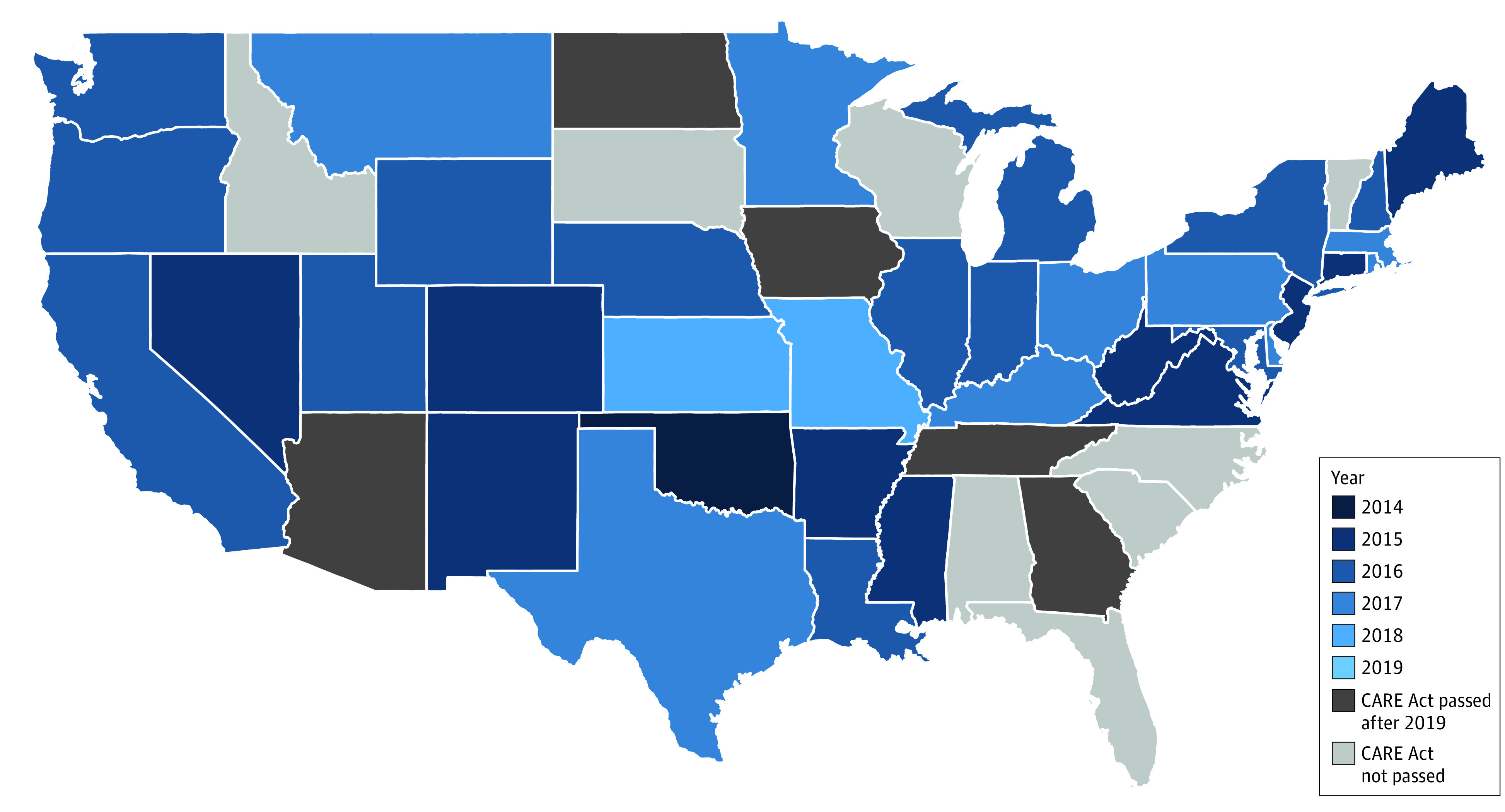
Communication with caregivers is often not established or standardized during hospitalization. The Caregiver Advise, Record, Enable (CARE) Act is a state-level policy designed to facilitate communication among patients, caregivers, and clinical care teams during hospitalization to improve patient experience; 42 states have passed this policy since 2014, but whether it was associated with achieving these goals remains unknown.
To determine whether passage of the CARE Act was associated with improvements in patient experience.
DESIGN, SETTING, AND PARTICIPANTS: This cohort study used a difference-in-differences analysis of short-term, acute-care US hospitals from 2013 to 2019 to analyze changes in patient experience before vs after CARE Act implementation in hospitals located in states that passed the CARE Act compared with those in states that did not. Analyses were performed between September 1, 2021, and July 31, 2022.
Time-varying indicators for whether a hospital was in a state that passed the CARE Act.
Patient-reported experience via the Hospital Consumer Assessment of Healthcare Providers and Systems survey.
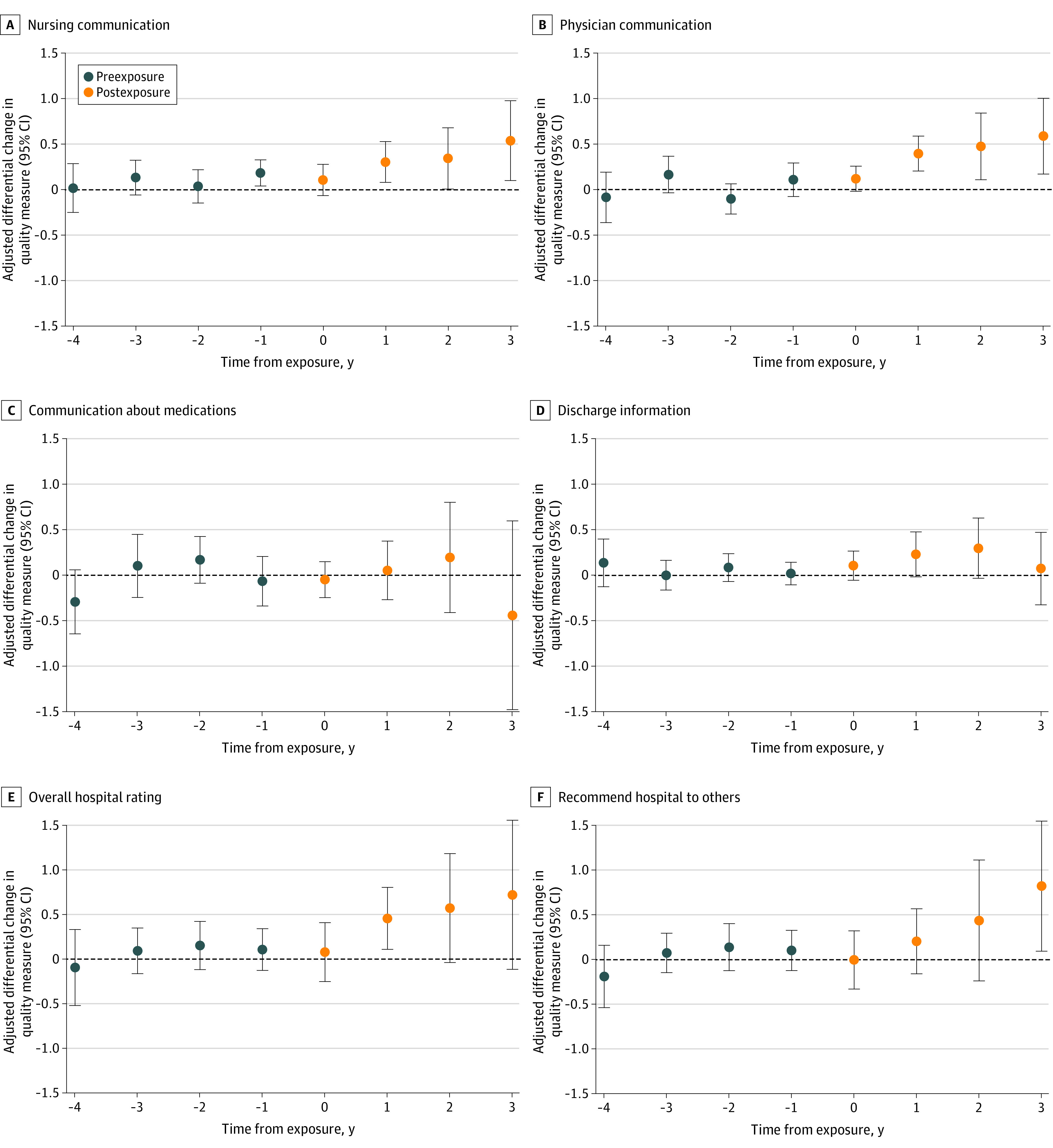
A total of 2763 hospitals were included, with 2188 hospitals in CARE Act states and 575 in non-CARE Act states. There were differential improvements in patient experience in the measures of communication with nurses (unadjusted mean [SD] score, 78.40% [0.42%]; difference, 0.18 percentage points; 95% CI, 0.07-0.29 percentage points; P = .002), communication with physicians (mean [SD] score, 80.00% [0.19%]; difference, 0.17 percentage points; 95% CI, 0.06-0.28 percentage points; P = .002), and receipt of discharge information (mean [SD] score, 86.40% [0.22%]; difference, 0.11 percentage points; 95% CI, 0.02-0.21 percentage points; P = .02) among CARE Act states compared with non-CARE Act states after policy passage. In subgroup analyses, improvements were larger among hospitals with lower baseline Hospital Consumer Assessment of Healthcare Providers and Systems performance on measures of communication with nurses, communication with physicians, and overall hospital rating.
These findings suggest that implementation of the CARE Act was associated with improvements in several measures of patient experience. Policies that formally incorporate caregivers into patient care during hospitalization may improve patient outcomes.
在住院期间,与护理人员的沟通通常没有建立或标准化。《护理人员建议、记录、赋能(CARE)法案》是一项州级政策,旨在促进患者、护理人员和临床护理团队之间的沟通,以改善患者体验;自 2014 年以来,已有 42 个州通过了该法案,但它是否有助于实现这些目标仍不清楚。
确定 CARE 法案的通过是否与患者体验的改善有关。
设计、地点和参与者:这项基于队列的研究使用了 2013 年至 2019 年美国短期急性护理医院的差异-差异分析,分析了在通过 CARE 法案的州的医院实施 CARE 法案前后患者体验的变化,与未通过 CARE 法案的州的医院进行了比较。分析于 2021 年 9 月 1 日至 2022 年 7 月 31 日进行。
医院是否位于通过 CARE 法案的州的时间变化指标。
通过医院消费者评估医疗保健提供者和系统调查报告患者的体验。
共纳入 2763 家医院,其中 CARE 法案州 2188 家,非 CARE 法案州 575 家。在护士沟通(未经调整的平均[SD]评分,78.40%[0.42%];差异,0.18 个百分点;95%CI,0.07-0.29 个百分点;P = .002)、医生沟通(平均[SD]评分,80.00%[0.19%];差异,0.17 个百分点;95%CI,0.06-0.28 个百分点;P = .002)和出院信息的接收(平均[SD]评分,86.40%[0.22%];差异,0.11 个百分点;95%CI,0.02-0.21 个百分点;P = .02)方面,与非 CARE 法案州相比,CARE 法案州在政策通过后都有改善。在亚组分析中,在护士沟通、医生沟通和整体医院评分方面,基线医院消费者评估医疗保健提供者和系统表现较低的医院,其改善幅度更大。
这些发现表明,CARE 法案的实施与改善患者体验的几个措施有关。在住院期间正式将护理人员纳入患者护理的政策可能会改善患者的结果。