Department of Medicine and Surgery, Unit of Endocrinology and Diabetes, Campus Bio-Medico University of Rome, 00128 Rome, Italy.
Department of Human Sciences and Promotion of the Quality of Life, San Raffaele Roma Open University, 00166 Rome, Italy.
Cells. 2023 Apr 12;12(8):1137. doi: 10.3390/cells12081137.
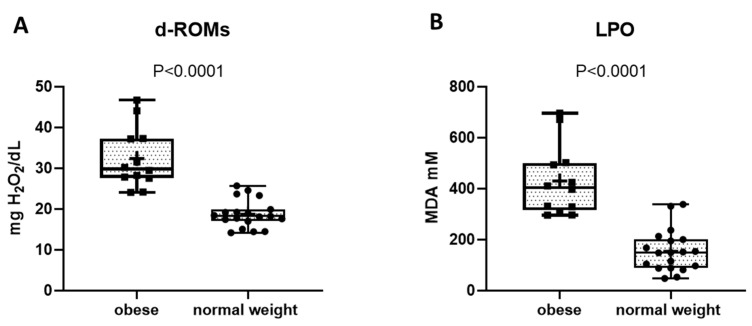
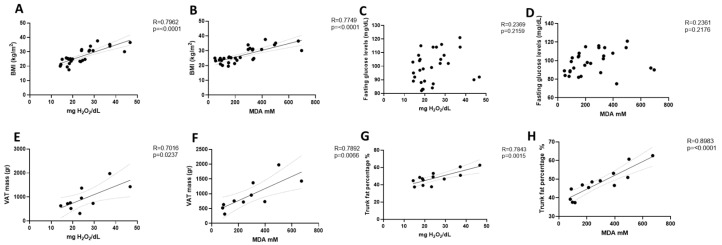
Oxidative stress, a key mediator of cardiovascular disease, metabolic alterations, and cancer, is independently associated with menopause and obesity. Yet, among postmenopausal women, the correlation between obesity and oxidative stress is poorly examined. Thus, in this study, we compared oxidative stress states in postmenopausal women with or without obesity. Body composition was assessed via DXA, while lipid peroxidation and total hydroperoxides were measured in patient's serum samples via thiobarbituric-acid-reactive substances (TBARS) and derivate-reactive oxygen metabolites (d-ROMs) assays, respectively. Accordingly, 31 postmenopausal women were enrolled: 12 with obesity and 19 of normal weight (mean (SD) age 71.0 (5.7) years). Doubled levels of serum markers of oxidative stress were observed in women with obesity in women with obesity compared to those of normal weight (HO: 32.35 (7.3) vs. 18.80 (3.4) mg HO/dL; malondialdehyde (MDA): 429.6 (138.1) vs. 155.9 (82.4) mM in women with or without obesity, respectively; < 0.0001 for both). Correlation analysis showed that both markers of oxidative stress increased with an increasing body mass index (BMI), visceral fat mass, and trunk fat percentage, but not with fasting glucose levels. In conclusion, obesity and visceral fat are associated with a greater increase in oxidative stress in postmenopausal women, possibly increasing cardiometabolic and cancer risks.
氧化应激是心血管疾病、代谢改变和癌症的一个关键介质,它与绝经和肥胖独立相关。然而,在绝经后妇女中,肥胖与氧化应激之间的相关性尚未得到充分研究。因此,在这项研究中,我们比较了肥胖和非肥胖绝经后妇女的氧化应激状态。通过 DXA 评估身体成分,通过硫代巴比妥酸反应物质 (TBARS) 和衍生反应氧代谢物 (d-ROMs) 测定分别测量患者血清样本中的脂质过氧化和总过氧化物。因此,共纳入 31 名绝经后妇女:12 名肥胖,19 名体重正常(平均(SD)年龄 71.0(5.7)岁)。与体重正常的妇女相比,肥胖妇女的血清氧化应激标志物水平增加了一倍(HO:32.35(7.3)vs. 18.80(3.4)mg HO/dL;丙二醛(MDA):429.6(138.1)vs. 155.9(82.4)mM 在有或没有肥胖的妇女中,分别为;均<0.0001)。相关性分析表明,两种氧化应激标志物均随体重指数(BMI)、内脏脂肪质量和躯干脂肪百分比的增加而增加,但与空腹血糖水平无关。总之,肥胖和内脏脂肪与绝经后妇女氧化应激的增加更为相关,可能会增加心血管代谢和癌症风险。