Bouchard Simon, Paniconi Teresa, Jubinville Éric, Goulet-Beaulieu Valérie, Goetz Coralie, Marchand Patrick, Jean Julie
Département des Sciences des Aliments, Institut sur la Nutrition et les Aliments Fonctionnels (INAF), Université Laval, Québec, QC, Canada.
Groupe Sani Marc, Victoriaville, QC, Canada.
Front Microbiol. 2023 May 11;14:1187142. doi: 10.3389/fmicb.2023.1187142. eCollection 2023.
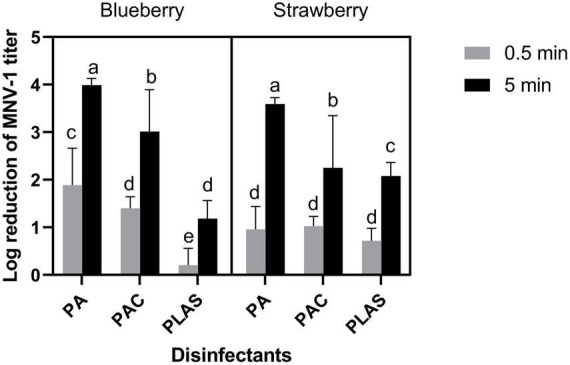
Viruses are responsible for most enteric foodborne illnesses worldwide. The foods most frequently involved are fresh fruits and vegetables since they undergo little or no processing. Washing with a chemical disinfectant is a convenient way of inactivating viruses on foods. Peracetic acid, widely used as a disinfectant in the food industry, has the drawback of leaving a strong odor and is ineffective alone against some foodborne viruses. In this study, four disinfectants, namely per levulinic acid with or without sodium dodecyl sulfate, peracetic acid and a commercial peracetic acid-based disinfectant were tested on murine norovirus 1 (MNV-1), hepatitis A virus (HAV), and hepatitis E virus (HEV). Disinfectant concentrations were 50, 80, 250, 500, and 1000 mg l and contact times were 0.5, 1, 5, and 10 min. Under these conditions, per levulinic acid supplemented with 1% SDS reduced MNV-1 infectious titer by 3 log cycles vs. 2.24 log cycles by peracetic acid within 0.5 min. On stainless steel at 80 ppm, only peracetic acid produced 3-log reductions within 0.5 min. None of these peroxyacids was able to reduce infectious titers of HAV or HEV by even 2 log cycles at any concentration or time-tested. This study will guide the development of new chemical formulas that will be more effective against major foodborne viruses and will have less impact on food quality and the environment.
病毒是全球大多数食源性肠道疾病的病因。最常涉及的食物是新鲜水果和蔬菜,因为它们几乎没有经过加工或未经过加工。用化学消毒剂清洗是使食物上的病毒失活的便捷方法。过氧乙酸在食品工业中广泛用作消毒剂,但其缺点是会留下强烈气味,并且单独使用对某些食源性病毒无效。在本研究中,对四种消毒剂进行了测试,即含或不含十二烷基硫酸钠的乙酰丙酸、过氧乙酸和一种基于过氧乙酸的商业消毒剂,测试对象为鼠诺如病毒1型(MNV-1)、甲型肝炎病毒(HAV)和戊型肝炎病毒(HEV)。消毒剂浓度分别为50、80、250、500和1000 mg/l,接触时间分别为0.5、1、5和10分钟。在这些条件下,添加1% SDS的乙酰丙酸在0.5分钟内使MNV-1感染滴度降低3个对数周期,而过氧乙酸降低2.24个对数周期。在不锈钢表面,80 ppm的过氧乙酸在0.5分钟内仅产生3个对数的降低。在任何浓度或测试时间下,这些过氧酸均无法使HAV或HEV的感染滴度降低甚至2个对数周期。本研究将指导开发新的化学配方,使其对主要食源性病毒更有效,同时对食品质量和环境的影响更小。