Burns J P, Koduru P R, Alonso M L, Chaganti R S
Am J Hum Genet. 1986 Jun;38(6):954-64.
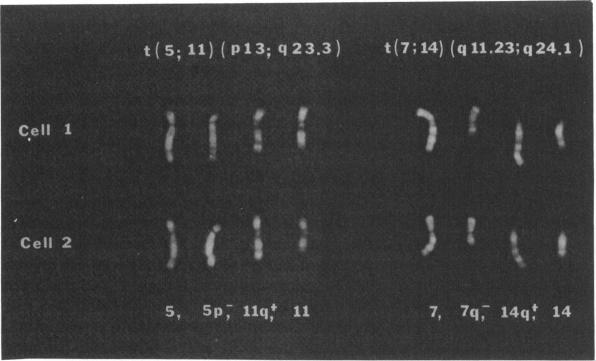
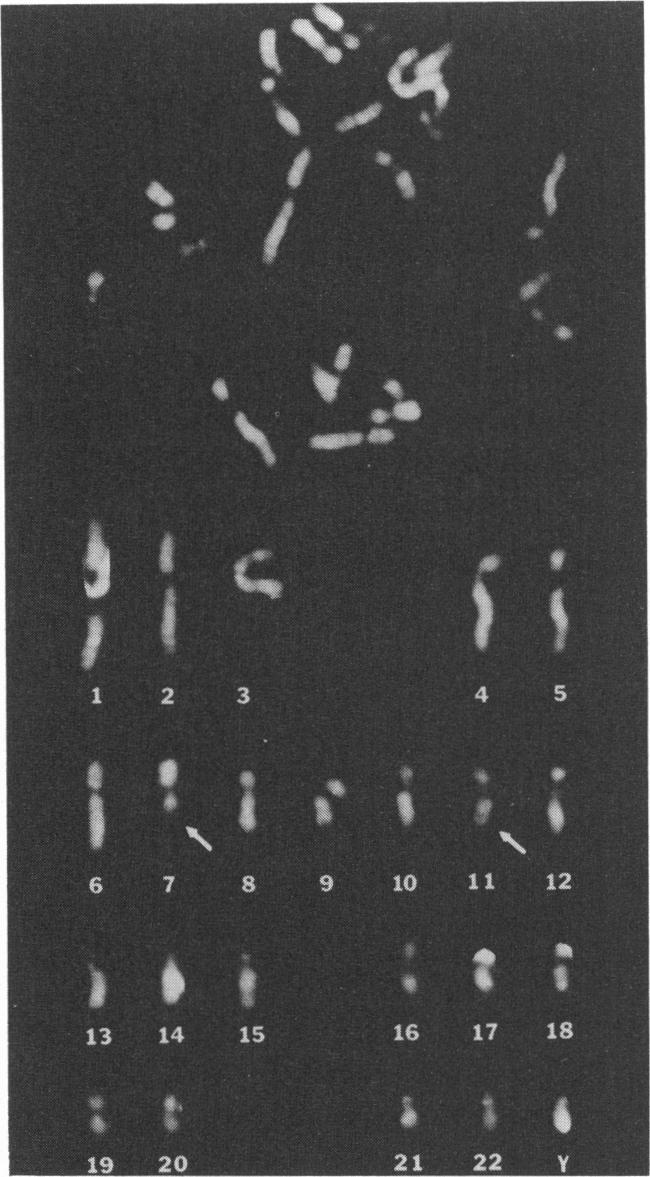
Sperm chromosomal complements of a man heterozygous for two reciprocal translocations and exhibiting the karyotype 46,XY,t(5;11) (p13;q23.2),t(7;14)(q11;q24.1) were analyzed following in vitro fusion with golden hamster zona-free eggs (the hamster in vitro penetration [HIP] system). Products of alternate, adjacent 1, and 3:1 segregation at meiosis I of both translocation quadrivalents were recovered, and the analysis of their output, which was dissimilar between the two translocations, permitted prediction of probable sites of chiasma formation in the chromosomes involved in the translocation. These data, which comprise the first reported analysis of the products of two translocations in a single individual (hence, in a common genetic background), emphasize the uniqueness in genetic behavior of individual translocations; they further demonstrate the usefulness of the HIP system to carry out such studies.
对一名核型为46,XY,t(5;11)(p13;q23.2),t(7;14)(q11;q24.1)的男性精子染色体组成进行了分析,该男性为两个相互易位的杂合子。在与金黄地鼠无透明带卵子进行体外融合(即地鼠体外穿透[HIP]系统)后,回收了两个易位四价体在减数分裂I时交替、相邻1和3:1分离的产物。对其产出的分析表明,两个易位之间存在差异,从而能够预测易位所涉及染色体上可能的交叉形成位点。这些数据构成了对单个个体(即在共同遗传背景下)中两个易位产物的首次报道分析,强调了单个易位在遗传行为上的独特性;它们进一步证明了HIP系统在开展此类研究中的有用性。