Aldughayfiq Bader, Ashfaq Farzeen, Jhanjhi N Z, Humayun Mamoona
Department of Information Systems, College of Computer and Information Sciences, Jouf University, Sakaka 72388, Saudi Arabia.
School of Computer Science, SCS, Taylor's University, Subang Jaya 47500, Malaysia.
Diagnostics (Basel). 2023 Jun 1;13(11):1932. doi: 10.3390/diagnostics13111932.
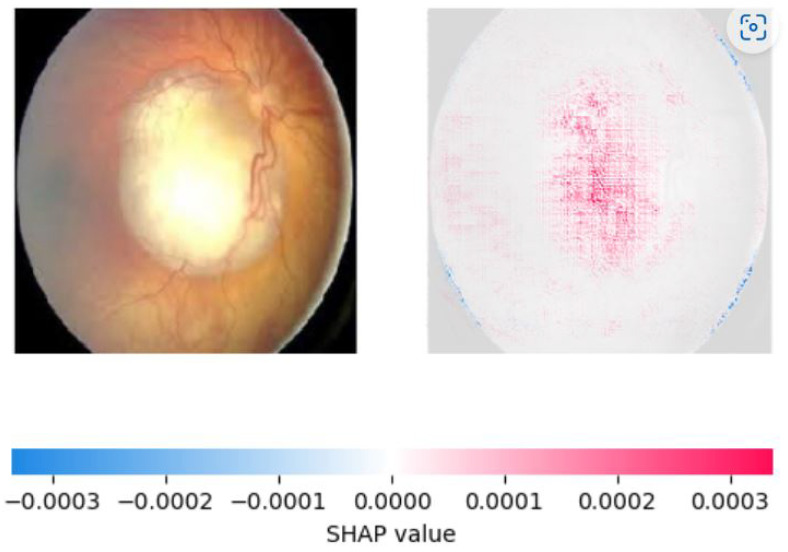
Retinoblastoma is a rare and aggressive form of childhood eye cancer that requires prompt diagnosis and treatment to prevent vision loss and even death. Deep learning models have shown promising results in detecting retinoblastoma from fundus images, but their decision-making process is often considered a "black box" that lacks transparency and interpretability. In this project, we explore the use of LIME and SHAP, two popular explainable AI techniques, to generate local and global explanations for a deep learning model based on InceptionV3 architecture trained on retinoblastoma and non-retinoblastoma fundus images. We collected and labeled a dataset of 400 retinoblastoma and 400 non-retinoblastoma images, split it into training, validation, and test sets, and trained the model using transfer learning from the pre-trained InceptionV3 model. We then applied LIME and SHAP to generate explanations for the model's predictions on the validation and test sets. Our results demonstrate that LIME and SHAP can effectively identify the regions and features in the input images that contribute the most to the model's predictions, providing valuable insights into the decision-making process of the deep learning model. In addition, the use of InceptionV3 architecture with spatial attention mechanism achieved high accuracy of 97% on the test set, indicating the potential of combining deep learning and explainable AI for improving retinoblastoma diagnosis and treatment.
视网膜母细胞瘤是一种罕见且侵袭性强的儿童眼癌,需要及时诊断和治疗以防止视力丧失甚至死亡。深度学习模型在从眼底图像中检测视网膜母细胞瘤方面已显示出有前景的结果,但其决策过程通常被视为一个缺乏透明度和可解释性的“黑匣子”。在这个项目中,我们探索使用LIME和SHAP这两种流行的可解释人工智能技术,为基于在视网膜母细胞瘤和非视网膜母细胞瘤眼底图像上训练的InceptionV3架构的深度学习模型生成局部和全局解释。我们收集并标记了一个包含400张视网膜母细胞瘤图像和400张非视网膜母细胞瘤图像的数据集,将其分为训练集、验证集和测试集,并使用从预训练InceptionV3模型进行迁移学习的方式训练模型。然后,我们应用LIME和SHAP为模型在验证集和测试集上的预测生成解释。我们的结果表明,LIME和SHAP可以有效地识别输入图像中对模型预测贡献最大的区域和特征,为深度学习模型的决策过程提供有价值的见解。此外,带有空间注意力机制的InceptionV3架构在测试集上达到了97%的高精度,表明将深度学习和可解释人工智能相结合在改善视网膜母细胞瘤诊断和治疗方面的潜力。