Department of Computer Science and Engineering, Bangladesh University of Business and Technology, Dhaka 1216, Bangladesh.
Department of Computer Science, American International University-Bangladesh, Dhaka 1229, Bangladesh.
Sensors (Basel). 2023 May 30;23(11):5204. doi: 10.3390/s23115204.
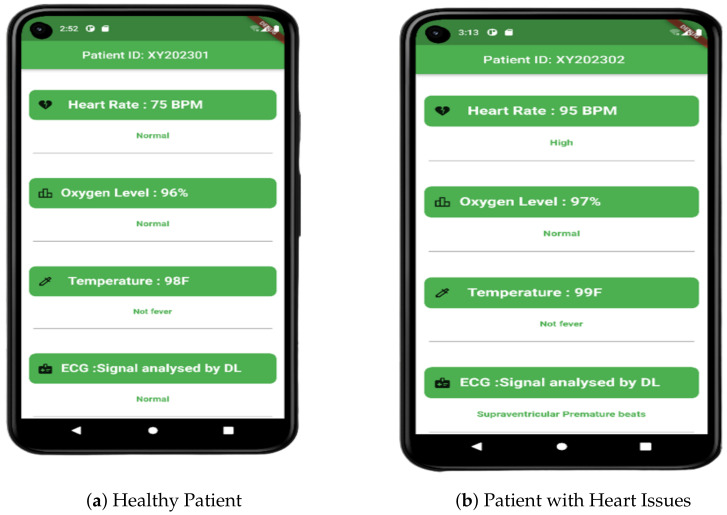
With an aging population and increased chronic diseases, remote health monitoring has become critical to improving patient care and reducing healthcare costs. The Internet of Things (IoT) has recently drawn much interest as a potential remote health monitoring remedy. IoT-based systems can gather and analyze a wide range of physiological data, including blood oxygen levels, heart rates, body temperatures, and ECG signals, and then provide real-time feedback to medical professionals so they may take appropriate action. This paper proposes an IoT-based system for remote monitoring and early detection of health problems in home clinical settings. The system comprises three sensor types: MAX30100 for measuring blood oxygen level and heart rate; AD8232 ECG sensor module for ECG signal data; and MLX90614 non-contact infrared sensor for body temperature. The collected data is transmitted to a server using the MQTT protocol. A pre-trained deep learning model based on a convolutional neural network with an attention layer is used on the server to classify potential diseases. The system can detect five different categories of heartbeats: Normal Beat, Supraventricular premature beat, Premature ventricular contraction, Fusion of ventricular, and Unclassifiable beat from ECG sensor data and fever or non-fever from body temperature. Furthermore, the system provides a report on the patient's heart rate and oxygen level, indicating whether they are within normal ranges or not. The system automatically connects the user to the nearest doctor for further diagnosis if any critical abnormalities are detected.
随着人口老龄化和慢性疾病的增加,远程健康监测对于改善患者护理和降低医疗成本变得至关重要。物联网(IoT)最近作为一种潜在的远程健康监测解决方案引起了广泛关注。基于物联网的系统可以收集和分析包括血氧水平、心率、体温和心电图信号在内的广泛生理数据,并实时向医疗专业人员提供反馈,以便他们采取适当的行动。本文提出了一种基于物联网的系统,用于在家庭临床环境中进行远程监测和早期发现健康问题。该系统包括三种传感器类型:用于测量血氧水平和心率的 MAX30100;用于 ECG 信号数据的 AD8232 ECG 传感器模块;以及用于体温的 MLX90614 非接触式红外传感器。收集到的数据使用 MQTT 协议传输到服务器。服务器上使用基于卷积神经网络和注意力层的预训练深度学习模型对潜在疾病进行分类。该系统可以从 ECG 传感器数据中检测到五种不同类型的心跳:正常心跳、室上性早搏、室性早搏、心室融合和无法分类的心跳,以及体温的发热或非发热。此外,该系统还提供了患者心率和血氧水平的报告,指示它们是否在正常范围内。如果检测到任何关键异常,系统会自动将用户连接到最近的医生进行进一步诊断。