COVID-19 Response Team, U.S. Centers for Disease Control and Prevention, Atlanta, Georgia, United States of America.
Epidemic Intelligence Service, U.S. Centers for Disease Control and Prevention, Atlanta, Georgia, United States of America.
PLoS One. 2023 Jun 23;18(6):e0275125. doi: 10.1371/journal.pone.0275125. eCollection 2023.
Understanding the drivers of SARS-CoV-2 transmission can inform the development of interventions. We evaluated transmission identified by contact tracing investigations between March-May 2020 in Salt Lake County, Utah, to quantify the impact of this intervention and identify risk factors for transmission.
RT-PCR positive and untested symptomatic contacts were classified as confirmed and probable secondary case-patients, respectively. We compared the number of case-patients and close contacts generated by different groups, and used logistic regression to evaluate factors associated with transmission.
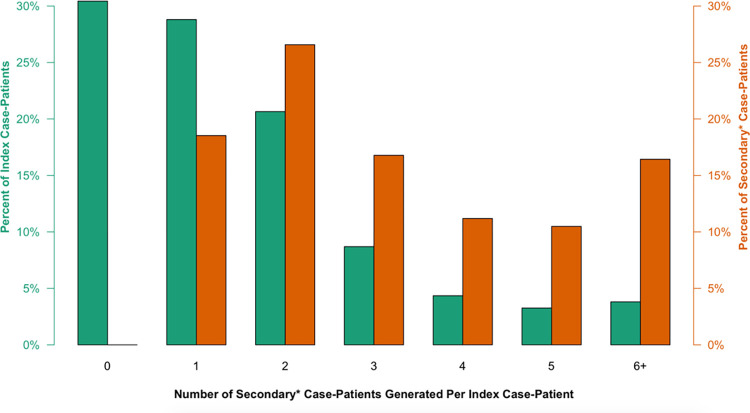
Data were collected on 184 index case-patients and up to six generations of contacts. Of 1,499 close contacts, 374 (25%) were classified as secondary case-patients. Decreased transmission odds were observed for contacts aged <18 years (OR = 0.55 [95% CI: 0.38-0.79]), versus 18-44 years, and for workplace (OR = 0.36 [95% CI: 0.23-0.55]) and social (OR = 0.44 [95% CI: 0.28-0.66]) contacts, versus household contacts. Higher transmission odds were observed for case-patient's spouses than other household contacts (OR = 2.25 [95% CI: 1.52-3.35]). Compared to index case-patients identified in the community, secondary case-patients identified through contract-tracing generated significantly fewer close contacts and secondary case-patients of their own. Transmission was heterogeneous, with 41% of index case-patients generating 81% of directly-linked secondary case-patients.
Given sufficient resources and complementary public health measures, contact tracing can contain known chains of SARS-CoV-2 transmission. Transmission is associated with age and exposure setting, and can be highly variable, with a few infections generating a disproportionately high share of onward transmission.
了解 SARS-CoV-2 传播的驱动因素可以为干预措施的制定提供信息。我们评估了 2020 年 3 月至 5 月在犹他州盐湖县通过接触者追踪调查确定的传播情况,以量化这种干预措施的影响,并确定传播的危险因素。
对 RT-PCR 阳性和未经检测的有症状接触者分别归类为确诊和可能的二级病例患者。我们比较了不同组产生的病例患者和密切接触者的数量,并使用逻辑回归评估与传播相关的因素。
共收集了 184 名指数病例患者和最多六代接触者的数据。在 1499 名密切接触者中,374 名(25%)被归类为二级病例患者。与 18-44 岁的接触者相比,年龄<18 岁的接触者的传播几率降低(OR=0.55[95%CI:0.38-0.79]),与工作场所(OR=0.36[95%CI:0.23-0.55])和社交(OR=0.44[95%CI:0.28-0.66])接触者相比,与家庭接触者相比,传播几率降低。与其他家庭接触者相比,病例患者的配偶的传播几率更高(OR=2.25[95%CI:1.52-3.35])。与通过接触者追踪发现的社区病例患者相比,通过接触者追踪发现的二级病例患者产生的密切接触者和自身二级病例患者明显减少。传播存在异质性,41%的指数病例患者产生了 81%的直接关联二级病例患者。
在有足够资源和互补公共卫生措施的情况下,接触者追踪可以控制已知的 SARS-CoV-2 传播链。传播与年龄和暴露环境有关,并且变化很大,少数感染产生了不成比例高的传播份额。