Department of Preventive Oncology, Institute of Health Sciences, Dokuz Eylul University, 15 July Medicine and Art Campus, Inciralti-Balcova 35340 İzmir, Türkiye.
Department of Translational Oncology, Institute of Oncology, Dokuz Eylul University, 35340 İzmir, Türkiye.
Nutrients. 2023 Jun 12;15(12):2722. doi: 10.3390/nu15122722.
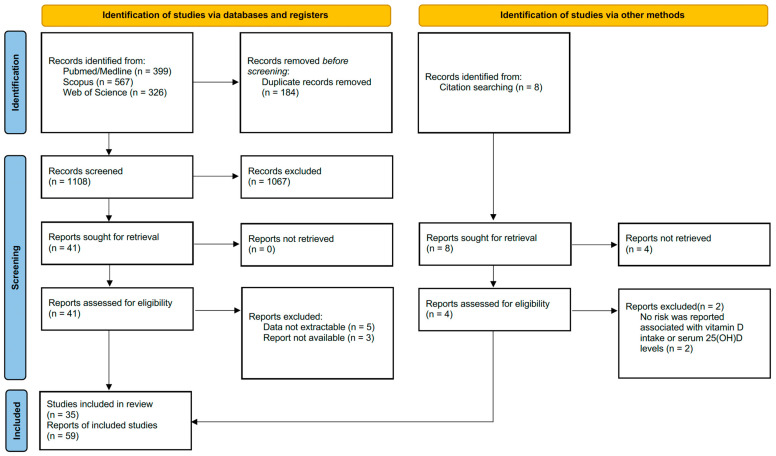
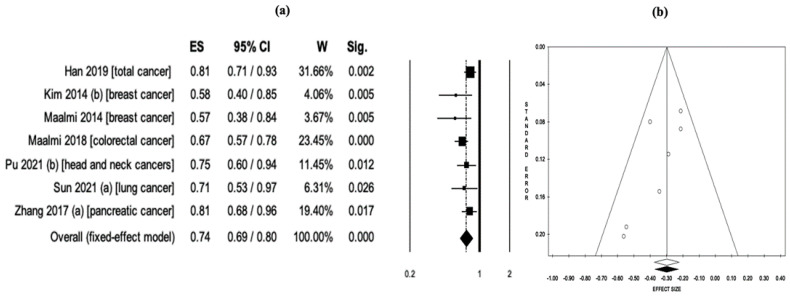
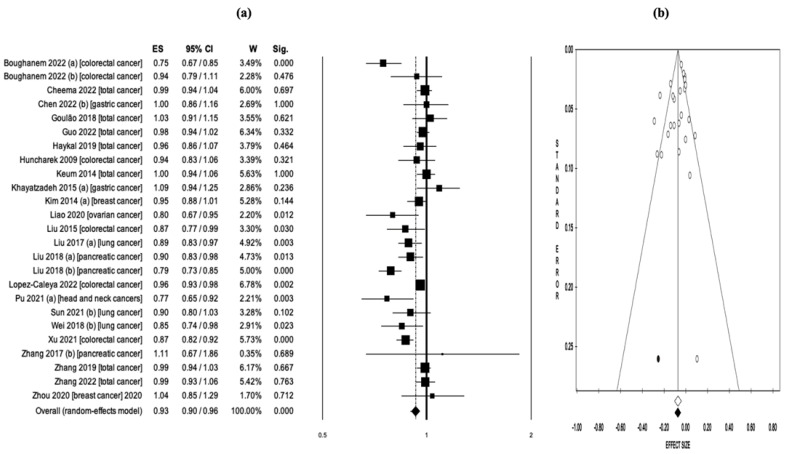
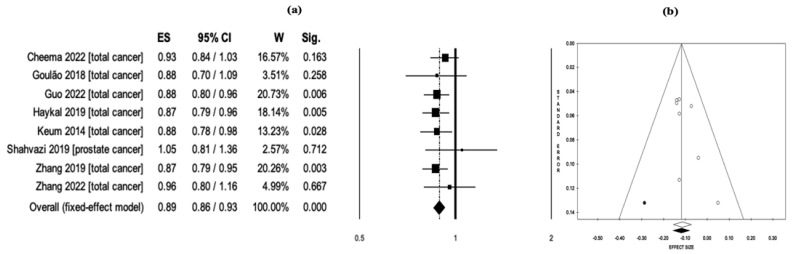
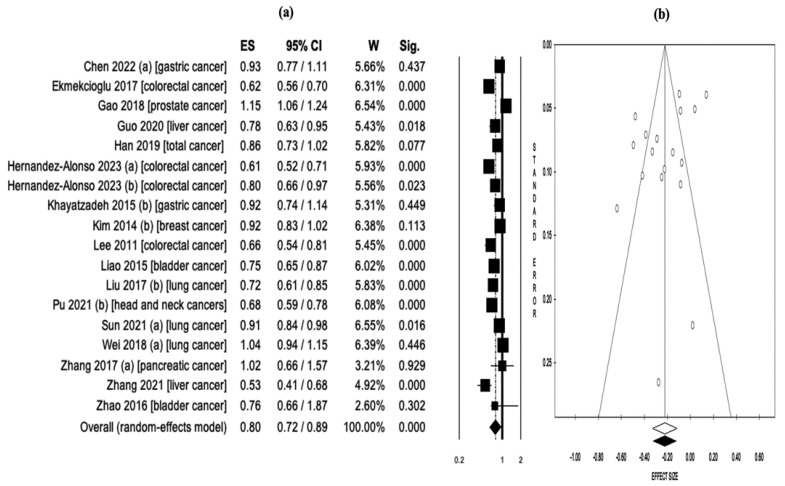
It is a well-established fact that inadequate Vitamin D (Vit-D) levels have negative effects on the development and progression of malignant diseases, particularly cancer. The purpose of this paper was to elucidate the effects of Vit-D intake and serum 25-hydroxyvitamin-D (25(OH)D) levels on cancer incidence and mortality, the current evidence in this field, and the biases of this evidence, using the meta-meta-analysis method. Meta-analyses focusing on Vit-D intake, serum 25(OH)D levels, and cancer risk/mortality were identified. A structured computer literature search was undertaken in PubMed/Medline, Web of Science (WoS), and Scopus electronic databases using predetermined keyword combinations. Primary and secondary meta-meta-analyses were carried out, combining odds ratios (ORs), risk ratios (RRs), and hazard ratios (HRs) for outcomes reported in selected meta-analyses. A total of 35 eligible meta-analyses (59 reports yielded from these studies) assessing the association between Vit-D and cancer incidence and/or mortality were included in this study. In the pooled analysis, higher Vit-D intake and serum 25(OH)D levels were associated with lower cancer risk (OR = 0.93, 95% confidence interval (CI): 0.90-0.96, < 0.001; OR = 0.80, 95% CI: 0.72-0.89, < 0.001, respectively) and cancer-related mortality (RR = 0.89, 95% CI: 0.86-0.93, < 0.001; RR = 0.67, 95% CI: 0.58-0.78, < 0.001, respectively). When meta-analyses whose primary reports included only randomized controlled trials were pooled, there was no significant association between Vit-D intake and cancer risk (OR = 0.99, 95% CI: 0.97-1.01, = 0.320). In subgroup analysis, Vit-D consumption was associated with a significant decrease in colorectal and lung cancer incidence (OR = 0.89, 95% CI: 0.83-0.96, = 0.002; OR = 0.88, 95% CI: 0.83-0.94, < 0.001, respectively). Taken together, both Vit-D intake and higher 25(OH)D levels may provide remarkable benefits in terms of cancer incidence and mortality; however, careful evaluation according to cancer types is critically important and recommended.
已有充分的事实表明,维生素 D(Vit-D)水平不足会对恶性疾病的发展和进展产生负面影响,尤其是癌症。本文旨在阐明 Vit-D 摄入和血清 25-羟维生素 D(25(OH)D)水平对癌症发病率和死亡率的影响,探讨这一领域的现有证据及其偏倚,采用荟萃荟萃分析方法。确定了专注于 Vit-D 摄入、血清 25(OH)D 水平和癌症风险/死亡率的荟萃分析。在 PubMed/Medline、Web of Science(WoS)和 Scopus 电子数据库中,使用预定的关键字组合进行了结构化计算机文献检索。进行了主要和次要荟萃荟萃分析,结合了选定荟萃分析报告的结局的比值比(ORs)、风险比(RRs)和风险比(HRs)。这项研究共纳入了 35 项符合条件的荟萃分析(从这些研究中得出了 59 份报告),评估了 Vit-D 与癌症发病率和/或死亡率之间的关联。在汇总分析中,较高的 Vit-D 摄入量和血清 25(OH)D 水平与较低的癌症风险(OR=0.93,95%置信区间(CI):0.90-0.96,<0.001;OR=0.80,95%CI:0.72-0.89,<0.001)和癌症相关死亡率(RR=0.89,95%CI:0.86-0.93,<0.001;RR=0.67,95%CI:0.58-0.78,<0.001)相关。当汇总仅包含随机对照试验的主要报告的荟萃分析时,Vit-D 摄入量与癌症风险之间没有显著关联(OR=0.99,95%CI:0.97-1.01,=0.320)。在亚组分析中,Vit-D 消耗与结直肠癌和肺癌发病率的显著降低相关(OR=0.89,95%CI:0.83-0.96,=0.002;OR=0.88,95%CI:0.83-0.94,<0.001)。综上所述,Vit-D 摄入和较高的 25(OH)D 水平可能在癌症发病率和死亡率方面带来显著的益处;然而,根据癌症类型进行仔细评估至关重要,并建议这样做。