You Yanwei, Chen Yuquan, Chen Xiangyu, Wei Mengxian, Yin Jiahui, Zhang Qi, Cao Qiang
Division of Sports Science and Physical Education, Tsinghua University, Beijing, China.
School of Social Sciences, Tsinghua University, Beijing, China.
Front Aging Neurosci. 2023 Jun 22;15:1214748. doi: 10.3389/fnagi.2023.1214748. eCollection 2023.
It has been demonstrated that elderly people's cognitive capacities can be improved with exercise, and short sleep is linked to cognitive decline. However, the impact of physical exercise on cognitive performance in seniors who do not get enough sleep is largely unknown. This makes it an intriguing subject to explore further.
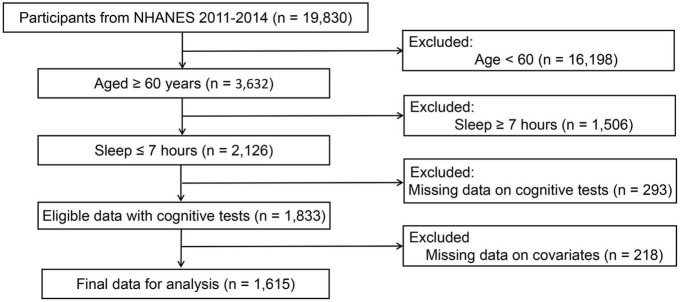
This study consisted of elders (over 60 years old) who participated throughout the National Health and Nutrition Examination Survey's 2011-2014 cycle (NHANES). Weighted linear regression model and restricted cubic splines analysis were performed to evaluate the association between physical exercise and cognitive function. In the end, 1,615 samples were scrutinized and the total number of weighted respondents was 28,607,569.
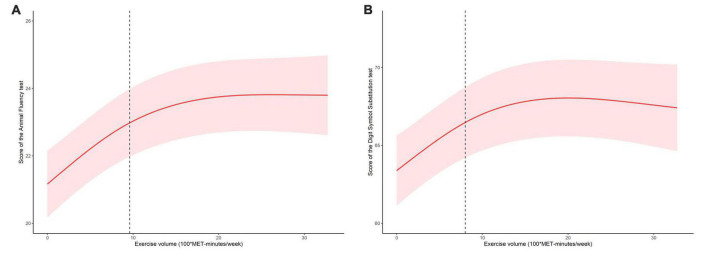
Results showed that in the Animal Fluency test and the Digit Symbol Substitution test, a positive association was found between physical exercise volume and scores in the fully adjusted model. A two-piecewise linear regression model was then applied to explore the threshold effect of exercise on cognitive performance. Before 960 and 800 MET-minutes/week, there were consistent positive relationship between exercise and scores of the Animal Fluency test [ß (95% CI): 0.233 (0.154, 0.312), < 0.001] and Digit Symbol Substitution test [β (95% CI): 0.555 (0.332, 0.778), < 0.001], respectively. However, there was a saturation effect where physical exercise volume reached the two inflection points.
According to our research, the benefit of exercise did not always expand with the exercise volume increment under the short-sleep condition, which challenged existing knowledge. The short-sleep elder group could maintain cognitive performance with no more than 800 MET-minutes/week of physical exercise. Verification of these findings requires further biological investigations.
已有研究表明,运动可改善老年人的认知能力,而睡眠不足与认知能力下降有关。然而,体育锻炼对睡眠不足的老年人认知表现的影响在很大程度上尚不清楚。这使得它成为一个值得进一步探索的有趣课题。
本研究纳入了参与2011 - 2014年全国健康与营养检查调查(NHANES)周期的老年人(60岁以上)。采用加权线性回归模型和受限立方样条分析来评估体育锻炼与认知功能之间的关联。最终,对1615个样本进行了审查,加权受访者总数为28607569人。
结果显示,在动物流畅性测试和数字符号替换测试中,在完全调整模型中,体育锻炼量与得分之间存在正相关。然后应用两段式线性回归模型来探索运动对认知表现的阈值效应。在每周960和800代谢当量 - 分钟之前,运动与动物流畅性测试得分[ß(95%置信区间):0.233(0.154,0.312),<0.001]和数字符号替换测试得分[β(95%置信区间):0.555(0.332,0.778),<0.001]之间分别存在一致的正相关关系。然而,当体育锻炼量达到两个拐点时,存在饱和效应。
根据我们的研究,在短睡眠条件下,运动的益处并不总是随着运动量的增加而扩大,这对现有知识提出了挑战。短睡眠老年组每周进行不超过800代谢当量 - 分钟的体育锻炼即可维持认知表现。这些发现需要进一步的生物学研究来验证。