Jin Mu, Osman Marwan, Green Brianna A, Yang Yufan, Ahuja Aditi, Lu Zhengyu, Cazer Casey L
Department of Public and Ecosystem Health, Cornell University College of Veterinary Medicine, USA.
Department of Epidemiology, Johns Hopkins Bloomberg School of Public Health, USA.
One Health. 2023 Jun 26;17:100593. doi: 10.1016/j.onehlt.2023.100593. eCollection 2023 Dec.
Transmission of antimicrobial resistant bacteria between people and household pets, such as dogs and cats, is an emerging global public health problem. This scoping review synthesized existing evidence of human-pet bacteria transmission to understand the magnitude and breadth of this issue.
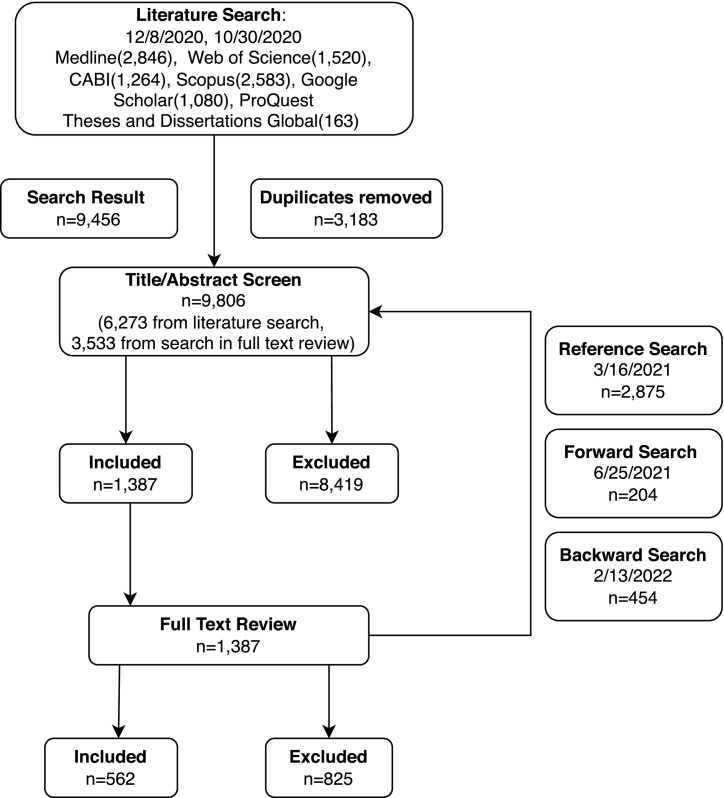
The search included specific and generic terms for bacteria, resistance, transmission, pets, and humans. Searches were conducted through PubMed, Scopus, Web of Science, CABI Global Health, Networked Digital Library of Theses and Dissertations, Google Scholar. All studies published in English and Mandarin that isolated bacteria from pets (cats and dogs) and humans who had contact with the pets, and reported phenotypic or genotypic antimicrobial sensitivity test results, were included in this review. In cases of bacterial species that are commonly associated with pets, such as and , we also included studies that only isolated bacteria from humans.
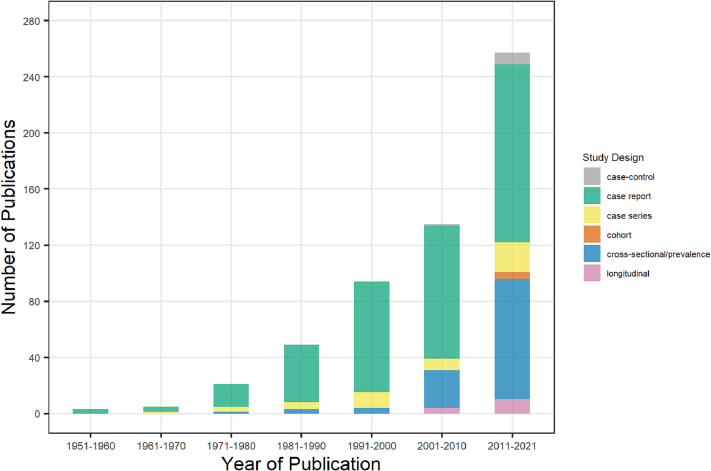
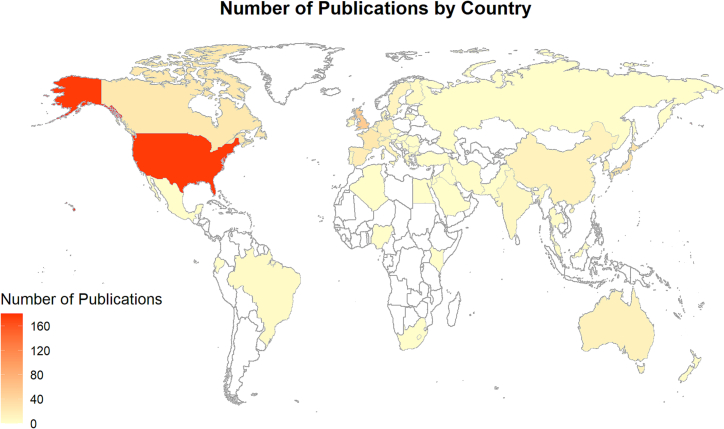
After removing duplication, the search captured 9355 studies. A total of 1098 papers were screened in the full-text review, and 562 studies were identified as eligible according to our inclusion criteria. The primary reason for exclusion was the lack of sensitivity testing. The included studies were published between 1973 and 2021. The most common study location was the United States ( = 176, 31.3%), followed by the United Kingdom ( = 53, 9.4%), Japan ( = 29, 5.2%), and Canada ( = 25, 4.4%). Most of the included studies were case reports ( = 367, 63.4%), cross-sectional/prevalence studies ( = 130, 22.4%), and case series ( = 51, 8.8%). Only few longitudinal studies ( = 14, 2.4%), case-control studies ( = 12, 2.1%), and cohort studies (n = 5, 0.9%) were included in our review. Most studies focused on ( = 221, 39.3%), ( = 81, 14.4%), and ( = 52, 8.9%). For the 295 studies that used strain typing methods to compare bacteria from humans and pets, most used DNA banding pattern-based methods ( = 133, 45.1%) and DNA sequencing-based methods ( = 118, 40.0%).
Transmission of bacteria could occur in both directions: pets to humans (e.g., and ) and humans to pets (e.g., ). The majority of studies provided a low level of evidence of transmission (e.g., case reports), suggesting that more rigorous longitudinal, cohort, or case-control studies are needed to fully understand the risk of human-pet resistant bacterial transmission.
抗菌耐药菌在人和家养宠物(如狗和猫)之间传播是一个新出现的全球公共卫生问题。本综述综合了关于人畜细菌传播的现有证据,以了解该问题的规模和广度。
检索词包括细菌、耐药性、传播、宠物和人类的特定及通用术语。通过PubMed、Scopus、Web of Science、CABI全球健康数据库、学位论文网络数字图书馆、谷歌学术进行检索。纳入所有以英文和中文发表的、从宠物(猫和狗)及与之接触的人类中分离出细菌,并报告了表型或基因型抗菌药敏试验结果的研究。对于常见于宠物的细菌种类,如 和 ,我们还纳入了仅从人类中分离出细菌的研究。
去除重复文献后,检索共获取9355项研究。全文筛选了1098篇论文,根据纳入标准确定562项研究符合要求。排除的主要原因是缺乏药敏试验。纳入研究发表于1973年至2021年之间。最常见的研究地点是美国( = 176,31.3%),其次是英国( = 53,9.4%)、日本( = 29,5.2%)和加拿大( = 25,4.4%)。纳入研究大多为病例报告( = 367,63.4%)、横断面/患病率研究( = 130,22.4%)和病例系列研究( = 51,8.8%)。本综述仅纳入了少数纵向研究( = 14,2.4%)、病例对照研究( = 12,2.1%)和队列研究(n = 5,0.9%)。大多数研究聚焦于 ( = 221,39.3%)、 ( = 81,14.4%)和 ( = 52,8.9%)。对于295项使用菌株分型方法比较人和宠物细菌的研究,大多数采用基于DNA条带模式的方法( = 133,45.1%)和基于DNA测序的方法( = 118,40.0%)。
细菌传播可能双向发生:从宠物到人类(如 和 )以及从人类到宠物(如 )。大多数研究提供的传播证据水平较低(如病例报告),这表明需要更严格的纵向、队列或病例对照研究来全面了解人畜耐药菌传播的风险。