Ouazan-Reboul Vincent, Agudo-Canalejo Jaime, Golestanian Ramin
Max Planck Institute for Dynamics and Self-Organization, Am Fassberg 17, D-37077, Göttingen, Germany.
Rudolf Peierls Centre for Theoretical Physics, University of Oxford, OX1 3PU, Oxford, UK.
Nat Commun. 2023 Jul 26;14(1):4496. doi: 10.1038/s41467-023-40241-w.
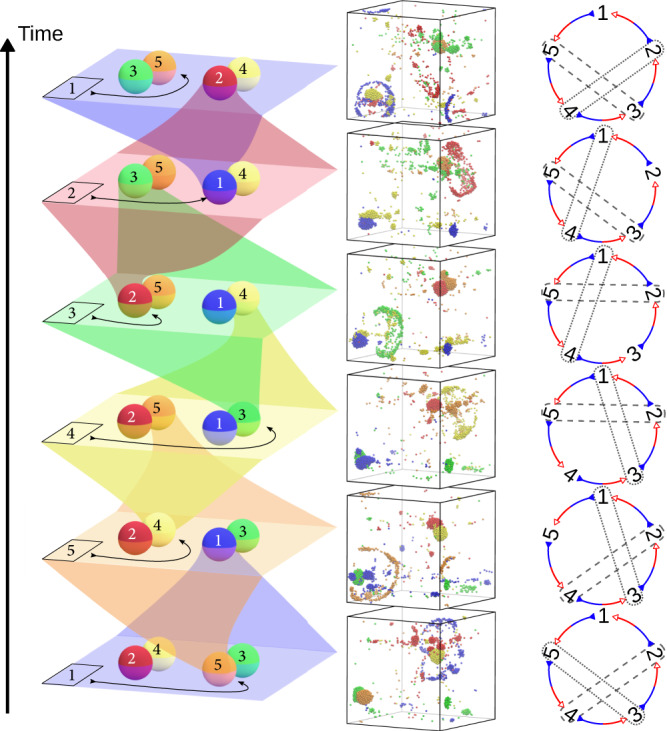
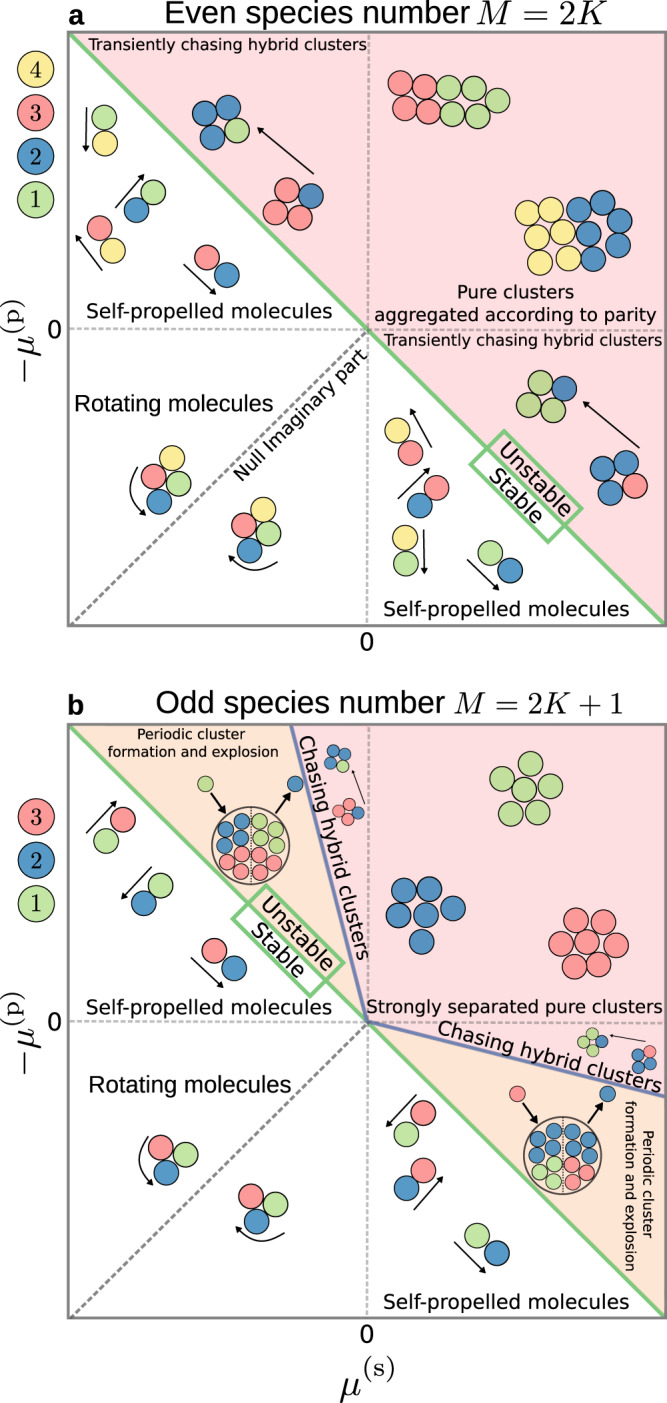
One of the greatest mysteries concerning the origin of life is how it has emerged so quickly after the formation of the earth. In particular, it is not understood how metabolic cycles, which power the non-equilibrium activity of cells, have come into existence in the first instances. While it is generally expected that non-equilibrium conditions would have been necessary for the formation of primitive metabolic structures, the focus has so far been on externally imposed non-equilibrium conditions, such as temperature or proton gradients. Here, we propose an alternative paradigm in which naturally occurring non-reciprocal interactions between catalysts that can partner together in a cyclic reaction lead to their recruitment into self-organized functional structures. We uncover different classes of self-organized cycles that form through exponentially rapid coarsening processes, depending on the parity of the cycle and the nature of the interaction motifs, which are all generic but have readily tuneable features.
关于生命起源的最大谜团之一是,在地球形成后生命如何如此迅速地出现。特别是,人们并不理解为细胞的非平衡活动提供动力的代谢循环最初是如何形成的。虽然一般认为非平衡条件对于原始代谢结构的形成是必要的,但迄今为止,研究重点一直放在外部施加的非平衡条件上,比如温度或质子梯度。在此,我们提出一种替代范式,即能够在循环反应中协同作用的催化剂之间自然发生的非互易相互作用,会导致它们被招募到自组织功能结构中。我们发现了不同类别的自组织循环,这些循环通过指数级快速的粗化过程形成,这取决于循环的奇偶性和相互作用基序的性质,这些都是普遍存在的,但具有易于调节的特征。